
Flashcards
Thermodynamics
Cards in this deck (77)
- 1Define thermodynamicsDescribes relation between properties of matter in a system and quantities heat and work which cause a change of state
- 2Define statistical mechanicsAttempts to describe behaviour of a macroscopic system from models of microscopic behaviour of particles that make up the system
- 3Zeroth lawIf 2 bodies are each in thermal equilibrium with some 3rd body, then they are also in equilibrium with each other
- 41st lawHeat is a form of energy, and thermodynamic processes are therefore subject to the principle of conservation of energy
ΔU = Q - W
where ΔU is change in internal energy, Q is heat energy, and W is thermodynamic work done - 52nd lawStates that processes involving transfer or conversion of heat energy are irreversible; also nothing useful is 100% efficient. Effectively determines the direction in which a process can proceed.
- 63rd law (or Nernst Theorem)A system's entropy approaches a constant value as its temperature approaches absolute zero; can't reach absolute zero in a finite number of operations
- 7kWh in J1 kW = 3.6 x 10⁶ J
- 8eV in J1 eV = 1.6 x 10⁻¹⁹ J
- 9MToe (million tonnes of oil equivalent) in J1 MToe = 4.19 x 10¹⁶ J
(defined as amount of energy released by burning one million tonnes of crude oil) - 10Max. Efficiency calculation1 - T?/ Tₕ
(where T? is T(cold), lowest temperature in cycle, often just slightly above environmental temp. and Tₕ is T(hot), the max. engine temp.) - 11Why are biofuels seen as controversial?Lan used to grow biofuel crops is land not available for growing food or for carbon capture
- 12Nuclear fusionA reaction in which 2 or more atomic nuclei are combined to form one or more different atomic nuclei and subatomic particles
- 13Nuclear fissionRadioactive decay process in which the nucleus of an atom splits into 2 or more smaller, lighter nuclei- often produces gamma photons, and releases a very large amount of energy
- 14What is an RTG?Radioisotope thermoelectric generator- a type of nuclear battery that converts heat released by the decay of a suitable radioactive material into electricity by the Seebeck effect
- 15Seebeck effectWhen electricity is created between a thermocouple when the ends are subjected to a temperature difference between them
- 16ThermocoupleElectrical device consisting of 2 different electrical conductors forming an electrical junction. A thermocouple produces a temperature-dependent voltage as a result of the thermoelectric effect, and this voltage can be interpreted to measure temperature
- 17Thermoelectric effectCaused by charge carriers within the material (either electrons, or places where an electron is missing, known as 'holes') diffusing from the hotter side to the cooler side, similarly to the way gas expands when it is heated
- 18General form of ideal gas lawPV = nRT
(where P = pressure, V = volume, n = number of kilomoles of gas (1000 x mole), R is universal gas constant and T is temperature) - 19Kinetic theory assumptions for molecules of gas○ behave like hard spheres which move in continuous, random motion
○ are distribute randomly throughout container
○ exert no force on each other except for when they collide
○ move in straight line paths between collisions, which are either with each other or with walls of container - 20Mean Free Pathλ = average distance travelled between collisions
- 21How does mean free path (λ) change with density?As ρ increases, λ decreases
- 22Gas specific ideal gas lawPV = MRT
(where V = total volume and M = total mass in kg) - 23What is internal energy?Internal energy is the total energy contained within an object. It is the energy in a system arising from the relative positions and interactions of its parts, although does not include relativistic-mass energy from E = mc². It can also be defined as the energy associated with the random, disordered motion of molecules within the object.
- 24Define heatThe form of energy transfer that occurs across boundary when there is a temperature difference between a system and its surroundings
- 25Work is done by a system is...... the sole effect on surrounding could have been the raising of a weight.
- 262 types of workDisplacement work (where force produces a displacement) and shaft work (all other type of work, e.g. energy transferred by rotating a shaft)
- 27Heat and work are never......system properties- not possessed by system since they're energy transfers.
- 28Requirements for displacement workAn external force (or component of an external force) that acts normal to at least part of the system boundary and...
...movement of at least part of the boundary, acted on by the force, parallel to the direction of the force - 29If a process is 'slow' and fully resisted...○ Process is in near equilibrium
○ External force is equal and opposite to internal pressure force
(F = PA so W = ∫ pdV ONLY for slow process not for sudden expansions, otherwise W < ∫ pdV) - 30Specific heat capacityQuantity of heat added or removed from a unit quantity of a given material, to its change in temperature- heat energy required to raise temperature of 1 kg of a material by 1 K
- 31CᵥSpecific heat capacity at constant volume
- 32CₚSpecific heat capacity at constant pressure
- 33Why is Cᵥ not the same as Cₚ?Consider a process where heat energy is supplied to a gas. When the gas heats up, it naturally wants to expand. However, for a system at constant volume, the gas cannot expand therefore all the heat is transferred to the gas. On the other hand, for a system at constant pressure, it is free to expand therefore gas will expand and displace the surroundings (e.g. some sort of boundary or piston), therefore work is done. More input heat energy is therefore required in this case to raise the temperature of the gas by the same amount as before, to balance energy transferred out due to displacement work. So while Q = MCₚ ΔT, it is however, also Q = MCᵥ ΔT + PΔV, so Cₚ is larger than Cᵥ. The latter can be obtained using the first law, that ΔU = Q - W.
- 34Define calorically perfectCᵥ is constant ( and if the specific heat capacity changes with temperature, the gas is said to be calorically imperfect)
- 35In ideal gas model, which specific heat equation do we use?ΔU = MCᵥ ΔT (regardless of whether or not the process is actually at constant volume, where ΔU is changes in internal energy and Cᵥ is assumed to be a constant)
- 36Relation between specific heats and specific gas constantCₚ = Cᵥ + R
- 37Net energy transfer to a system (vs. net energy transfer when only change is associated with thermal energy)Energy transferred to system in form of heat - energy transferred from system as work = change in energy stored by system (Q - W = ΔE)
Only thermal energy --> Q - W = ΔU - 38Define gamma in terms of specific heatsCₚ/ Cᵥ = γ
- 39Net system energy can comprise of many different forms...E = U + K.E. + rotational K.E. + potential E. + ...
- 40Joule's experiments showed that heat and work are different forms of ...energy transfer and can produce the same effect on the state of a system.
- 41Define cyclic processNo difference between initial and final states
- 42Cyclic process heat and work (one corollary of 1st law)∮dQ − dW = 0 where dQ - dW is a system property, corresponding by energy stored by a system
- 43Another corollary of 1st lawA perpetual motion machine of the first kind (something which keeps doing work without energy input) is impossible
- 44Theory of specific heats- specific heat Cᵥ for monatomic and diatomic moleculesFor monatomic:
Cᵥ = 3/2 RT
For diatomic:
Cᵥ = 5/2 RT
For a more realistic model (e.g. a Van der Waals model gas), u is not just a function T but also v (specific volume) to account for potential energy due to spacing between molecules - 45Work done BY a systemW = -F x d = -P x A x d = - P x V
- 46First Law for a control volume (for unsteady flow)Q - Wₓ = Mₑ (uₑ + 1/2 v²ₑ) - Mᵢ (uᵢ + 1/2 v²ᵢ) + Σ δmₒᵤₜ (uₒᵤₜ + pₒᵤₜvₒᵤₜ + 1/2 v²ₒᵤₜ) - Σ δmᵢₙ (uᵢₙ + pᵢₙvᵢₙ + 1/2 v²ᵢₙ)
- 47Specific enthalpy and specific total enthalpySpecific enthalpy:
h = u + Pv
Specific total enthalpy:
h₀ = h + 1/2 v² - 48First Law for a control volume in terms of specific enthalpyQ - Wₓ = Mₑ (uₑ + 1/2 v²ₑ) - Mᵢ (uᵢ + 1/2 v²ᵢ) + Σ δmₒᵤₜ h₀ₒᵤₜ - Σ δmᵢₙ h₀ᵢₙ
- 49All the work done within the control volume is what type of work?Shaft work
- 50Sign convention for work done+ve is work done BY system
- 51What type of work is work done at inflow/outflow of a control volume?Displacement work
- 52What is enthalpy?A combination property- doesn't have a basic physical meaning like other quantities but useful for accounting for energy transfers when system does displacement work - equal to the internal energy of a system plus the product of pressure and volume
- 53Specific enthalpy for a perfect gash = CₚT
- 54Steady Flow energy equationQ - Wₓ = M ( h₀ₒᵤₜ - h₀ᵢₙ )
- 55What is entropy?A thermodynamic quantity representing the unavailability of a system's thermal energy for conversion into mechanical work, often interpreted as the degree of disorder or randomness in the system. Boltzmann described entropy as a measure of the number of possible microscopic arrangements or states of individual atoms and molecules of a system that comply with the macroscopic condition of the system.
- 56Change in entropy in a systemEntropy in isolated systems left to spontaneous evolution cannot decrease, but rather end up arriving at a thermal equilibrium where the entropy is highest. For systems where all processes are reversible, the entropy is simply constant.
- 57If entropy increases during a process, what does that mean about the process?An increase in entropy accounts for the irreversibility of natural processes, often referred to in the concept of the arrow of time
- 58Basic principle of a heat pumpIdentical to that of a refrigerator, except interested in heat delivered rather than extracted (imagine mounting a refrigerator in a window, with fridge door open to outside whilst pumps left inside- albeit very inefficient). Essentially extracts heat from resevoir to deliver
- 59A reversible processA process which is withotu friction or rapid heat transfer and is always in local equilibrium (means motion is fully resisted at system boundaries)
- 60Kelvin Planck StatementIt is impossible to devise a cyclic system which produces no effect other than to deliver work and receive heat from a single resevoir
- 61Clausius StatementNo continuous cyclic process is possible, which causes heat to flow from a reservoir at a low temperature to one at a high temperature with no other effect (e.g. a refrigerator without a work input)
- 62Define adiabaticA process or condition in which heat does not enter or leave the system
- 63A cycle is reversible if and only if......it conists entirely of reversible processes.
- 64What is the Carnot cycle?A theoretical thermodynamic cycle that provides an upper limit on the efficiency that any classical thermodynamic engine can achieve during the conversion of heat into work
- 65Processes involved in the Carnot cycle1 → 2: Adiabatic, reversible compression
2 → 3; Reversible, isothermal expansion (Q in)
3 → 4: Adiabatic, reversible expansion
4 → 1: Reversible, isothermal compression (Q out) - 66Define isothermalAt constant temperature
- 67Relationship between pressure and specific volume for isothermal processesP₁v₁ = P₄v₄
P₂v₂ = P₃v₃ - 68Relationship between pressure and specific volume for adiabatic processesP₁(v₁^γ) = P₂(v₂^γ)
P₃(v₃^γ) = P₄(v₄^γ) - 69Net work and heat in Carnot cycleW = ∫(lim: 2-1) P dv + ∫(3-2) P dv + ∫(4-3) P dv + ∫(1-4) P dv
W = W₂₃ + W₃₄ - W₄₁ - W₁₂ + Q₂₃ - Q₄₁ - 70Carnot corollary 1Maximum efficiency is that of a reversible engine- it is impossible to construct an engine operation between 2 heat reservoirs with an efficiency greater than that of a reversible engine operating between the same two reservoirs
- 71Carnot corollary 2All reversible engines operating between same reservoirs have equal efficiency
- 72Efficiency depends only on...... the temperature (operating temperature limits of reservoir)
- 73The temperature of any other reservoir when one reservoir is at a reference temperature of T₀T = T₀ Q/Q₀
- 74Carnot efficiencyMax efficiency for heat engine operating between T? and Tₕ
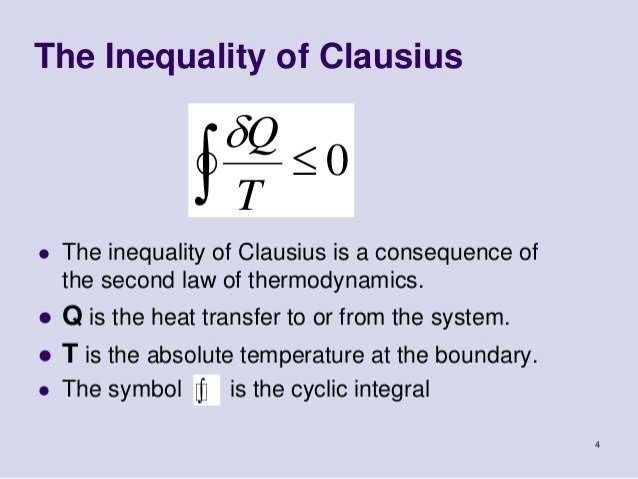
η = 1 - T?/Tₕ - 75Clausius inequalityWhen a system undergoes a cyclic process, the Clausius inequality holds, where =0 is reversible and <0 is irreversible
- 76Entropy defined in terms heat energy for a reversible process∫(2-1) dQᵣₑᵥ/T = S₂ - S₁
- 77—
Information
- Description
- Undergraduate Thermodynamics Flashcards on Thermodynamics, created by Paris Hart on 21/01/2021.
- Created by
- Paris Hart
- Views
- 1
- Rating