
Flashcards
ABA OLYMPICS
Cards in this deck (46)
- 11. Define determinism. What implications does determinism have for personal credit and blame?- The notion that behaviour is determined solely by heredity and environment
- This implies that credit and blame can not be placed on the person because they do not have free will to choose their actions, it is all based on heredity and environment, both things that are out of their control. - 22. What is free will? What implications does free will have for personal credit and blame?- Free will is something within the individual; despite inheritance and despite all environmental factors, a person who behaves one way could have chosen to behave another way because they have the ability to choose.
- This places all credit and blame on an individual because they choose to act in a certain way and to make certain decisions; the individuals themselves cause the behaviour. - 33. Can the conflict between determinism and free will ever truly be resolved? Why or why not?- No it can not; it can never be resolved by evidence since there is conflicting information from both sides that oppose each other. The debate about which view is right rests on arguments about the social and aesthetic consequences of adopting one view or the other (social justice and responsibility and theological arguments i.e. God)
- 44. Describe the societal implications if free will does not exist- It is necessary to preserve democracy and morality in society. If people do not make decisions and are not responsible for their actions, then no one can be held accountable for committing crimes. And if they cant make decisions, there is no such thing as true democracy as they can’t truly vote.
- 51. Briefly define pragmatism- the power of scientific inquiry lies not so much in our discovering the truth of the way the objective universe works, but in what scientific inquiry allows us to do. In particular, the great thing that science permits us to do is to make sense out of our experiences. It makes our experience seem comprehensible; rain falls not because of some mysterious god but because of water vapor and weather conditions in the upper atmosphere.
- 62. Why do radical behaviorists prefer pragmatism to realism?- realism leads to a dualistic view of people that is incompatible with a science of behavior
- realism leads to confusing definitions of behavior. In the context of studying behavior, realism
would hold that there is some real behavior that goes on out in the real world, and that our senses, whether used with instruments or in direct observation, only provide us with sense data about that real behavior, which we never know directly. - 71. Describe the three ways in which the word “free” is used.- people speak of freedom from restraint, as in becoming free from slavery. This is often spoken of as being free, suggesting that freedom is an attribute or possession.
- Second, people speak of political and social freedom. Here the issue is not so much constraint as having to face unpleasant consequences for certain choices.
- Third, people—particularly religiously minded people—speak of spiritual freedom. When a church advertises that “Jesus will free you from bondage,” no lack of free will or political or religious freedom is suggested, but rather deliverance from a metaphorical prison. - 82. Describe and provide a novel example of the key obstacle to feeling free.- The key obstacle is coercion. People cannot feel free when they are coerced—that is, when their behavior benefits another because of the threat of aversive consequences. An example of this is you will not get a bonus as Christmas time if you do not work Thanksgiving holiday and 2 weekends a month.
- 93. What are reinforcement traps? Provide a novel example.- Small, conspicuous reinforcers delivered immediately can be so powerful that people sacrifice long‐term welfare for short‐term gain. An example would be smoking, taking drugs, overeating or procrastinating school work to watch Netflix
- 101. Describe extenuating circumstances and compassion from a behavioral perspective. Describe the situations under which people tend to blame and give credit to others for their actions. Explain.- Extenuating circumstance: environmental factors and their effects on behavior (e.g., depression),
- compassion means considering those environmental factors and behavioral effects.
- when people get credit for some praiseworthy deed, they often resist any suggestion that environmental factors may have played a role. Successful businesspeople frequently attribute their achievements to hard work and sacrifice, rarely to the advantages they enjoyed growing up in an affluent community. People make up all sorts of excuses when they are caught in some shameful act,
everything from “The devil made me do it” to “my unhappy childhood.” The point is to assign blame to something else—the devil, the unhappy childhood—in other words, to put the causes for the behavior in the environment. - 112. Describe the concept of “responsibility” from a lay perspective and a behavioral perspective.- Lay person: responsibility is a person behaving in ways that society deems useful.
- Behavioral: talk about responsibility is talk about the desirability or usefulness of applying consequences. To say we hold someone responsible is to say we hope to change the person’s behavior by punishing or reinforcing it. - 123. From a behavioral perspective, how do people make choices? What is one problem that may arise when parents or managers refuse to control the behavior of children or employees?- We never choose freely in the sense of exercising free will, but rather based on our genes and environment.
- If parents or managers refuse to control the behavior of children or employees, they leave the control to others – and to accident. There is always something controlling behaviour, if they don’t control it something else will. - 131. What are the advantages and benefits of using self-management?- It Can Influence Behaviors Not Accessible to External Change Agents
- It Can Promote the Generalization and Maintenance of Behavior Change
- A Small Repertoire of Self-Management Skills Can Control Many Behaviors
- People with Diverse Abilities Can Learn Self-Management Skills
- Some People Perform Better under Self-Selected Tasks and Performance Criteria
- People with Good Self-Management Skills Contribute to More Efficient and Effective Group Environments
- Teaching Students Self-Management Skills Provides Meaningful Practice for Other Areas
of the School Curriculum
- Self-Management Is an Ultimate Goal of Education
- Self-Management Benefits Society
- Self-Management Helps a Person Feel Free - 142. What are antecedent-based self-management strategies? What are some examples? How are they implemented?- An antecedent-based self-management tactic is one whose primary feature is the manipulation of events or stimuli antecedent to the target (controlled) behavior.
- Examples include:
o Limiting undesired behaviour to restricted stimulus control (A person may be able to decrease the frequency of an undesired behavior by limiting the setting or stimulus conditions under which he engages in the behaviour)
o Providing response prompts (Creating stimuli that later function as extra cues and reminders for desired behaviors)
o Performing the initial steps of a behavior chain to ensure being confronted later with a discriminative
stimulus that will evoke the desired behavior ex: hanging umbrella on doorknob to remember to bring it with you - 153. What is systematic desensitization and how is it employed?- Systematic desensitization involves substituting one behavior, generally muscle relaxation, for the unwanted behavior—the fear and anxiety. The client develops a hierarchy of situations from the least to the most fearful and then learns to relax while imagining these anxiety-producing situations, first the least fearful situation, then the next fearful one, and so on. When a person is able to go completely through his hierarchy, imagining each scene in detail while maintaining deep relaxation and feeling no anxiety, he begins to expose himself gradually to reallife (in vivo) situations
- 164. What steps are necessary for conducting an effective self-management program?- Specify a goal and define the behavior to be changed.
- Begin self-monitoring the behavior.
- Contrive contingencies that will compete with natural contingencies
- Go public with your commitment to change your behavior.
- Get a self-management partner.
- Continually evaluate your self-management program and redesign it as necessary. - 171. Describe the three views on what it means to exert willpower. Do each propose a practical means for obtaining self-control; describe these.- Religious- Willpower does not control behavior it instead dictates if good or evil will. Willpower does not guide your hand to put down the cigarette, rather it allows your desire to “do the right thing” to take over. Its not about how you did it, its about why. Most religions offer a way to achieve self-control (e.g. studying sacred texts or prayer)
- Cartesian- spirits in humans are regulated by two opposing forces; – External control: controlled by external factors – Self control: controlled by the soul itself • Willpower is a literal interpretation in this model – Our souls must wrest control of our behavior from the opposing forces of the outside world
- Rene Descartes- Descartes suggested that animal sprits were responsible for behavior. These sprits traveled down nerves to muscles to activate them (filling like a balloon). Stimuli enter the body from the outside opening a value which allows the spirits to flow causing movement “behavior”. No willpower is needed, the animal acts as a machine - 181. Define verbal behavior- Behavior whose reinforcement is mediated by a listener; includes both vocal-verbal behavior (e.g., saying “Water, please” to get water) and nonvocal-verbal behavior (pointing to a glass of water to get water).
- 192. Describe the three elements of the verbal contingency: antecedent stimulus, response, reinforcer.- Antecedent stimulus= MO or want/need for something
- Response= pointing, vocalization etc to others
- Reinforcer= control over environment and the thing they wanted - 203. Describe the differences between the radical beahviourist account of verbal behaviour and the traditional account with respect to: (a) mentalism, (b) structure versus function, (c) the concept of usage, (d) meaning versus reference.- Mentalism
o Radical behaviourist= not mentalistic
o Traditional account= Most traditional accounts of verbal behavior are mentalistic in that they attempt to explain verbal behavior in terms of underlying mental causes
- Structure vs function
o Radical behaviourist= The behavioral account adopts a functional approach where the verbal community shapes the fundamental unit from the stream that is verbal behavior
o Traditional account= Traditional accounts take a structural approach & divide speech into components of phonemes morphemes, syllables, words, phrases, sentences, paragraphs, etc.
- Concept of usage
o Radical behaviourist= A behavioral account emphasizes usage, but differently from a traditional account. For radical behaviorist, the usage in verbal behavior does not imply the existence of a thing (e.g., word) that is used, but simply of an act in context
o Traditional account= A traditional account might say that speakers “use words” to express themselves
- Meaning vs reference
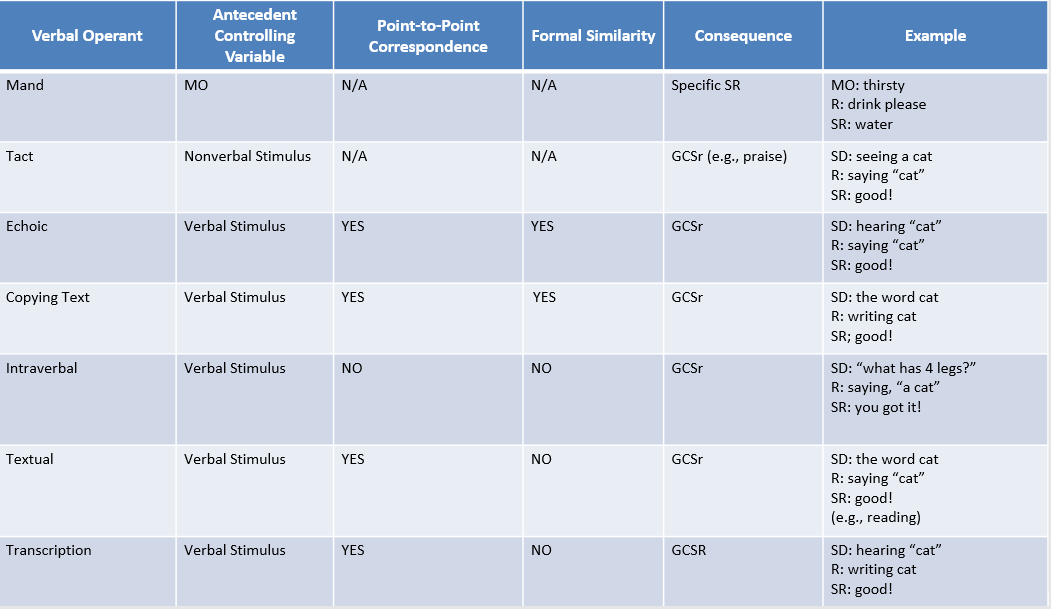
o Radical behaviourist= From a behavioral perspective, there are two senses of “meaning”; Meanin - 214. Define (in terms of contingencies) and give an example of the following elementary verbal relation: mand, mand, echoic, intraverbal, textual, copying text, transcription. In your answer, be able to specify the antecedent controlling variable, the consequence, and whether point-to-point correspondence and formal similarity between the _______________ and the ___________ exist (take-home point lecture)- Point to point correspondence- Relationship between the SD and the response (ex: first part of SD controls first part of response). Does not have to be the same sense mode)
- Formal similarity- Relationship between the SD and the response. Both SD and the response must the same sense mode e.g. both visual, both auditory or both tactile - 221. What is generalized echoic responding? What kind of behavioral interventions can be used to support the development of an echoic repertoire?- Generalized echoic responding: When a child readily imitates novel verbal behavior in the absence of contingent social reinforcers. Generalized echoic responding is fundamental to the development of more complex behaviors such as self-instructions, listener behavior, and naming and it is considered a behavioral cusp.
- Stimulus-stimulus pairing: Strategically pair vocal sounds with delivery of high preference stimuli. This results in these specific sounds functioning as conditioned reinforcers. - 232. What role do self-reinforcing responses play in the development of language? What is the difference between self-reinforcing responses and echoic behavior?- Automatic reinforcement occurs when reinforcement is the product of a response and is not socially mediated. From the time of an infant’s birth, parents’ sounds and words that are paired with reinforcing activities (i.e., feeding) become conditioned reinforcers for the infant. These sounds, when produced by the child, will help strengthen the muscle movements that are necessary to produce babbling. As a result, infants will babble the sounds that are paired with socially mediated reinforcement more frequently. The process of automatic reinforcement helps strengthen a child’s vocal verbal repertoire and prepare them for speaking in words and eventually full sentences.
- Difference between the 2: Echoic behaviour is socially mediated and self-reinforcing Reponses are not - 243. Describe the relationship between motivating operations (MOs) and mands. Describe two approaches to teaching mands which involve MOs.- Goal of mand instruction is to teach independent requests that are under the control of relevant motivating operations ex: When thirsty (MO) the child will request a drink. When there is a change in the environment that momentarily increases (establishing operation [EO]) or decreases (abolishing operation [AO]) the value of a reinforcer and evokes behavior that has previously resulted in access to the reinforcer. For example, if a child has been denied access to their favorite toy dinosaur, the reinforcing value of the dinosaur is temporarily increased, and behaviors that have produced access to the dinosaur are evoked (i.e., the child says, “Give me the dinosaur” or simply “dinosaur”).
- 2 approaches to teach mands involving MO’s
o Capturing learning opportunities as they occur (natural environment teaching)
o Limiting access to preferred/necessary items prior to teaching (deprivation) - 251. Describe how the same word could be an echoic, mand, tact, or intraverbal. Provide an example. Ex: word Appleo Echoic; saying apple when you hear the word apple
o Mand; see an apple and they want it, say apple, get the apple
o Tact; Show picture of apple, say what it is, they answer apple
o Intraverbal; What is your favorite fruit, say apple - 262. What is the difference between taking dictation and copying text? Describe one procedure that is used to promote each- Taking dictation= A written response controlled by a verbal stimulus (e.g. writing down a phone number that someone reads to you); derived relational responding to teach it
- Copying text= A written response controlled by a written response (e.g. copying down an ISBN number from a book); derived relational responding to teach it - 271. What do the authors suggest is overlooked by assessment protocols that focus on Skinner’s verbal operants (e.g. the VB-MAPP and ABLLS-R)?- These protocols ignore hundreds of research studies on how language develops through derived relational responding and corresponding transformations of stimulus function
- 282. Briefly outline which aspects of the PEAK curriculum can be considered Skinnerian and which would best be considered post-Skinnerian.- Skinnerian; direct training module and generalization (first 2 modules)
- Post- Skinnerian; equivalence module, transformation module (focuses on derived relational responding) - 293. What behavioral theories are the final two modules of the PEAK curriculum (e.g. PEAK Equivalence and Peak Transformation) based on? How does this translate into highly efficient learning?- PEAK Equivalence & Transformation modules use techniques derived from stimulus equivalence and Relational Frame Theory. This includes procedures emphasizing derived relational responding
- Efficient training of verbal skills in which meaning transfers to new stimuli without direct training and Exemplars are provided that set the occasion for derived responding to emerge as a functional operant - 301. According to Baum, what is rule-governed behaviour?- To say that behavior is “governed” by a rule is to say that it is under stimulus control by the rule or induced by the rule and that the rule is a certain type of discriminative stimulus—a verbal discriminative stimulus. When my father told me You must be home for supper by 6:00, that was a rule that “governed” my behavior because the consequences of being late were most uncomfortable
- 312. Define the two relations (or contingencies) involved in rule-governed behaviour. Provide an example to support your definition.- Long-term (ultimate) relation: the reason for the rule in the first place
- Short term (proximate) relation: reinforcement relation for following the rule
- Example: wearing shoes- short term you will be comfortable, wont get cuts etc. Long term it will lead to health which leads to procreation - 323. From a behaviorist perspective can a pigeon’s behavior be considered rule-governed? Why or why not?- Whether a nonhuman animal’s behavior should ever be called rule‐governed remains a debatable point, but this pigeon’s behavior cannot qualify as rule‐ governed because no verbal discriminative stimulus is involved. A pigeon trained to match to sample pecks at the key with the stimulus that matches the sample key. It could be said to be following a rule, but the “rule” is only a short description, of its performance.
- 334. Distinguish between rule-governed behavior and implicitly shaped behavior. Give an example of how the same topography of behavior can be shaped by both.- Rule governed; Behavior that is talked about, directed or instructed, is Under the control of verbal discriminative stimuli and Requires another person/person(s) to speak or write down the rule, knowing about
- Implicitly shaped; Shaped directly by relatively immediate consequences, it does not depend on hearing or reading a rule, it Does not require another person (only interaction with non-social reinforcement) and involves knowing how. Ex: closing a twisting lid; we may at first twist it the way it works to seal the lid, but later learn the rule righty tighty lefty loosy - 341. Describe the benefits of using an FBA- Allows us to make hypotheses about the relations among a specific behavior and the environmental events
- Identify the type and source of reinforcement for a challenging behavior – Construct an intervention aimed to change the contingency to support; Decreases challenging behavior, Increase adaptive behavior (replacement skills) - 352. List and explain the typical conditions (4 test, 1 control) of a functional analysis. In your response, include the antecedent and consequent conditions in each condition as well as the assessed contingency
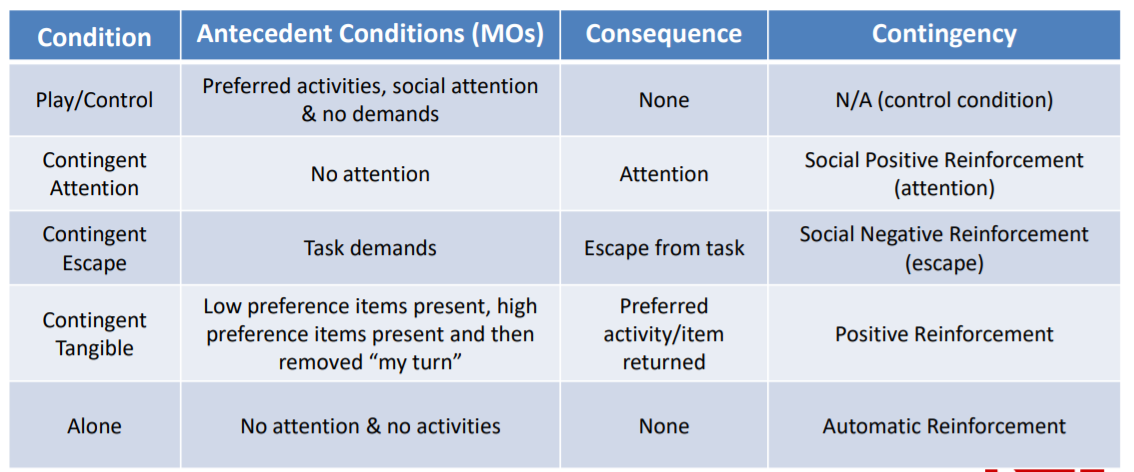
- 363. Discuss the advantages and limitations of a functional analysis.- Advantages; The primary advantage of functional analysis is its ability to yield a clear demonstration of the variable(s) that relate to the occurrence of a problem behavior, development of effective reinforcement-based treatments and less reliance on punishment procedures
- Disadvantages; the assessment process may temporarily strengthen or increase the undesirable behavior, some behaviors (e.g., those that, albeit serious, occur infrequently) may not be amenable to functional analyses, functional analyses that are conducted in contrived settings might not detect the variable that accounts for the occurrence of the problem behavior in the natural environment, the time, effort, and professional expertise required to conduct and interpret functional analyses have been frequently cited as obstacles to its widespread use in practice - 374. Using a novel example, describe why is it important to identify the conditions that account for a behavior rather than just the topographySimilar topographies of problem behavior can serve different functions ex: head banging; could be automatically reinforcing or could be to access social attention
- 381. Describe the 5 hypotheses discussed in this paper.- Positive reinforcement hypothesis; Self injurious behaviour is a learned operant, maintained by positive social reinforcement
- Negative reinforcement hypothesis; Self injurious bx is a learned operant maintained by the termination of an aversive stimuli (escape from something etc)
- Self-stimulation hypothesis; Self injurious bx is a means of providing sensory stimulation
- Organic hypothesis; Self injurious bx is the product of aberrant physiological processes (ex; genetic condition)
- Psychodynamic hypothesis; Self injurious bx is an attempt to establish ego boundaries or to reduce guilt (inability to distinguish self from others) - 392. Describe the treatment implications for SIB maintained by intrinsic and extrinsic reinforcement.- Intrinsic; Source of reinforcement is inherent in the behavior itself and cannot be controlled by others (ex; Self-stimulation, Organic features. Changing contingencies of reinforcement may not be helpful. Instead, we would need to negate or attenuate the reinforcers themselves. Treating source of pain, Increasing external stimulation
- Extrinsic; Controlled by individuals other than the client (Social reinforcement or Negative reinforcement). Treatment would consist of changing the contingencies of reinforcement – If maintained by social reinforcement > extinction or time-out - 401. How does Baum define culture?- culture is learned behavior that is shared by members of a group. It consists of operant behavior, both verbal and nonverbal, acquired as a result of group membership
- 412. What does Baum say about altruism and society?- Altruism is the hallmark of a society. When a group lives together in a stable association and behaves altruistically toward one another, that is what makes a society.
- 423. Describe what it meant by: Variation, Transmission, and Selection when it comes to the evolution of culture.- Variation: cultural evolution requires that various cultural “alleles” or “genes” must compete and various trait packages must be possible.
- Transmission: In cultural evolution, transmission occurs by more direct means: the transfer of behavior from one group member to another.
- Selection: In genetic evolution, selection occurs because of differential survival and reproduction. Something analogous must be true in cultural evolution. As with genes, some variants among the cultural replicators are longer‐lived, more fecund, or more faithfully copied. - 431. Define guided variation, as described by Baum, as well as its effect on evolution- They equate guided variation with behavior that is individually acquired and then
transmitted by imitation or teaching. The effect of the guided variation force on evolution depends on the existence of some adaptive standard such as taste or a sensation of pleasure or pain. - 442. How is happiness defined by Baum? How is short-term happiness distinguished from long-term happiness?- ultimately, because we are products of natural selection, our happiness tends to coincide with the fitness of our genes. For most people, happiness (reinforcement) derives from conditions in themselves and others (reinforcers) ultimately tied to fitness: personal survival and comfort, the welfare of children, the welfare of family members and other relatives, and the welfare of nonrelatives with whom we have mutually beneficial relationships. People are happiest when they are free from threats or aversive consequences, when their environment provides choices and when they are free from coercion.
- Long‐term happiness derived from one’s culture often conflicts with short‐term personal
reinforcement. In the short run, no one enjoys paying taxes, but everyone benefits from schools and trash collection in the long run - 451. Why does behaviour modification (e.g., aversion therapy, . . .) often fail in creating lasting change outside of a clinical setting for people? Use an example from the text to illustrate your answer.- discrimination learning are neglected. The home, the bar, or streets in which the problem drinking normally takes place are easily discriminated from the contrived conditions of the clinic, or even the simulated bars used to promote transfer of training. Differences between these contrived settings and the real-life situations are still far greater than those found in laboratory discrimination learning studies where responding regularly comes under stimulus control. Behavior is adaptable. It adjusts to the contingencies of reinforcement or punishment
- The therapist attempts a technical fix for special defects in the drunk by applying aversive stimuli in the clinic, but outside the clinic all those conditions prevail that maintain the behavior in the first place, and behavior adjusts to these conditions. One of the adjustments is drinking itself. And so the problem, as defined by the employer of the behavior modifier, returns-hence recidivism or the lack of transfer. - 462. From an applied behaviour analytic perspective, how can societal problems be addressed more effectively?- Although applied behaviorists have frequently focused on fixing individuals, the science of Behaviorism provides the means to analyze the structures, the system, and the forms of societal control that produce the "problems". By addressing the problems, you don’t need to fix the person
Information
- Description
- Flashcards on ABA OLYMPICS, created by Meghan Watson on 17/04/2021.
- Created by
- Meghan Watson
- Views
- 1
- Rating