
Flashcards
IB Physics HL Topic 9 Wave Phenomena
Cards in this deck (23)
- 1Simple Harmonic MotionFor an object to be in SHM, its acceleration must satisfy two conditions:
*The acceleration is proportional to the displacement
*The acceleration is in the opposite direction to the displacement (towards the equilibrium point) . - 2At what point in the wave is the object at maximum velocity?When displacement is 0.
The middle of the swing. - 3At what point in the wave is the object at maximum acceleration?Maximum acceleration occurs at maximum displacement.
- 4Energy of SHMAt any point during SHM kinetic and potential energy is equal.
- 5DiffractionDiffraction is when waves pass through a gap and spread out. The amount of diffraction depends on the size of the wavelength in comparison to the size of the gap. Greatest diffraction when wavelength = gap.
- 6Diffraction GratingA diffraction grating is a series of narrow slits. COmmonly 500 slits per mm.
- 7X-ray CrystallographyX-rays have very small wavelengths. Inner atomic spacing of crystals are similar to this distance, thus x-rays can be diffracted by crystals. The pattern can be recorded using photographic film.
- 8What is interference?Interference is a special case of superposition, where the waves that combine are coherent. The waves overlap forming a repeating interference pattern of minima and maxima
- 9CoherenceWaves that are of the same frequency, wavelength, polarisation and amplitude and in a constant phase relationship.
A laser is coherent but a light bulb is not. - 10Constructive InterferenceThe path difference between the waves is a whole number of wavelengths so the waves arrive in phase adding together to give a large wave.
2 Peaks Overlap - 11Destructive InterferenceThe path difference between the waves is a half number of wavelengths so the waves arrive out of phase cancelling out to give no wave at all.
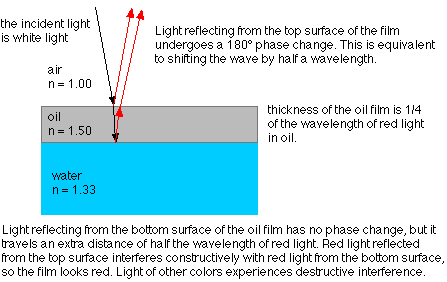
A peak and a trough overlap - 12Thin Film Interference
- 13Use of thin filmsCamera lenses are coated with a thin film to reduce reflections and increase transmission.
- 14What is resolution?Resolution is the ability to distinguish images of two objects that are close together.
- 15Rayleigh CriterionThe point at which two images are just resolved. THe peak from the central maximum of one is no closer than the first minimum of the other.
θ = 1.22λD
θ is the angle of separation of the two objects, D is the diameter of the aperture and λ is the wavelength of light. - 16Dawes LimitDawes limit is the first point at which a double star is elongated enough to suspect the presence of two stars. Dawes limit is the maximum resolving power of the telescope. It is an angle measurement between the two stars and the observer.
Dawes limit (arc seconds) = 116/D (mm) - 17Applications of Dawes limitAn optical or other reception systems must be able to resolve the intended images. This has implications for satellite transmissions, radio astronomy, and many other applications in physics and technology.
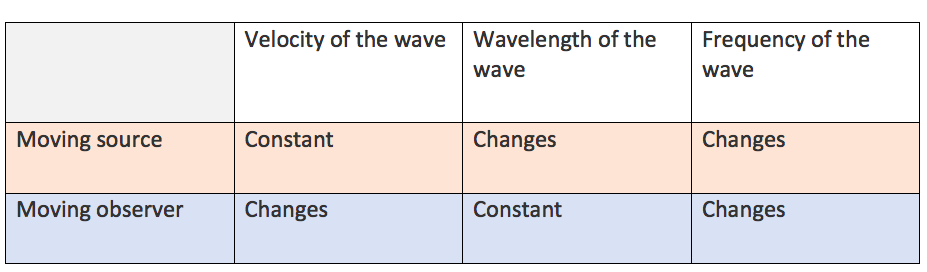
- 18Doppler EffectThe Doppler effect refers to the change in the observed frequency of a wave due to the movement of the observer and/or that of the wave source
- 19Source moving towards an observerThe observed frequency is higher. A higher-pitched sound is heard. Shorter wavelength higher frequency.
Moving towards = - - 20Source moving away from an observerThe observed frequency is lower. A lower-pitched sound is heard. Longer wavelength lower frequency.
Moving towards = + - 21Table of Doppler Effect
- 22Doppler equation of electromagnetic waves.V is the velocity of the observer.

- 23Doppler Effect when source and observer are moving.Add Δf to f to obtain the observed frequency (f’) when the wave source and the observer are moving towards each other.
Subtract Δf from f to obtain the observed frequency (f’) when the wave source and the observer are moving away from each other.