
Flashcards
NPP

Cards in this deck (88)
- 1Quarks ForcesEM, Strong, Weak
- 2Leptons ForcesEM, Weak
- 3Neutrinos ForcesWeak
- 4Gluon ForcesStrong Force
- 5Fundemental Force order (strongest to weak)Strong Nuclear, EM, Weak, Gravitaional
- 6Feymann Diagram purposegraphical way to describe particle interaction
- 7Feynman Diagram: Coupling strength QED Vertexamplitude prop e^n
Prob prop e^2n
Prob prop fine structure constant ^n
n- number of verticies - 8Basic relativistic variables
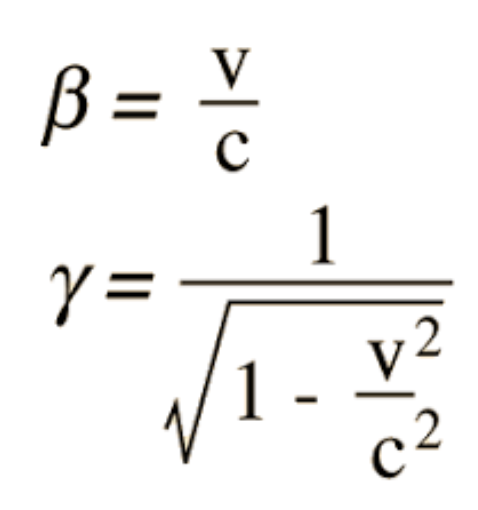
- 9Relativistic Kinematics Lorentz invariant equation of EMassless particles becomes E=|p|c
- 10Multiparticle system, total mass (relativistic)P_T= sum(P)
E_T=sum(E)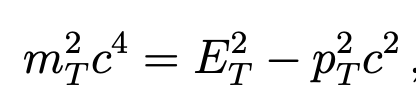
- 11Total mass / Center of mass energy (invariance)

- 12Is 4-Vector a lorentz invarient object?NO, but the length of a 4-vector is
|P|^2= m^2c^2 - 13Four Vector exampledecay X->c+d (X rest frame)
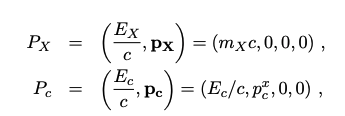
- 14Conserved quantities in standard modelEnergy, momentum, Angular momentum, Charge
- 15Spin angular momentum
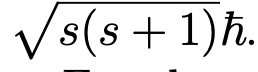
- 16Number of values spin in z direction has Sz2s+1
- 17Helicityprojection of spin along the particles momentum vector. EG h=+1/2 (when spin and momentum align) OR =1/2( when anti-aligned)
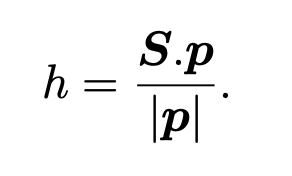
- 18Parity congugationreflects position vector of each particle through the origin.
P=+/- 1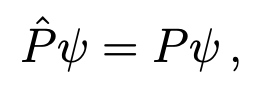
- 19Charge conjugationflips all internal charges (particle -> antiparticle)

- 20Conservation of charge and parity conjugation- EM and strong forces conserve C and P
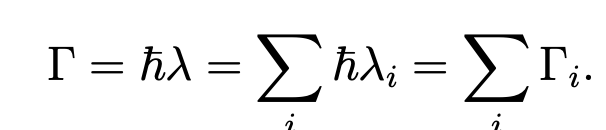
- Weak forces do NOT - 21Decay- probability of survival until time t (S)λ - decay rate
τ- lifetime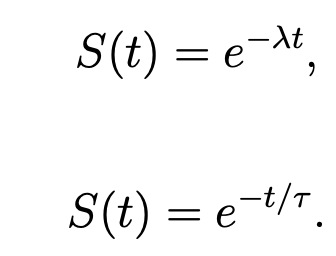
- 22collision of e + p -->Z, with mass_Z=91GeV/c^2Need COM Energy=sqrt(s) = 91GeV
- 23Number of particles after time t (decay)

- 24Half timeTime taken for 1/2 of the initial samples to decay

- 25Decay widthunstable state doesn't have an exact energy. . has energy units. width quantises the uncertainty of mass for particle with finite lifetime
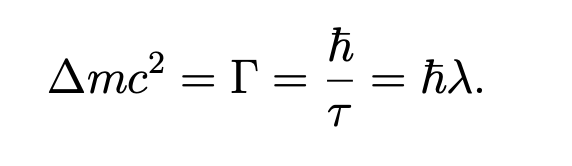
- 26Decay width vs lifetimeLarge lifetime = Low width
Small lifetime = Large width
Stable particles have 0 width - 27Total decay ratesum of separate rates
- 28Total widthactual physical uncertainty of mass
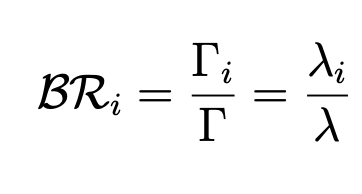
- 29Branching ratioProportion of decay to a particular mode
- 30Quarksu,d,c,s,t,b
- 31Leptonse,v_2,miu,v_miu,tau,v_tauc
- 32Cross section of reactiontotal target area = Adno
effective target area presented to the incoming particle to cause a reaction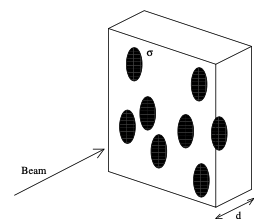
- 33Reaction rate per unit area of targetφ= particle flux (particles/area/time)
n= atom density= atom (quantity of atoms in molecule) density*Navogrado/Atomic mass
- 34Mean free path lparticles will more this distance before interacting

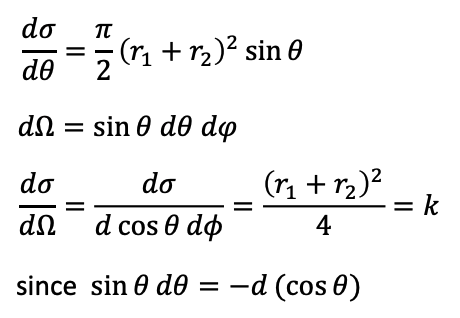
- 35Differential cross section - isotropic scattering caseprobability of scattering at a particular energy or angle...
- 36Reaction Thresholdminimum (kinetic) energy of the incident particle for
the reaction to occur; assume head-on collision, products stick together
(i.e. the most favourable conditions lead to the threshold condition) - 37Realtivity

- 38UNITS1 fm = 10−15 m
1 barn = 10−28 m2 = 10−24 cm2 = 100 fm2
proton, neutron and amu masses are all around 1 GeV/c2 - 39UNITSm_proton*c^2~ 1GeV
mass=GeV/c^2
Momentum= GeV/c
Energy=GeV
r_proton ~ 1fm - 40Calculating nn= atom density= atom (quantity of atoms in molecule) density*Navogrado/Atomic mass

- 41Feyman diagram propertiesIngoing lines: particles with well defines energy and momentum
Verticies: place where actual interaction take place, each has a factor of the relevant charge associated with it (e when EM force). Number of verticies depends on forces.
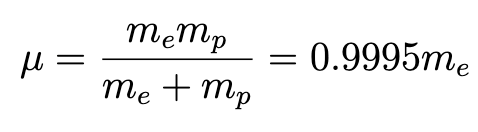
Between Varticies: mediator/force carrier and is virtual - 42Reduced mass
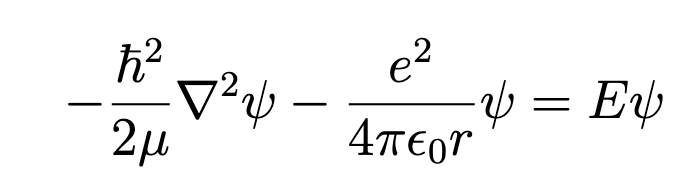
- 43TISE using Coloumb potential
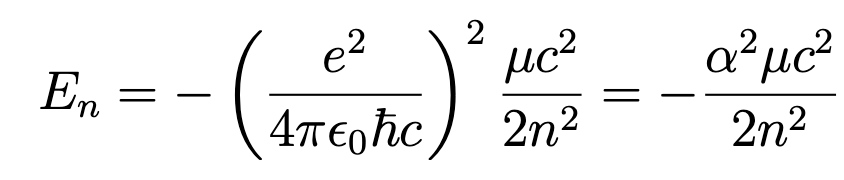
- 44Energy Eigenstate TISE using coloumb potential
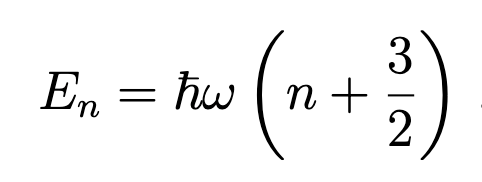
- 45Energy Eigenstates TISE using SHM potential mω^2r^2/2
- 46EM Decay + Feynman Diagramat vertex:
- Charged fermion (anti-fermion) radiates or absorbs a photon
- - 47Type of decay- excited state to a ground state of a composite particle
-electron positron annihilation possible through reversal of one fermion line at the vertex - 48Positronium decay- ground state decay to only even number of photons
-higher state decay to only odd number
- Dance between e and e+ before they anihilate
- Energy levels: miu=me/2
En=-6.8/n^2 eV - 49Range of weak force¯h/mc
- 50Charge conjugationTakesevery particle and replaces it with its antiparticle
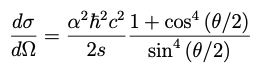
- 51Rutherford scattering- evidence of compact nuclei at core of atomsdistribution of scattering- theta, differential cross section.
Result is not isotropic, falls rapidly with increase angle (due to small force at large angle)
- 52Rutherford scattering, with spin
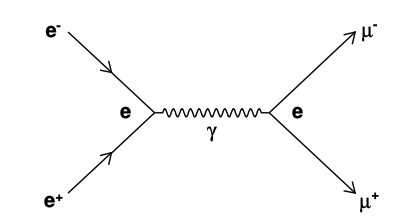
- 53Electron positon annihilation into muons (Feynman diagram)
- 54Strong Force-Affects quarks and gluons
-short range
-Mediator: Gluons - 55Quarks-6 quark: u,d,c,s,t,b
Baryon number = +1/3
- 6 anti-quark: u^-,...
Baryon number= -1/3 - 56Gluons- only interact with quarks
-massless
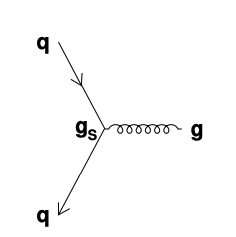
-colouredL each has 1gs of colour and 1gs of anticolour - 57Quark-gluon vertex
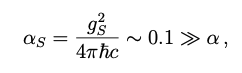
- 58gluon fine structure constant
- 59Gluon self interaction- each gluon carries colour and anticolour
1) Confinement
2)Asymptotic Freedom - 60Confinement- We never see single quarks of gluons but only hadrons.
- never have a state with a non-zero strong charge on it
-Gluons radiate more gluons so field lines increase while density stays constant, which means total energy becomes infinate which is impossible leading to confinement of gluons. - 61Asymptotic Freedom- at short distance, force goes to 0
-balloon modell
-if quark hit (by photon), for a short time (doesnt go very far), it acts as if it is not a bound state at all
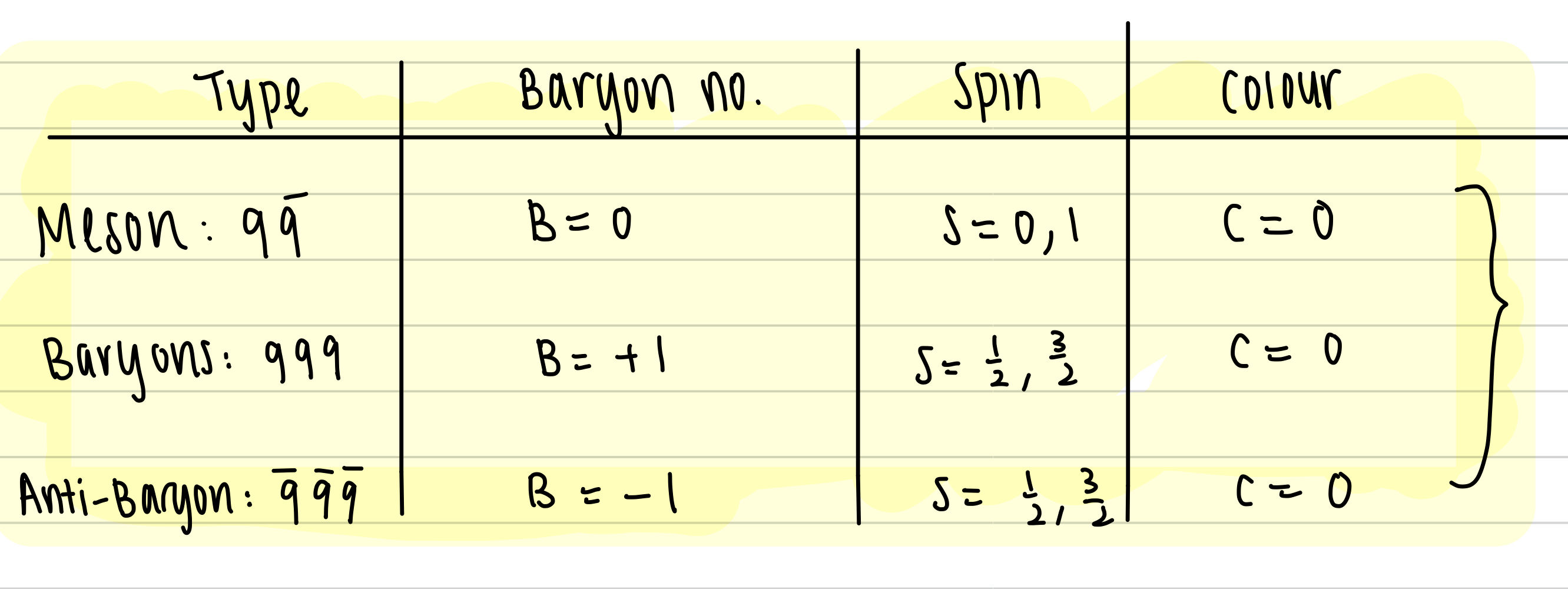
- Force between 2 quarks at a distance - 14tonnes - 62Hadrons- bound states of quarks
-mesons q, baryons qqq
- Must be colour singlet C=0 (COLOURLESS)
- - 63Colour singletsCan achieve C=0 in 2ways:
1)symmetric sum over all colourless pairs
2) antisymmetric sum over colourless triplet of each colour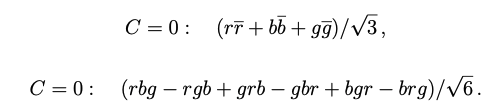
- 64BARYON chart
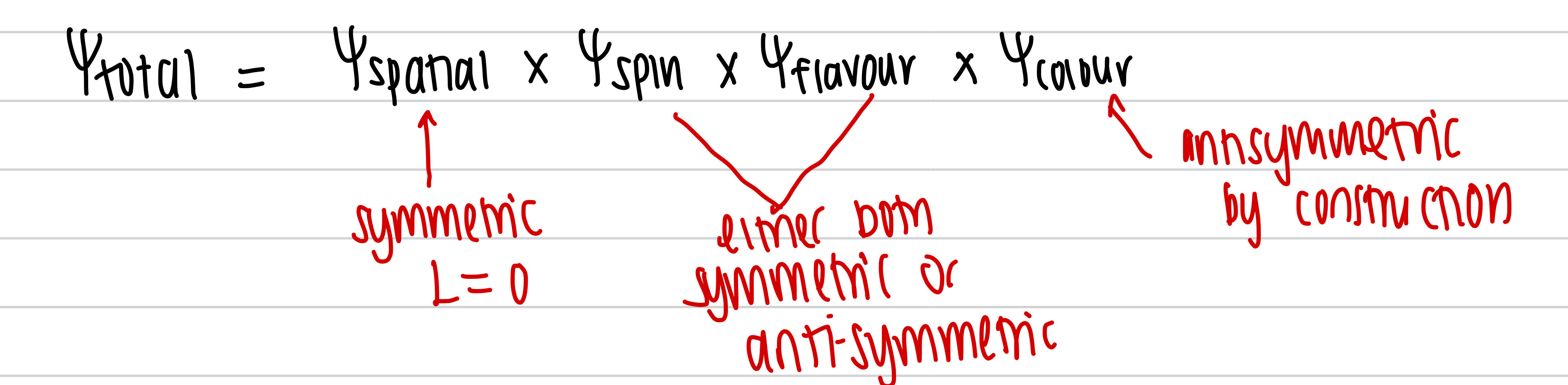
- 65Baryon wavefunctionTotal wavefunction must be ANTISYMMETRIC
- 66Meson- ground state J=0
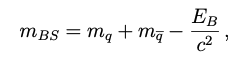
- Excited states J=1 - 67For baryon bound state massEb=binding energy >0
- 68Magnetic dipole relationfundemental dirac eq

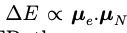
- 69Energy splitting due to mag dip momergy level splitting arises due to mag dip mom of circulating electron colupling to nuclear mad dip mom.
- 70Binding energy relation to spinK= constant of proportionality
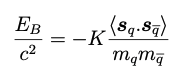
- 71Working to find mass. Ground state J=0, Excited J=1L=0 so J=sq+sq^-
- use J^2 to find dot product to sub into binding energy
- 72Decay of baryon excited state- Decay to ground state through photon emission
- RARE: EM force decay, so strong force decay would be preffered - 73p+ meson decay-mostly decays into pion ρ+ → π+π
-very fast decay: strong force with only 2 verticies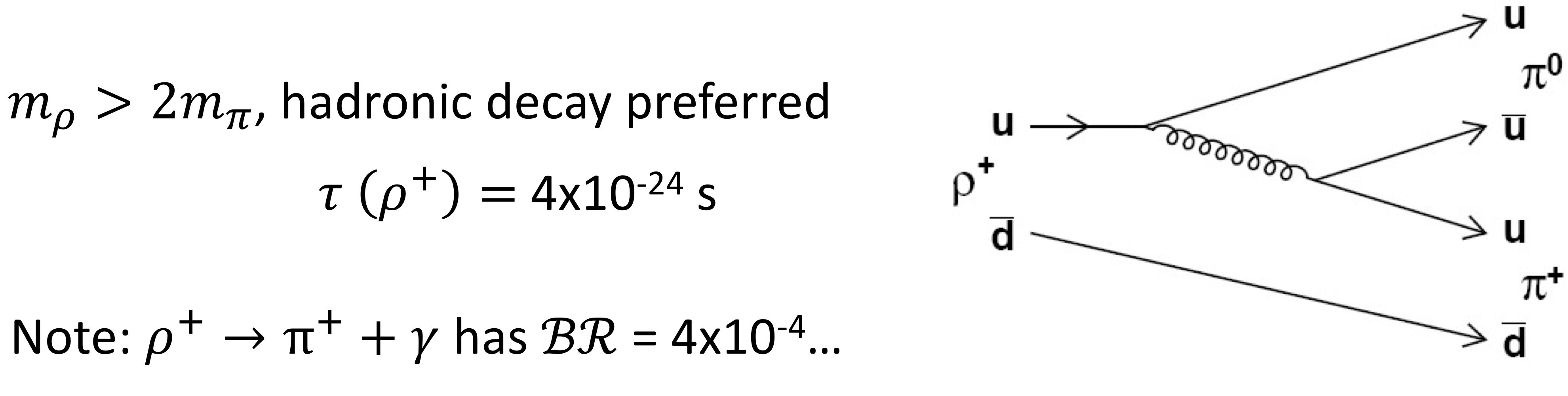
- 74Strong force decays-Very fast
- order 10^-23 seconds
- eg:
K∗+ → K0π+ - 75Charge conjugation calc

- 76Gluon addition- Gluon carries colour change
-will produce a jet of hadrons
- contribute additional term to cross section for hadron - 77Angular information contribution-tell us about the spin of the particle
- 78Why is proton stable and neutron is not?SM -> Baryon number must be conserved
- Neutron can decay to a proton (mp - 79Neutron decayn → p + e− + ̄νe + νμ
Conserve momentum by recoiling both neutrino and antineutrino
against the electron. - 80SEMF*Insert pic*
- 81Volume TermThe nuclear force is short range so the
most important contributions come from the neighbouring nucleons. The principal contribution to the binding energy therefore scales with A. - 82Surface TermCorrection to reduce the binding energy to take into account the fact that the nucleons on the surface have fewer nearest neighbours than those in the centre.
Nuclear radius scales with A, so, term is proportional to A^2/3 - 83Coulomb termElectrostatic repulsion between protons
produces a potential that reduces the binding energy.
The A contribution scales with the number of proton-proton pairs, i.e. Z(Z − 1). - 84Asymmetry TermNuclei with the same number of protons and neutrons are observed to be more stable, i.e. the binding energy is larger.
This is a “penalty term” proportional to. the asymmetry in the numbers of protons and neutrons. - 85PairingPauli exclusion principle implies that nucleons must be added to the next energy level up if two protons or two neutrons occupy the same energy level
with opposite spins. So, if the nucleus contains an even number of protons and an even number of neutrons δ > 0 and the binding energy is increased.
Conversely, if Z and N are odd, then δ < 0 and the binding energy is reduced.
For even/odd or odd/even nuclei δ = 0. - 86Electron- positron annihilation into quarks
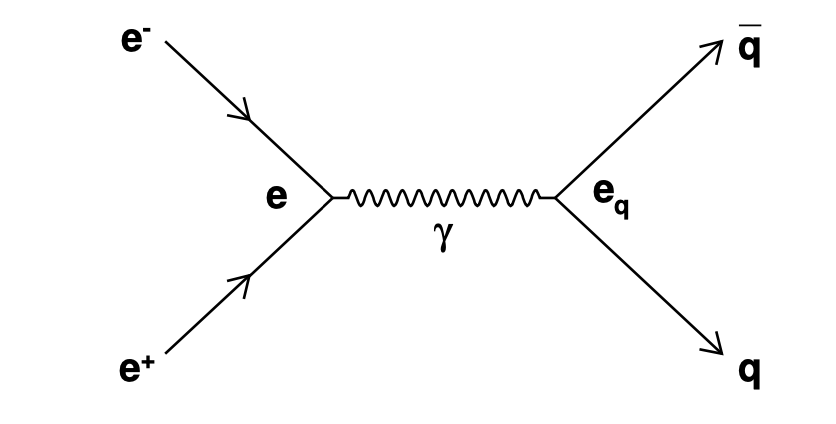
- 87Quark electric chargee_q instead of e
Amplitude(qq) ∝ eeq ,
Cross section: σqq ∝ e^2eq^2
= e^4(eq/e)^2 ∝ α^2(eq/e)^2 . - 88Cross section for hadron production
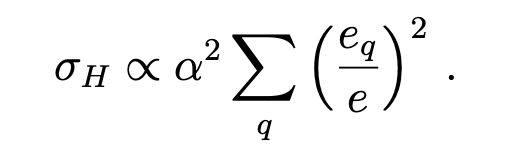
Information
- Description
- Highers NPP Flashcards on NPP, created by Luisina Canto on 09/03/2022.
- Created by
- Luisina Canto
- Views
- 0
- Rating