Flashcards
SCIENCE CELLS,DIFFUSION AND OSMOSIS!
Cards in this deck (56)
- 1What is a eukaryotic cell?Cells which have a membrane, cytoplasm and a nucleus.
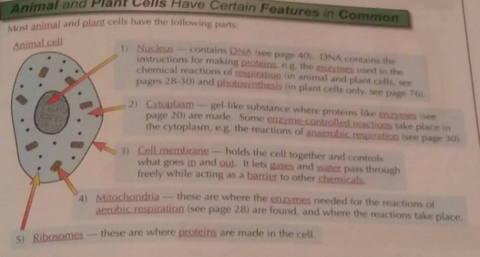
- 2What do most animal cells have?A nucleus, cytoplasm, membrane, mitochondria and ribosomes.
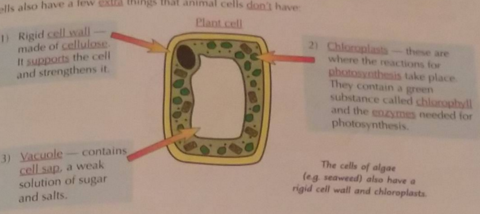
- 3what do plant and algal cell walls also usually have?Chloroplasts and a permanent Vacuole.
- 4What are organelles?They are small organs within the cell.
- 5What is the job of the Nucleus?Where DNA is stored in the cell as well as cell control.
- 6What is Mitochondria?Where cellular respiration occurs.
- 7What is cellular respiration?Cellular respiration refers to the breakdown of glucose to make energy carrying molecules called ATP and then releases waste products.
- 8what does the Chloroplast do?converts sunlight energy into chemical energy stored
in sugar molecules. - 9What type of cell is the bacteria cell?Prokaryotic Cell
- 10Prokaryotic cells are more what than eukaryotic cells.prokarytic cells are Smaller
- 11what does the bacterial cell have?A cell wall, membrane and cytoplasm.
- 12what do bacterial cells lack since they are prokaryotic?A nucleus
- 13what is the bacteria cells genetic material and what is it called?A single loop of DNA or 3 small rings of DNA called plasmids which are located in the cytoplasm
- 14what is the cytoplasm?A gel-like substance where proteins like enzymes are made.
- 15What does the DNA hold?DNA contains the instructions for making proteins like enzymes in the chemical reaction of respiration.
- 16What are chloroplasts used for?They are used for the process of photosynthesis.
- 17what is photosynthesis?photosynthesis A chemical process used by plants to make glucose and oxygen from carbon dioxide and water, using light energy.
- 18Give 2 ways a sperm cell is adapted to do it's job?It has a long tail which disconnects once inside the egg and a streamline head.
- 19What is the job of a sperm cell?To get the male DNA to the Female DNA
to start the creation of the embryo. - 20What is fertilisation?The process of the sperm and egg cell mixing together.
- 21What is the job of red blood cells?To carry oxygen around the body.
- 22How to red blood cells travel around the body?Through Capillaries
- 23Give 2 ways in which red blood cells are adapted to do their job?Their concave shape gives them a big surface area to help them absorb oxygen. Their big surface area also helps them ass smoothly through capillaries.
- 24What do red blood cells have in them?Haemoglobin
- 25What is Haemoglobin?The pigment that absorbs oxygen
- 26What is a prokaryotic cell?A cell that does not contain a nucleus or any other membrane bound organelle?
- 27What is a membrane bound organelle?Eukaryotic cells contain many membrane-bound organelles. An organelle is an organized and specialized structure within a living cell. The organelles include the nucleus, ribosomes, endoplasmic reticulum, Golgi apparatus, vacuoles, lysosomes, mitochondria, and, in plants, chloroplasts.
- 28Whats is the job of ribosomes?The job of the ribosome is to make new proteins.
- 29what is the cell membrane?controls what goes in and out of the cells.
- 30what is the cytoplasm?Jelly-like substance, where chemical reactions happen. In plant cells there's a thin lining, whereas in animal cells most of the cell is cytoplasm.
- 31What is the chloroplast?Where photosynthesis happens – chloroplasts contain a green substance called chlorophyll.
- 32what is the vacuole?Contains a liquid called cell sap, which keeps the cell firm.
- 33What is the cell wall?Made of a tough substance called cellulose, which supports the cell.
- 34What do nerve cells do?They carry impulses around the body.
- 35How is the nerve cell adapted so it can do it's job better?1. Long
Connections at each end. - 36What is the job of the root hair cell?To absorb water and mineral for the plant.
- 37What does the leaf cell do?It absorbs sunlight for photosynthesis to occur.
- 38How do you use a light microscope?Turn the revolving turret so that the lowest power objective lens is clicked into position. Place the microscope slide under the stage
clips. Look at the objective lens and the stage from the side and turn the focus knob so the stage moves upward until clear. - 39What is better about an electron microscope and what can it be used for?An electron microscope has a much higher magnification and resolution than a light microscope, so it can be used to study cells in much finer detail and show organelles.
- 40How do you calculate the real size of something?real size = image size
-----------------------
magnification - 41What is diffusion?The spreading of particles from a higher concentration to a lower concentration.
- 42What substances can move into and out of cells across membranes by diffusion?Things like simple sugars, water or ions.
- 43What substances can't move into and out of cells across membranes by diffusion?Big molecules like starch and proteins.
- 44What factors affect diffusion?The rate of diffusion is increased when:
The distance is decreased.
The surface area is increased.
The concentration difference (concentration gradient) is increased. - 45What passes through cell membranes by diffusion?Oxygen, carbon dioxide and urea.
- 46Single celled organisms have a bigger surface to area volume ratio than multicellular organisms, Why is this?To transfer sufficient substances across their surface.
- 47What are multicellular organisms?Organisms that consist of at least 2 or more cells.
- 48What is an organism?An individual animal, plant, or single-celled life form.
- 49Multicellular organisms require specialised organ systems. Why is this?To exchange sufficient substances.
- 50What is osmosis.It is the movement of water particles from a dilute solution to a more concentrated solution through a partially permeable membrane.
- 51can water move across cell membranes?Yes
- 52What does semipermeable mean?Allowing certain substances to pass through it but not others.
- 53What is the practical using salt and potatoes?1. cut 4 equal cubes of potato
2. Measure their surface area and record it
3. Take 4 beakers fill each one with 200ml of water starting at 20° and increase each beakers degree by another 20° each time.
4. then add 2 spatulas of salt to each pot and stir the, until all the salt has dissolves in all beakers.
5. Next place the potatoes in for five minutes exactly at the same time.
6. After 5 minutes pull the cubes of potato out of the water dab them with a paper towel to dry them and now for the last time measure their surface area and record your results. - 54What is active transport?The movement of ions or molecules across a cell membrane into a region of higher concentration, assisted by enzymes and requiring energy.
- 55What is a ciliated cell?Cilia are tiny hair like structures on the surface of the cell. The hairs sweep hair, mucus, trapped dust and bacteria up to the back of the throat where it can be swallowed.
- 56—