
Flashcards
Fuel Cell
Cards in this deck (5)
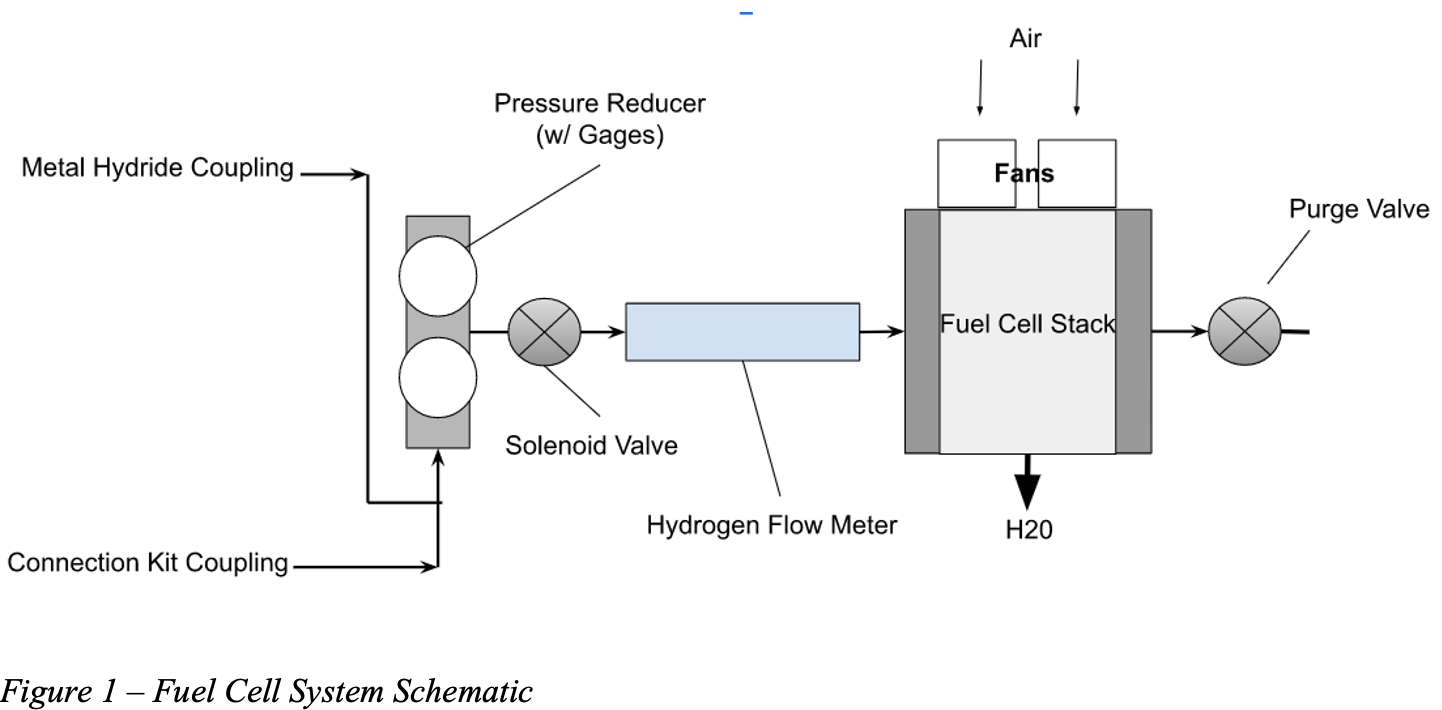
- 1Describe the operation principles of a PEM fuel cell operating on hydrogen. How do fuel cells convert fuel chemical energy to electricity?Hydrogen is pumped into the fuel cell stack by the pressure reducer. The hydrogen is combined with air that is taken into the system via fans to create both water and energy as a byproduct. The fuel cell is a proton exchange membrane fuel cell that uses the chemical reaction between hydrogen and oxygen to create electrical energy. Any excess byproducts are discarded via the purge valve. The chemical reaction that takes place can be seen below:
H2 + 1/2 O2 → H2O + energy
The positively charged hydrogen is exchanged between the electrodes of the fuel cell stack. The electrons then flow through the circuit and provide power to the load.
A fuel cell is able to utilize chemical reactions to covert hydrogen and oxygen into electricity. The hydrogen is fed to the anode, while the oxygen is fed to the cathode in the fuel cell. The hydrogen molecules are then separated into protons and electrons, in which the electrons are directed elsewhere to create an electric flow. - 2What is the ideal reversible voltage of an electrochemical device? How do we calculate it and what does it mean?Subtracting the negative oxidation from the more positive reduction potential
1.229V
Used to minimize losses through irreversibilities
Creates theoretical maximum cell potential
Additionally, the fuel cell stack operates with excess air at λ =10. This “excess air” represents the relationship between the actual volumetric air flow and the estimated air flow. This means that the fuel cell is operating with 10 times the required amount of air in order to complete the chemical reaction as found in calculations. The excess air is important as the oxygen in the air intake is affected by the chemical reaction, meaning the oxygen in the air will always be sufficient for the fuel cell stack.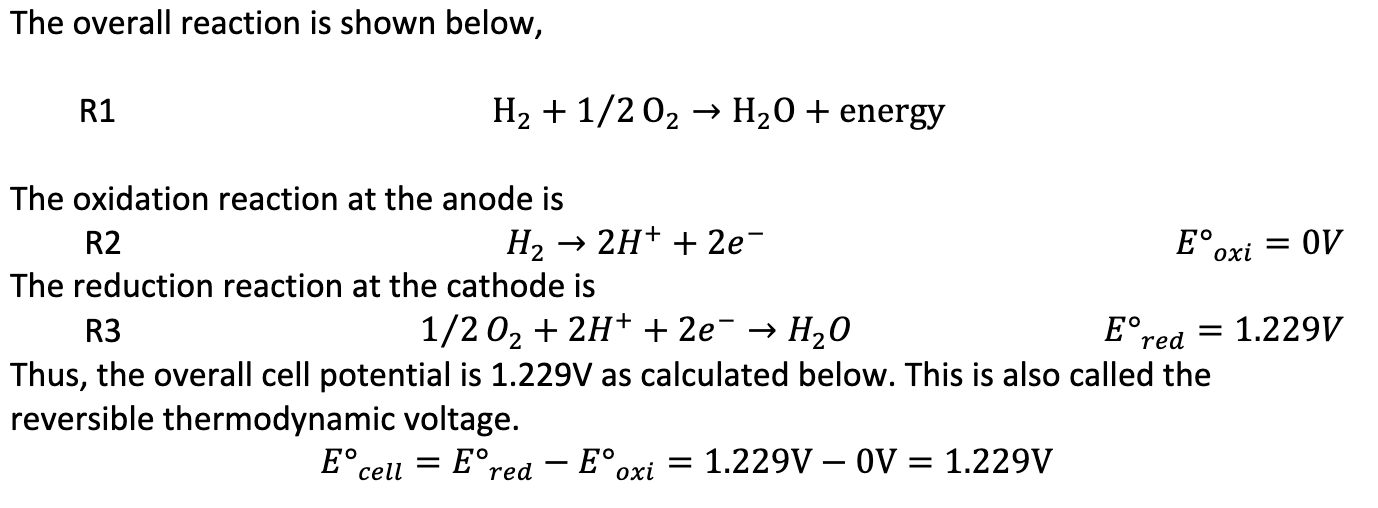
- 3Draw the characteristic curve of a fuel cell. Describe the losses that lead to the shape of the curve. How does the curve change as a function of parameters like fuel cell operating pressure?The stack voltage is seen to decrease as the current increases. Additionally, the curve begins to become more linear as the current approaches 10 A. When the current is extremely low, the voltage initially falls exponentially. This is due to the reaction within the fuel cell causing voltage to drop with rising current. In condition 1, the low temperature of the system causes the stack voltage to be lower at low currents. This is because the chemical reaction taking place in the fuel cell stacks are accelerated by higher temperatures, meaning the first condition with low temperature will reduce the number of electrons available, leading to a lower stack voltage at the same current.
In condition 3, the fan speed was set to just 6 percent, which greatly limits the oxygen intake of the system. Since the fuel cell needs both hydrogen and oxygen, and if either is not sufficiently supplied, the stack power will fall. Due to the load current being kept constant, the voltage also falls as the fuel cell temperature rises.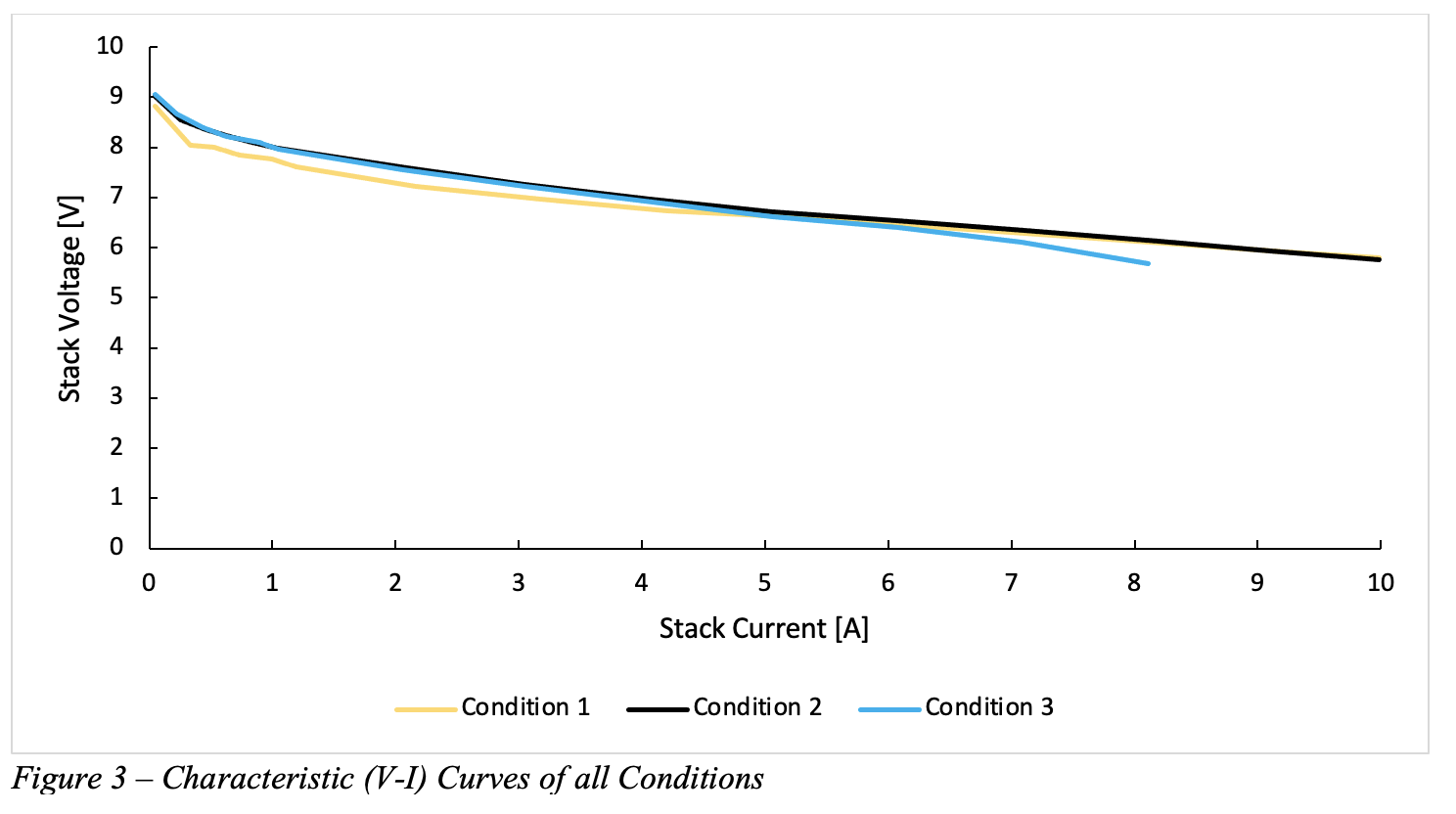
- 4What are the different ways to characterize the efficiency of a fuel cell. How does ideal fuel cell efficiency compare to ideal heat engines as a function of temperature?Voltage Eff v. Stack Current
- Drops with increased stack
- Gives losses in chemical reaction process
Current Eff v. Stack Current
- Approaches value of 1, nearly 100% eff
- Gives how efficiently fuel is utilized
Stack Eff v. Stack Current
- Quick increase, then decrease
- Combo of first two, starts with current, then voltage
- Gives peak stack efficiency at roughly 63%
System Eff, Overall
[VIEW LAB REPORT]
The stack efficiency begins at its maximum efficiency, causing the plot to appear as a constant drop in efficiency. This means that the optimal point of operation occurs at the lowest power output. The stack efficiency represents the ratio of delivered power from the stack to the power that is absorbed. Meanwhile, the system efficiency is the opposite, representing the power from the system that is delivered to the stack. It is for this reason that the optimal point of operation occurs at the highest power output in the case of system efficiency. - 5What are the physical limitations of PEM fuel cells for use in power generation and transportation? What are the promising characteristics compared to other choices for energy conversion from chemical to electrical?Useful in characterizing loads for vehicle usage (flow rate, power, time)
More efficient to stay at a constant load than the stop and start
Overall fuel cells provide many advantages such as relatively high efficiency, low noise output, low emissions, small size, and low degradation of parts, as the chemical reaction does not pose a threat to the physical construction of the fuel cell stack. The efficiency of the system was able to peak at just over 66 percent, with a fuel cell stack efficiency peak of just over 60 percent. However, the parts for a fuel cell are not cheap and hydrogen itself is not a widely manufactured commodity.
Information
- Description
- Flashcards on Fuel Cell , created by G Hon on 12/12/2022.
- Created by
- G Hon
- Views
- 3
- Rating