
Flashcards
Exam 2
Cards in this deck (44)
- 1Chromosomebundled up DNA and some other proteins
- 2Genediscrete sequences of DNA that code for specific traits
- 3Homologous Chromosomespairs/copies of chromosomes that code for the same genes and are the same length.(*one of each homologous chromosomes is inherited from the mother and the father)
- 4Diploid cellA cell containing two sets of identical (nearly!!) chromosomes (said to be “2n”)
- 5Haploid cellA cell containing a single set of chromosomes (said to be “1n”)
- 6Mitosisthe division of a single cell ( or nucleus) that is diploid, into two identical daughter cells. asexual cell division
- 7Taxoltoxin that inhibits cell division
- 8Mutation and typesA change in the nucleotide sequence of an organism’s DNA.
Two types:
1. Deleterious
2. Beneficial - 9Deleterious MutationsA mutation that decreases the ability of an organism to survive and/or
reproduce. - 10Beneficial MutationsA mutation that increases the ability of an organism to survive and/or
reproduce. - 11MeiosisCreation of 4 genetically unique gametes through sexual cell division. ( gamete cells are all haploid, "1n")
- 12Gametesa cell that fuses with another cell during fertilization in organisms that reproduce
sexually. There are two types of gametes, those produced by males (sperm) and those produced
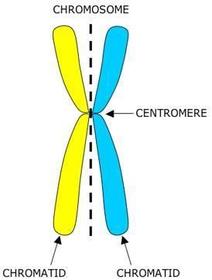
by females (eggs). - 13ChromatidOne of two identical chromosome strands into which a chromosome splits longitudinally preparatory for cell division
- 14Sister chromatidsThe two identical halves of a single replicated eukaryotic chromosome.
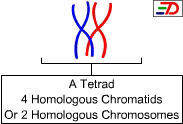
- 15TetradA 4-part structure that forms during prophase 1 of meiosis. Consists of 2 homologous chromosomes, each composed of 2 identical chromatids
- 16"1n"Haploid cell
- 17"2n"Diploid cell
- 18DNAis a polynucleotide: a long chain of many individual nucleotides.
- 19Sexual reproductionThe creation of genetically unique offspring by the fusion of two haploid
sex cells (gametes), forming a diploid zygote. - 20Hybrid(taxonomic) any offspring resulting from breeding of two different species.
- 21Monohybrid crosscross of individuals with different alleles for a single gene
- 22Dihybrid crosscross of individuals with different alleles for two genes.
- 23AlleleDifferent versions (nucleotide sequences) of a gene that code for specific traits
(e.g., gene for flower color may have alleles for red or white, or other colors). - 24Dominant Alleleexpressed as phenotype in either homozygous dominant or
heterozygous condition - 25Recessive Alleleexpressed as phenotype ONLY in homozygous recessive condition
- 26Centromere– the constriction at the center of chromosomes / chromatids where the mitotic
spindle attaches. - 27Mitotic spindleA network of microtubules and associated proteins that move chromosomes
during mitosis and meiosis - 28GenomeThe entirety of an organism’s hereditary information
- 29HeredityThe transmission of genetic features (characters) from one generation to the next.
- 30CharacterA heritable feature that varies among individuals (e.g., flower color).
- 31TraitA specific variant of a character (e.g., red or white flowers).
- 32Sexual breedingHuman mediated sexual reproduction of two members of a species, the
object of which is to maintain or enhance certain traits (phenotypes) - 33Speciesa group of organisms capable of interbreeding and producing fertile offspring
- 34PhenotypeThe expressed (i.e., “visible”) traits of an organism
- 35GenotypeThe genetic makeup of an organism
- 36Homozyogoushaving two identical alleles for a particular trait
(e.g., flower color: maternal allele = red; paternal allele = white) - 37Heterozyogous– having two different alleles for a particular trait
(e.g., gene for flower color: maternal allele = red; paternal allele = red) - 38ZygoteThe diploid fertilized egg, which results from the union of a sperm and
an egg cell nucleus - 39EmbryoA multicellular diploid eukaryote in early stages of development, from
first cell division of the zygote to birth/hatching/germination. - 40True breedingproduces offspring identical to the parent when self-pollinated – they are
homozygous - 41F1 generationThe F1 generation is the generation resulting immediately from a cross of the first set of parents
- 42F2 generationThe F2 generation is the result of a cross between two F1 individuals
- 43the "classic five" plant hormones1. Gibberellic acid
2.Cytokinins
3. Ethylene
4. Abscissic acid
5. Auxins - 44—
Information
- Description
- DNA and cell division Hormones Mendelian genetics Primary tissues leaves and stems Xylem and phloem functions roots secondary tissues - wood and bark secondary metabolites
- Created by
- amwhorton
- Views
- 3
- Rating