
39009717
Description

Flashcards by Erin Duxbury, updated more than 1 year ago

|
Created by Erin Duxbury
over 2 years ago
|
|
| Question | Answer |
| first atoms to form and when in the universe | Hydrogen and Helium, 300,000 after the big bang |
| stellar nucleo synthesis | fusion in stars formed increasingly heavy elements, up to Fe |
| why are supernovae important to the creation of solar system | formed elements heavier than Fe -these heavier elements along with hydrogen and helium created our solar system |
| what are the most common elements in nebulae | hydrogen and helium |
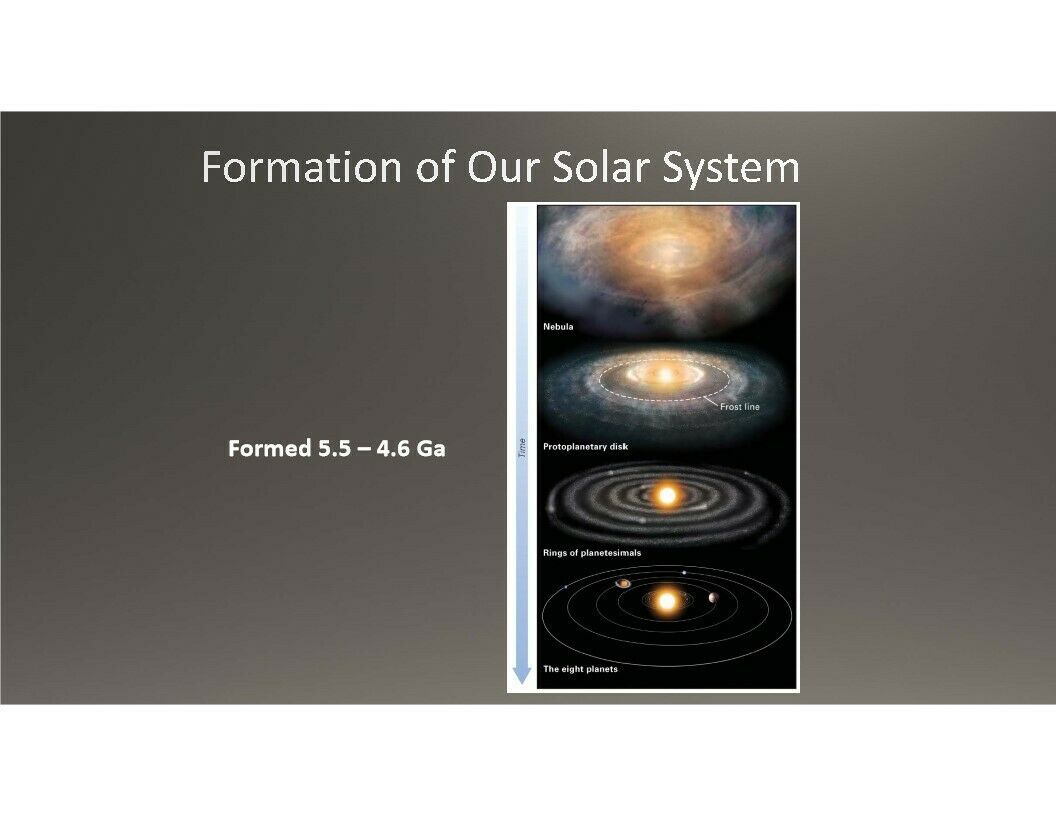
| when did our solar system form and the steps | 5.5-4.6 Ga after the big bang |
| nebular theory | dust and dense elements orbited the the sun, with lighter elements (volatile) on the outside. This dust formed the terrestrial planets. Gases formed the outer planets. Rapid rotation created a flat disk |
| planetisimal | a minute planet; a body that could or did come together with many others under gravitation to form a planet |
| Jovian planets | Gas and ice giants formed from the remains of the nebula |
| solar wind | the continuous flow of charged particles from the sun which permeates the solar system. |
| closest massive star forming factory | Orion. 1,500 light years away |
| chondrite meteorites | original solar system materials, the building blocks for planet earth. |
| stony (achondrites) | Like earth surface rocks |
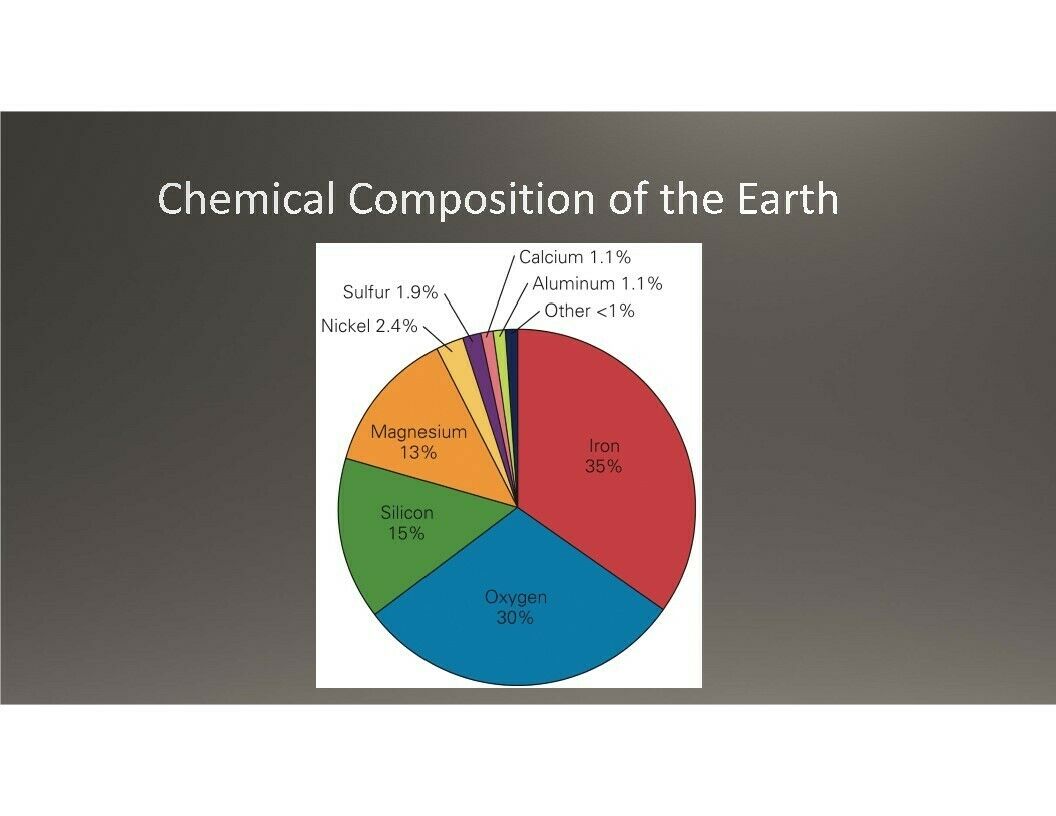
| chemical composition of the earth (top 8 elements) | |
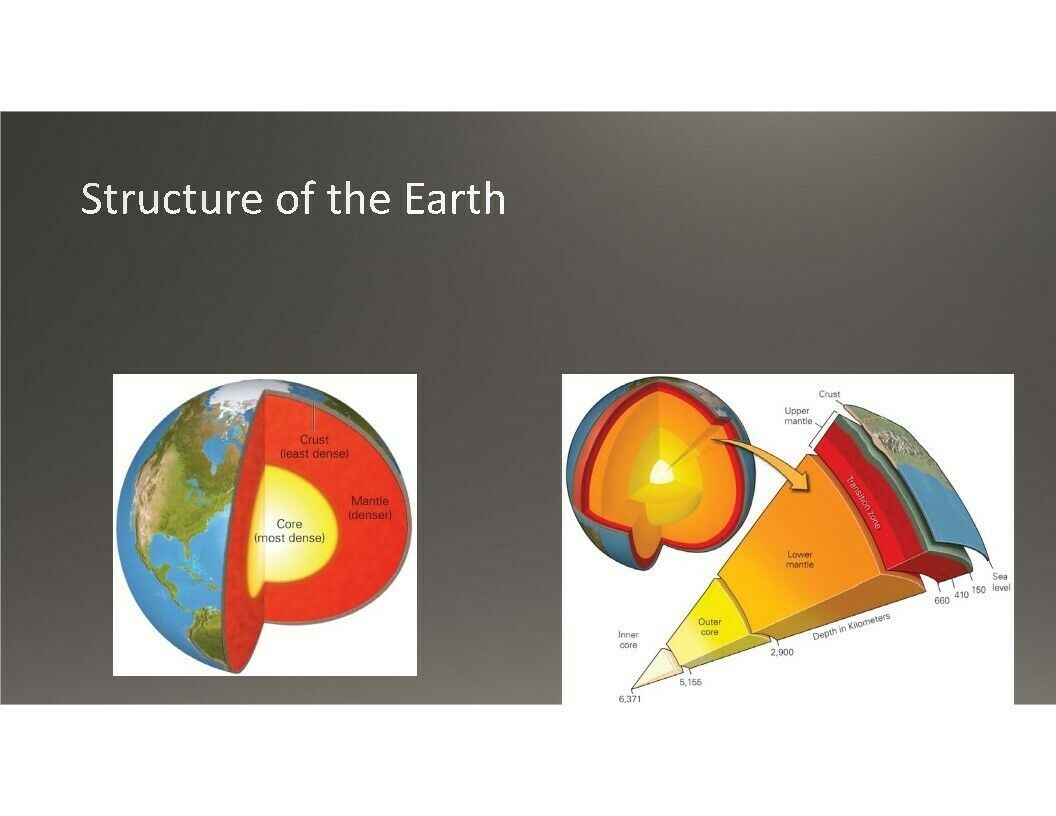
| general layers of the earth | |
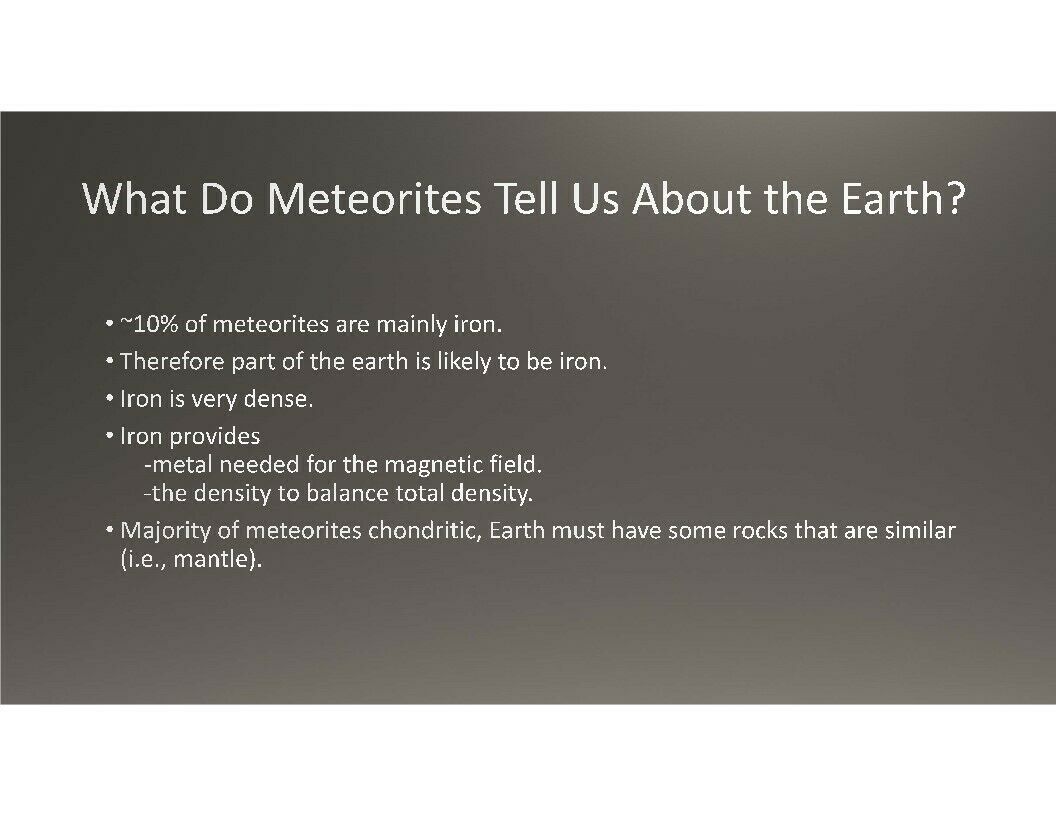
| what do meteorites tell us about earth | |
| numerical dating (geochronology) | using solid facts to date. Started with radiometric dating using isotopes in early 20th century |
| precambrian | accounts for 84% of geological time -before macroscopic life |
| what is an isotope? | -Isotope: different number of neutrons so different atomic mass |
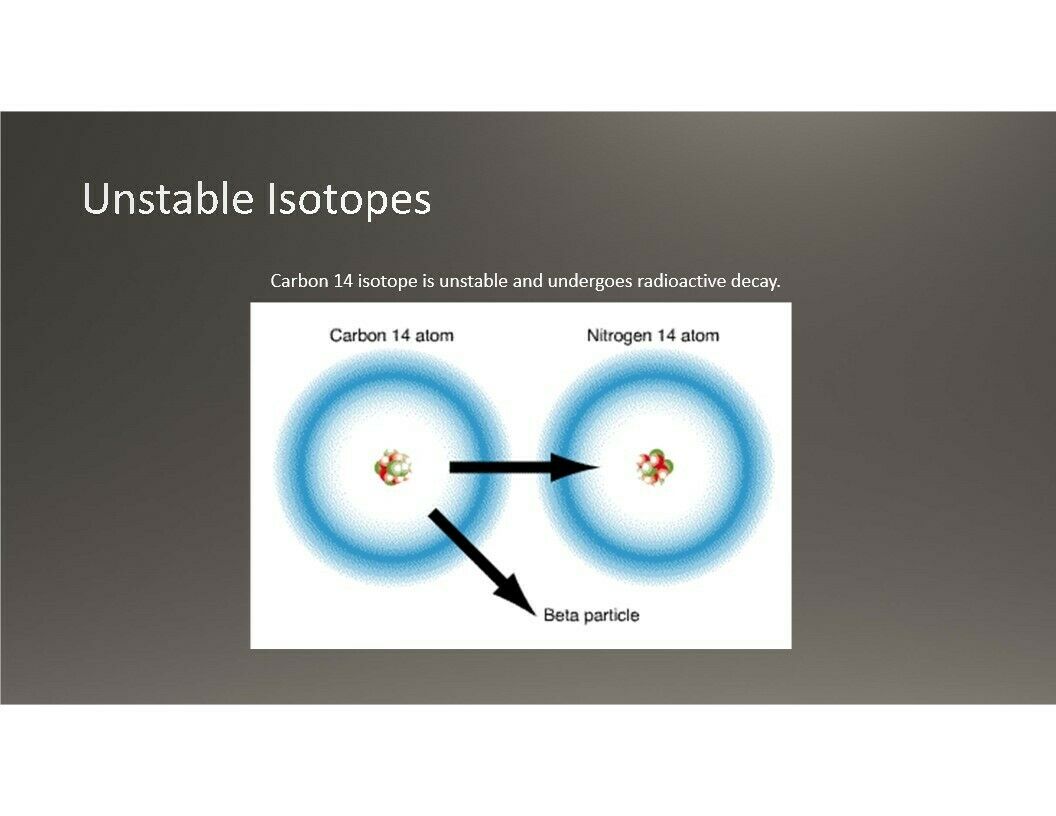
| Carbon isotope decay | Half life: 5730 |
| what is a half life | The time it takes for half of the parent isotope to decay to daughter isotope |
| difference between continental and oceanic crust | -continental and oceanic crust -continental crust is thick, whereas the oceanic crust is thin -composition is different -continental crust is lighter (less dense) rock (light silicates) -oceanic crust is heavier (more dense) rock (heavier silicates) -continental crust is thick around mountains and thin below the ocean. -continental Rocks are felsic: lighter silicate minerals (mainly made of Felds bar) -oceanic rocks are mafic rocks |
| Lecture 3 | Lecture 3 |
| The great oxigenation | -The first couple billion years, there was no oxygen -at 2.4 billion years, we get the great oxygenation -at this point, there was enough oxygen produced by bacteria to see oxygenation of minerals in the ocean (rusting) |
| Unstable isotope | radioactive decay |
| Plate boundries | we have 3 different types of plate boundaries subduction, collision and transform boundaries |
| Atom | An atom is the basic building block of chemistry. It is the smallest unit into which matter can be divided without the release of electrically charged particles. |
| molecule | Two or more atoms bonded together |
| Ionic bonding | Exchange of electrons. 90% of minerals use ionic bonding |
| metallic bonding | covalent: all neibouring atoms share electrons |
| Hydrogen bonds and van der waals | Hydrogen bonds: polarity van der waals: weak attraction between covalently bonded molecules |
| graphite and diamond | diamond formed from immense pressure. Same chemical formula |
| mineral structure: affected by and and controlled by | Controlled by: atomic size, charge and bonds affected by: temp, pressure and composition of environment |
| Minerals are classified by groups that share a common : ??? | anion or anionic group EG. Silicates, carbonates oxides sulfides Halides |
| 3 bigest minerals in the rock world | Quartz, feldspar and mica |
| Strongest bonding anions | Silica to oxygen (silicates) (50% ionic, 50% covalent bonding) |
| most common anion group | oxides |
| Identify minerals through: ??? | luster, hardness and cleavage |
| luster | The way minerals scatter light. categories: non-metalic and metalic |
| hardness | Scratchability, depends on bond strength |
| clevage | tendancy to break along planes of weakness |
| fracture | irregular breakage, not on planes of weakness |
| habit: | crystal form |
| what is a rock | a coherent, naturally occurring solid containing an agreggate of minerals |
| mineralogy | relative proportion of constituent minerals -reflects chemical composition |
| Texture | Size, shape and arrangement of rock's minerals |
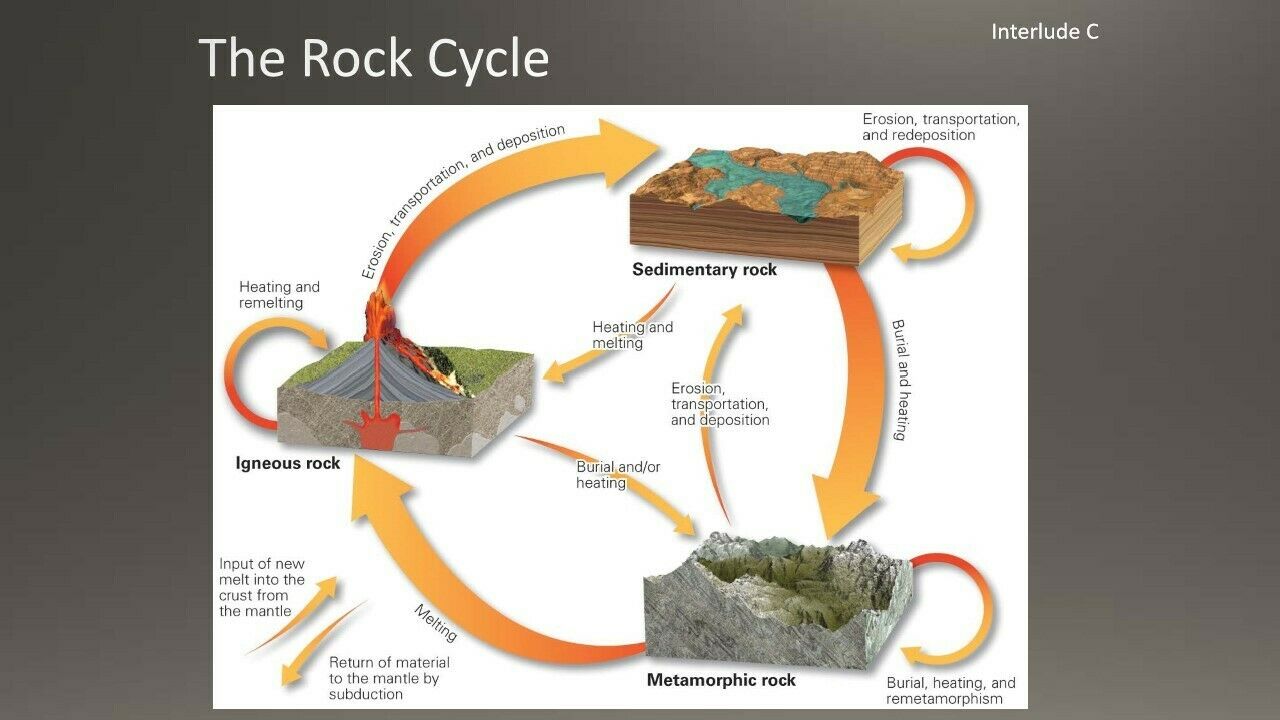
| Rock cycle | |
| Igneous rocks | Formed by crystallizing from a melt |
| igneous texture | Interlocking crystals |
| Intrusive rocks (plutonic) | solidified slowly in the earth, often have big minerals |
| Volcanic (extrusive) rocks | solidified quickly at surface. Often has small minerals |
| Sedimentary rocks | breakdown of other rocks at the earth's surface, grains held together by cement |
| metamorphic rocks | change from one rock to another through high temp and pressure, agragate of mineral grains |
| where magma forms | Subduction (convergent plate boundaries) Divergent plate boundaries (spreading ridges) -hot spots |
| major minerals in igneous rocks | Plagioclase, K-feldspar, quartz, mica, amphibole, pyroxene, olivine |
| Decompression melting | upward movement of the earth's mantle to a lower pressure area higher up. Continental rifts, mid ocean ridges, hot spots. melting happens even when temperature doesn't increase |
| partial melting | produce mafic magma, gabbro or basalt. local geotherm intersects the solidus line (part of decompression melting). Partial melts have higher silica then parent |
| melting by heat transfer | Hot magma rising melts the crust layer and forms magma with different composition. cool magma produces smoke, hot magma does not |
| addition of volititles through subduction | in the earth, the volitiles rise, carrying magma with it to create volcanoes. Causes dehydration reactions for rocks in it's path |
| Mountain building crust melt | Thickening continental crust during orogenesis increases geothermal gradient |
| fractional crystalization | Fe, Mg and Ca crystalize first and leftover rock is higher in silica |
| Assimilation of fluid at subduction zones causes: ??? | change in magma composition, |
| Dikes and sills | planar intrusions (intrusive) that cut across or intrude parallel layers. Can spread or raise the crust |
| a pluton is a: ??? | Crystalized magma chamber |
| Clastic sedimentary rocks | formed by erosion, weathering, transportation, deposition or lithification |
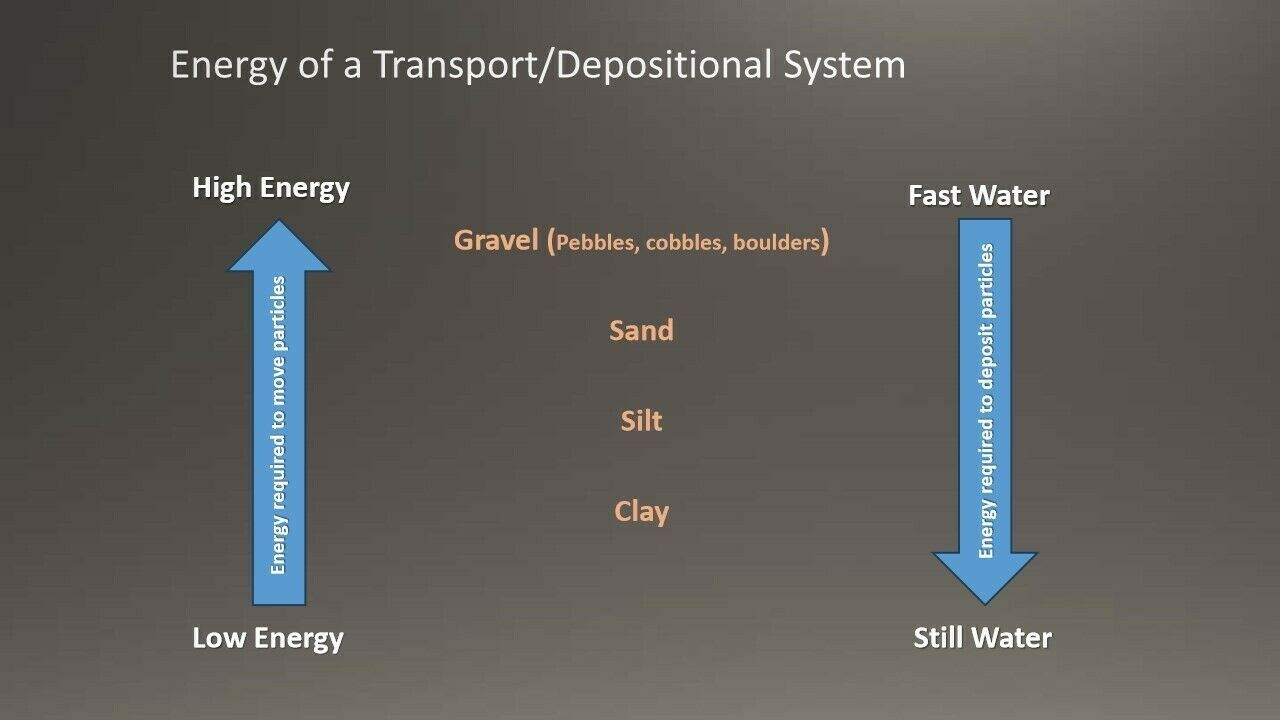
| high energy/low energy in water | |
| Lithification | the process by which clay, sand, and other sediments on the bottom of the ocean or other bodies of water are slowly compacted into rocks from the weight of overlying sediments |
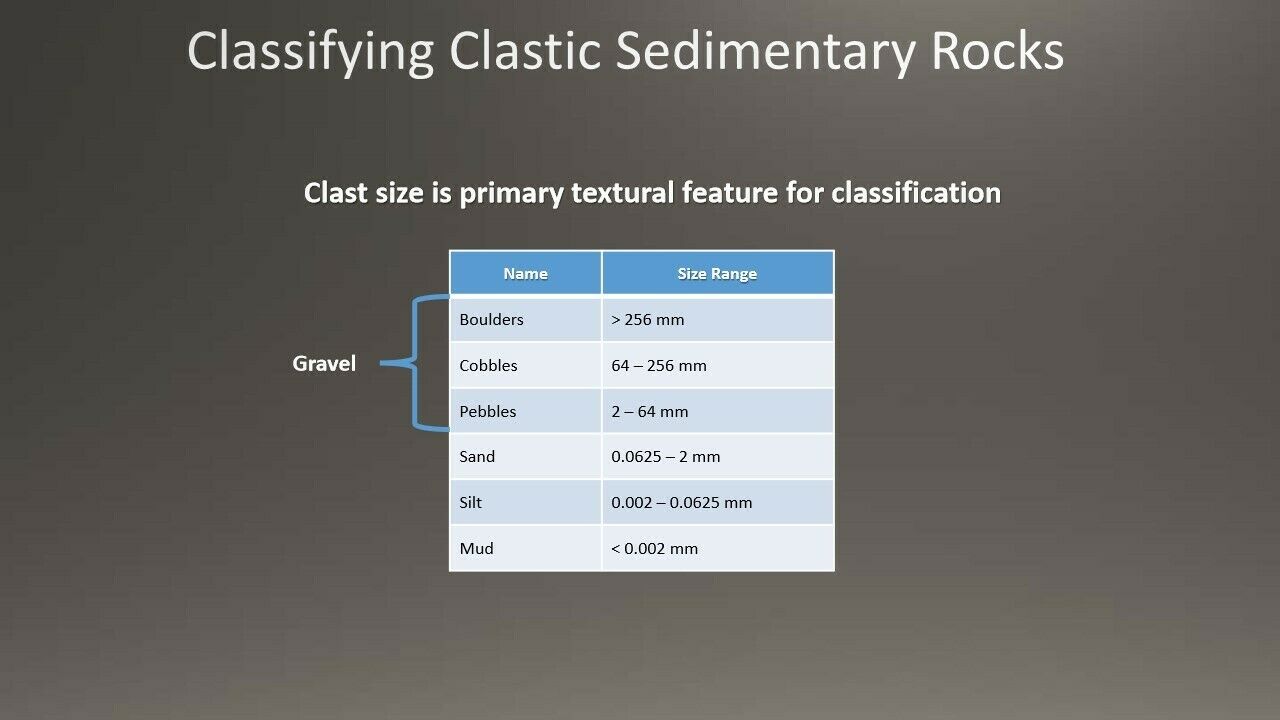
| Classifying sedimentary rocks (textural features) | |
| Gravel: breccia and conglomerate differences | Breccia: consolidated rubble with angular clasts Conglomerate: consolidated gravel, rounded |
| Sandstone features | Mostly made of quartz, compacted sand. Very small grains |
| Silt and mud | silt has larger particles than mud. Siltstone: consolidated silt mudstone: consolidated mud |
| Classifying sandstone | Quartz arenite: 90% quartz lithic arenite: has sand grains in it Feldspathic arenite: Contains lots of feldspar (alumino-silicate minerals) |
| Clastic rock classification | Grain size: closer to source, farther from source Sorting: well to poorly maturity angularity |
| chemical sedimentary rocks | From the precipitation of materials from solution: lime stone (calcite), chert (silicate), dolomite (mg and Ca) |
| evaporites | precipitated from solution and concentrated by evaporation: Gypsum and halite |
| biochemical sedimentary | made of debris from living organisms |
| Allochthonous vs autochthonous | Allochthonous objects have been displaced from their original site of origin, in contrast to autochthonous (auto,' self') objects that remain indigenous or in situ. |
| organic sediment | derived from organic material |
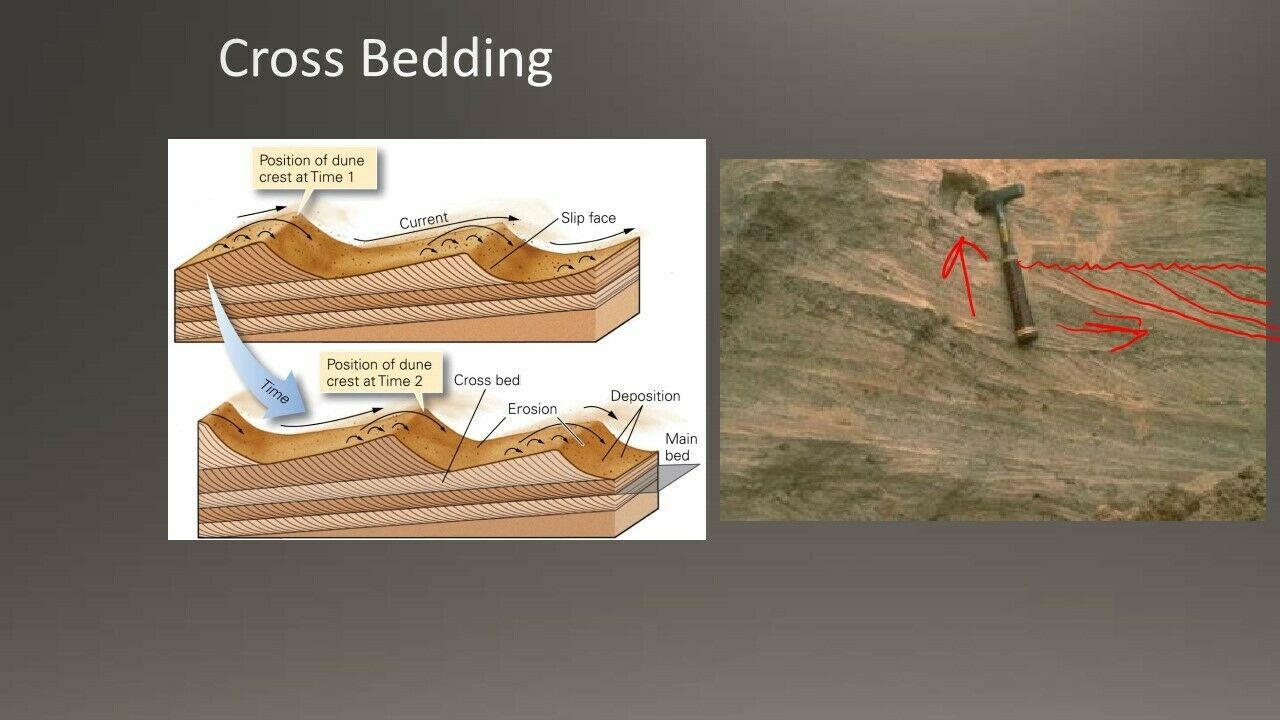
| bedding an lamination | layers -Small layers = lamination |
| Ripple marks | Asymmetric and symmetric ripples |
| cross bedding | formed from water |
| graded bedding | caused by falling or slumping sediment that arranges itself from heaviest to lightest (course to fine grained) |
| Stratigraphic formation | layered formation, can use relative age dating on |
| examples of chemical weathering | acid rain, oxidation, hydrolysis |
| where do rocks break and from what | bedding planes, fractures and joints. happens due to freezing or heating (contraction) |
| joints | fractures perpendicular to plane of weakness. Form to acomodate change in shape. Often formed by stress |
| Talus? | naturally occurring slope from fallen rocks |
| physical weathering examples | burrowing creatures, tree root wedging, rivers, lakes, glaciers |
| physical weathering def | breakdown of rock by physical process. does not alter chemical composition |
| chemical weathering - dissolution | forms pitted surface of rock since ions are dissolved from the rock into the water |
| minerals prone to dissolution | calcite, dolomite (carbonate minerals) |
| describe chemical weathering of granite | Granite has biotite, quartz and feldspar. rock breaks. K-spar turns to clay, biotite turns to clay. clay gets washed away, leaving quartz. |
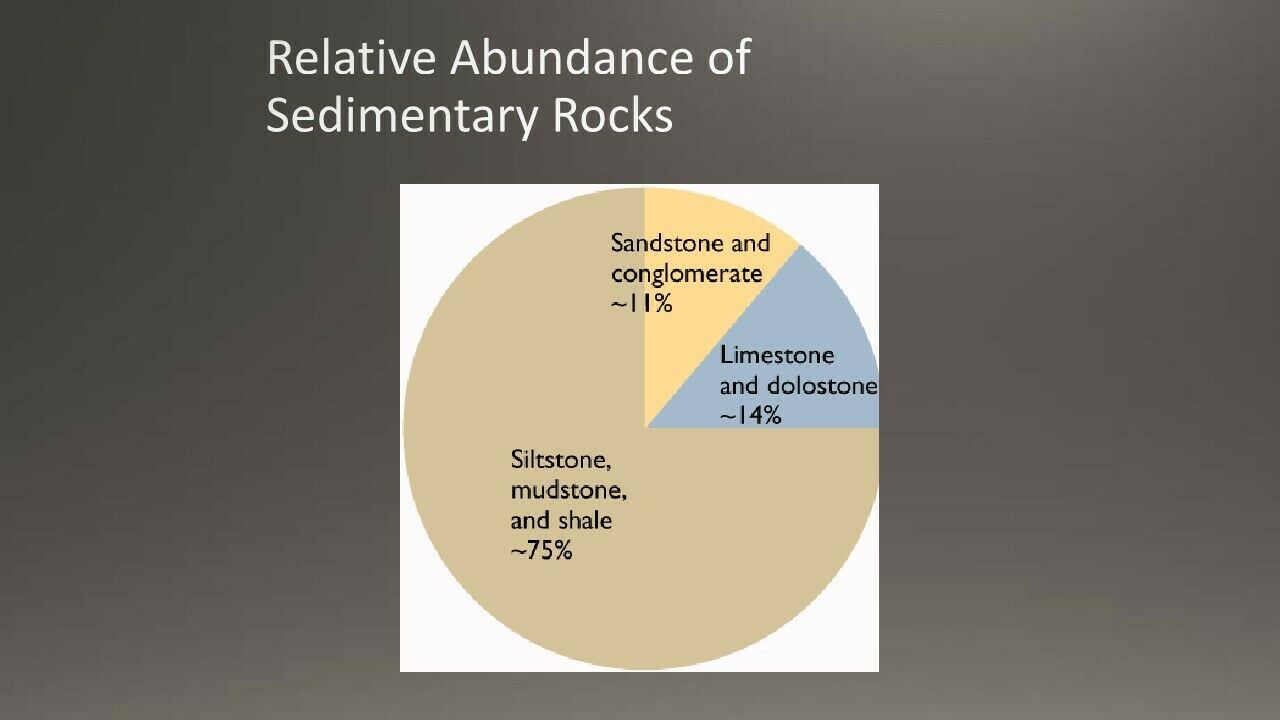
| relative abundance of sedimentary rocks | |
| Hydrolysis | water added, breaks feldspar to clay and ions |
| iron Oxidation (hematite) | addition of oxygen and water to pyroxene releases silica and iron oxide |
| effects of chemical weathering | leaches minerals and silica, creates water bearing minerals, ground water becomes less acidic |
| why are sedimentary rocks useful? | grain size, rounding, sorting and composition tells us about transport distance and medium. Also depositional environment |
| uniformatarianism | present is the key to the past!! |
| examples of depositional environments | alluvial fan, rivers, streams, river delta |
| metamorphism is a result of:??? | Temperature (heat flow), pressure (differential or confining), composition (fluid reacts with minerals and carries them in or out; metasomatism) |
| texture of a metamorphic rock | interlocking crystals accompanied by other crystalline rocks. foliation only happens in metamorphic rocks. |
| re-crystallization | protolith changes grain size. All in solid state (no melting |
| pressure dissolution | the grains (crystals) partly dissolve eg. circular to elliptical grains |
| plastic deformation | is re-crystallization with deferential stress. Internally change the shape of grains (flow and deform) |
| neocrystallization | growth of new minerals. Often occurs when you jam a sedimentary rock down deep |
| what kind of minerals does neocrystallization create? | Index minerals: chlorite, epidote, muscovite, biotite, hornblend, staurolite, garnet, pyroxene |
| what is one place where we see pressure and temperature work together to metamorphose? | Mountain building events |
| which type of pressure do you see when you go deep in the earth? | lithostatic pressure (vertical compression) |
| normal and shear stress | Normal: perpendicular shear, sideways motion |
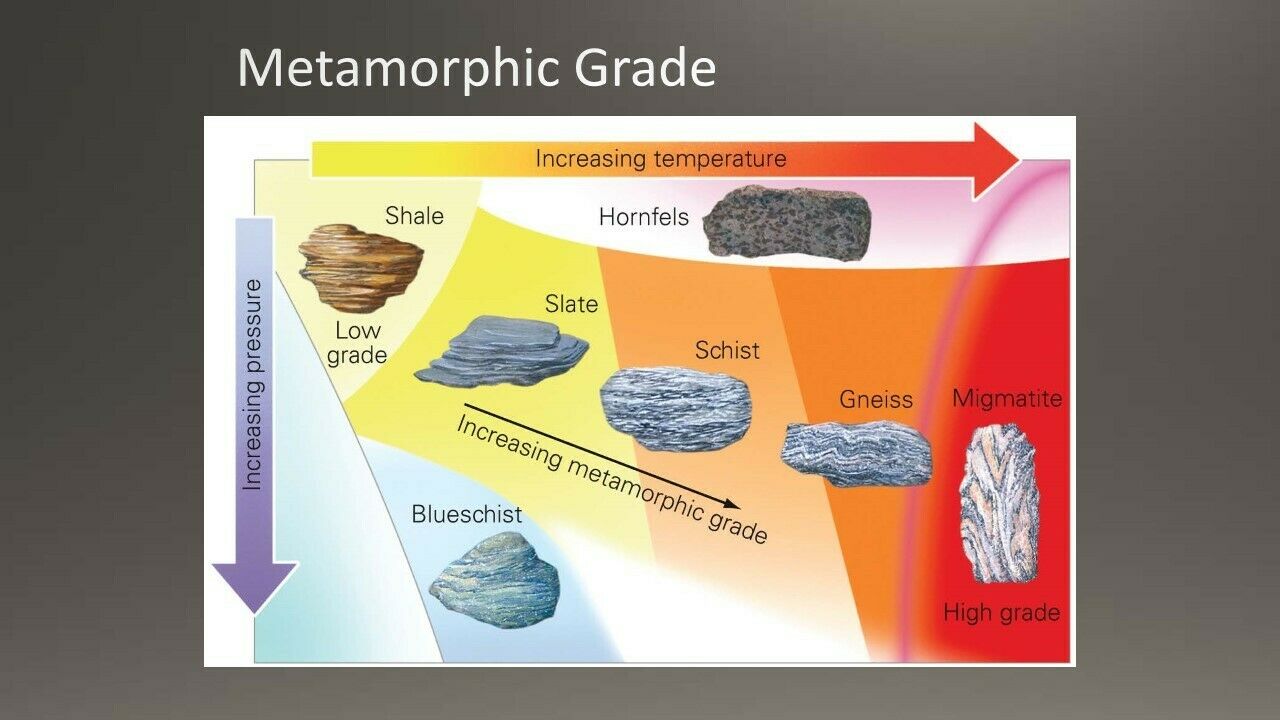
| under what conditions do we get blue schist? | high pressure, low temperature. Often water subduction (ocean lithosphere is shoved down) |
| high or low grade metamorphism location | low grade is generally close to the surface and high grade is deeper down. Increase in temp and pressure = higher grade |
| difference between foliated and non-foliated textures | foliated: planar arrangement of minerals non-foliated: crystalline texture with no alignment of minerals |
| foliation | due to plastic deformation, compression. new minerals can grow parallel to the foliation |
| slaty cleavage | fine grained foliated planes |
| phylitic foliation | bigger grains, start to see new minerals (often micas) |
| schistose foliation | large platy minerals (micas), larger grain size. often see index minerals |
| gneissic foliation | banding is present: alternating layers of different minerals |
| magmatite | Very deformed metamorphic rocks. very high grade. often see pockets of melt |
| metamorphic grade | |
| types of metamorphism | regional, contact, dynamic, hydrothermal |
| example of regional metamorphism | under mountain building area or rifting |
| example of contact metamorphism | Igneous intrusion heats the rocks around it. high grade when close, low grade when far. Often turns rocks to hornfels |
| example of dynamic metamorphism | faulting and to shear stress increase temp and pressure. forms mylonite |
| example of hydrothermal metamorphism | at mid ocean ridge, water seeps down, gets heated then brings basalt rocks to the surface with it. |
| how do metamorphic rocks get to the surface? | exhumation causes mountains, Collapse of mountain belts due to erosion |
| How is oceanic crust created? | from decompression melting. Oceanic crust is gabbro, with the very upper part being basalt. New gabbro pulls the ocean apart. |
| what is ryolite? | half mafic, half felsic. Formed from heat transfer |
| Mafic vs Felsic | Mafic: iron and magnesium rich (heavier minerals) Felsic :silica rich (lighter minerals) |
Want to create your own Flashcards for free with GoConqr? Learn more.