
391898


| Question | Answer |
| What will experience an attractive force when placed in a gravitational field? | Any object with mass |
| What will an increase in mass have on the gravitational force? | The force will also increase |
| What objects have a significant gravitational effect here on earth? | The moon and the sun- They cause our tides |
| What do gravitational field lines show? | The direction of the force that masses would feel in a gravitational field |
| If you put a small mass anywhere in the Earths gravitational field where would it be attracted to? | The earth |
| What type of gravitational field is the earth? | Far away: Radial Close to the earths surface: Uniform |
| If you move a mass further away from the earth what effect will this have on the force it experiences? | It will decrease |
| The force experienced by an object in a gravitational field is always ... | Attractive and a vector quantity |
| What do vector quantities depend on? | The masses involved and the distances between them |
| What does Newtons Law of gravitation calculate? | The force experienced between two masses |
| What type of law is the Newtons law of gravitation? | An inverse law |
| In Newtons law of gravitation, if the distance between the masses increases then the force will ... | decrease |
| In Newtons law of gravitation, if the distance doubles then the force will ... | be one quarter the strength of the original force |
| What is field strength defined as? | The force per unit of mass |
| What does the gravitational field strength depend on? | Where you are in the field |
| What are the units for Gravitational field strength? | Nkg^-1 |
| What type of quantity is 'g' Gravitational field strength? | Vector- always pointing towards the centre of the mass |
| What can we assume 'g' is at the earths surface? | a constant called acceleration due to gravity because the field is uniform |
| What type of field do point masses have? | Radial |
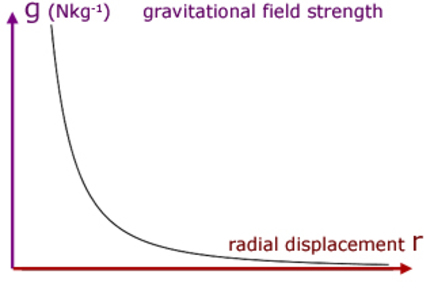
| In a radial field g is ... | inversely proportional to r^2 |
| What does a graph of g against r for the earth look like? |
Image:
g-graph01 (image/jpg)
|
| What does the area under a 'g' against 'r' graph find? | The gravitational potential |
| What is gravitational potential defined as? | Potential energy per unit mass |
| What are the units for gravitational potential ? | Jkg^-1 |
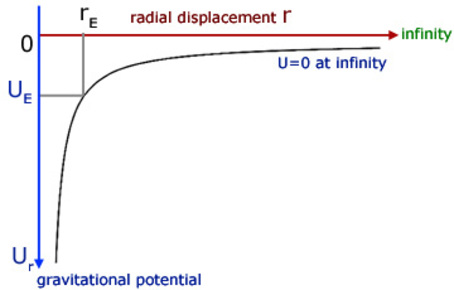
| Is gravitational potential positive or negative on the surface of the mass? | Negative and increases with distance |
| What will the gravitational potential be at an infinite distance from the mass? | Zero |
| How would a graph look for Gravitational potential varying with distance? |
Image:
jpeg (image/jpg)
|
| What does the gradient find of a Gravitational potential against distance graph? | The value of g at that point |
| What is gravitational potential difference? | The energy needed to move a unit of mass |
| How are planets and orbits kept in orbit? | By the gravitational forces |
| What keeps any object that is undergoing circular motion in its path? | A centripetal force |
| What does the force depend on? Give an example of this? | It depends on the object In satellites its the gravitational attraction of the mass there orbiting |
| What must the gravitational and centripetal forces equal? | Each other |
| What is the time taken for a satellite to make one orbit called? | The orbital period |
| The greater the radius of a satellites orbit ... | The slower it will travel and the longer it will take to complete one orbit |
| The energy of an orbiting satellite ... | Is constant |
| What energies does an orbiting satellite have? | Kinetic and potential energy |
| In a circular orbit a satellites speed and distance are ... | constant; so the kinetic energy and potential energy are also constant |
| In an elliptical orbit when will a satellite speed up? | When its height decreases |
| In an elliptical orbit when the kinetic energy increases... | The potential energy decreases |
| What do geosynchronous satellites do? | orbit directly over the equator and are always above the same point on the earth |
| What speed does a geosynchronous satellite travel at? | the same angular speed as the earth below |
| What are geosynchronous satellites useful for and why? | Sending TV and telephone signals- the satellite is stationary, so don't need to move the angle of your receiver |
| How long is a geosynchronous orbit? | Exactly one day |
Want to create your own Flashcards for free with GoConqr? Learn more.