
Flashcards
A2 Digital Technology
Cards in this deck (122)
- 1What is a LAN?Covers a restricted area such as office or building. uses cabling and wireless technology.
- 2What is a WAN?Covers a large geographical area. a country or countries. uses fibre optic, public telephone system, communication satellites, undersea cables.
- 3What is a MAN?Covers a highly populated area. serves a community. uses fibre optic and wireless technology.
- 4Describe the purpose of a network card?Connects a computer to a computer network typically a LAN so that it can exchange data with the network.
- 5Describe the purpose of a server?Manages network resources e.g. peripherals, printers etc. and processes requests from other nodes.
- 6Describe the purpose of a switched hub?It acts as a connection point for a number of network nodes It checks the IP address of a data packet and forwards it to the intended recipient using the optimal route.
- 7Describe the purpose of a repeater?It regenerates a data transmission signal which has been attenuated Used over long distances.
- 8Describe the purpose of a wireless access point?Used to connect a node using wifi/Bluetooth in a hotspot using radio transmitters.
- 9Describe the purpose of a media converter?It allows 2 dissimilar devices to connect. it changes physical signals from 1 media type to another.
- 10Describe the purpose of an IP address?It defines the connection address of a node on the internet Its set by the ISP it's linked to the physical location of the device and it updates the location of the device It uses 4 bytes.
- 11Describe the purpose of a media access control (MAC) address?It identifies the network interface cards address uniquely on a LAN It uses 6 bytes. Each address has a fixed MAC address, set by the manufacturer and embedded on the Network interface card.
- 12Describe the features of a peer-to-peer (P2P)?There is no central hub All nodes have equal status Each node is a consumer and supplier of resources.
- 13Describe the features of a server-based network?A central node controls the network and resources Each node has to request resources from the server Remote software upgrades are possible.
- 14Define the term ‘communications protocol’?A set of rules enabling different devices to communicate coherently.
- 15The need for communication protocols?A communication protocol is a standard set of rules used to ensure that different network devices, possibly using different technologies, can send and receive data properly.
- 16Evaluate the bus network topology?All nodes are connected using a backbone There are terminators at each end of the backbone Data can travel in both directions Less reliable as if backbone fails the whole network fails if a single cable fails then only that device is affected Less secure as all nodes can access the data on the backbone A node sends data to another node by placing it on the backbone.
- 17Evaluate the star network topology?All nodes are connected to a central hub by their own cable. It controls communication and the transfer of data. Most secure as the data is sent to the hub to the node directly. It controls all the security. Only the intended recipient gets the data packet. if a cable fails only that device is affected
- 18Evaluate the ring network topology?All nodes are connected in a loop Each node is connected directly to ring or by spur Data passes from node to node till the intended recipient receives it. Data travels in one direction Less secure as data goes from node to node till intended recipient Less reliable as if one cable fails the whole network is down.
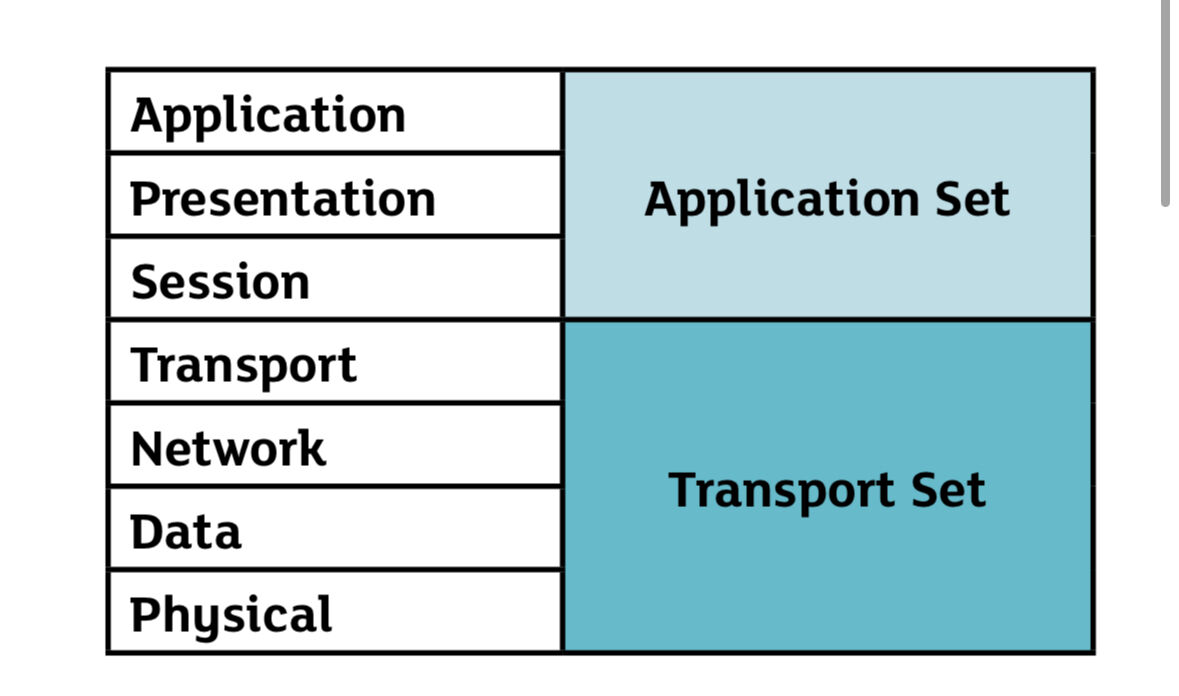
- 19Describe the Open Systems Interconnection (OSI) network organisation model and each of its component layers?Provides a framework for data to be transferred between networked computers. Model works even if different data formats or different types of networks are communicating.
- 20Describe 2 advantages of the OSI model?If a manufacturer's devices comply with the standards they can be connected to other manufacturers' device.
Network users have greater choice in DT devices as compliant devices from different manufacturers will work together. - 21Basic rules in the OSI model
- 22Application Layer?Presents information, data, resources to the end user. Deals with function such as data transfer messaging, distributed databases, operating system functions the end-user interface. interacts with the presentation layer.
- 23Presentation layer?Interacts with the Application/session layers. Converts information to the correct video/audio format. Implements encryption. compresses/decompresses information.
- 24Session layer?Interacts with the presentation layer and the transport layer. Open a temporary 'channel' to allow for communication.
- 25Transport layer?Shares information with the Session layer above it and the Network layer. Divide the information into convenient
sized packet, then be sent on different routes to their destination. Arrive in a different order. Then reassembled at the destination point. Checks for errors. - 26Network layer?Shares information with Transport layer above it and the Data Link layer beneath it. Network layer is the “traffic policeman” which works out the best route for the package for use.Every packet that the Transport layer has created needs to be sent to the correct machine across the network. computer has a unique address add the correct address to each packet. It also reads the addresses of incoming packets to a computer and if they
are destined for that computer then it allows them through. Packets not addressed are blocked. - 27Data Link layer?Deals with functions such as error detection and error correction, creating data blocks and synchronising data blocks. It converts each outgoing packets into a series of bits into data packets. interacts with the network/ physical layer.
- 28Physical layer?Coverts bits and bytes, packets of data, into a physical signal such as pulses of light or electrical voltage. Interacts with the data link layer.
- 29Transmission control protocol/Interent protocol?TCP/IP dictates how information should be packaged and sent and received The TCP layer handles file transfer between different computers and splits data into packets and allocates an address to each packet
The IP layer is responsible for transferring packets of data from node to node using IP addresses
It verifies the correct delivery of data and detects errors - 30Ethernet?Ethernet is a LAN protocol referred to as the IEEE 802.3 protocol
Ethernet also defines standards for physical plugs and sockets Uses CSMA/CD - 31Token passing?Uses a token, a special series of bits, to give a device permission to transmit over the network.Only the device which has the token can put
data into the network. When its transmission is complete, the device passes the token along to the next device in the topology.
Protocols determine how long a device may keep the token, how long it can transmit for and how to generate a new token if no token is currently in circulation. - 32Wi-Fi?WiFi connects a computer to a network via a WAP. WiFi is more secure. Are wireless media and relatively short range
- 33Bluetooth?Both must be Bluetooth enabled
the computer will display the devices within range which are set to visible
The mobile device will be selected
The device may require pairing/a passcode
A piconet is created - 34Voice over internet protocol(VoIP)?VoIP allows telephone calls to be made over computer networks
It converts analogue signals into digital data packets
It supports real-time conversations/two-way transmission
It supports call recording/caller ID/voicemail to email - 35Radio-frequency identification(RFID)?An RFID tag contains data programmed into a small computer chip. The
tag is activated by radio waves emitted from an RFID reader. The tag sends the data stored in its memory back to the reader. The tag can be active or passive. A bar code contains data in a machine-readable code. Numbers and a pattern of parallel lines of varying widths. The data is read by a scanner using red light or a laser.
RFID tags can be read from much further away
Direct line of sight not required
RFID tags can be read in harsh environments
RFID tags are more impervious to damage/dirt
RFID tags can be dynamically updated
The information stored in a barcode is fixed
Bar codes usually require human intervention RFID tags do not
Barcodes must be visible on the outside of the packaging RFID tags can be placed inside the packaging
More data can be stored in an RFID tag than on a barcode
RFID tags have read/write capability
Barcodes are read-only and cannot be reused - 36Bandwidth?Bandwidth is a measure of the capacity of a communication channel It is the range of frequencies available
Bandwidth may be a frequency range e.g. 3 kHz/measured in Hz or a transmission rate, e.g. 64 kbps or line speed e.g. 64k - 37Broadband?Broadband is wide bandwidth data transmission handling multiple signals and traffic types
Refers to high-speed Internet access that is always on
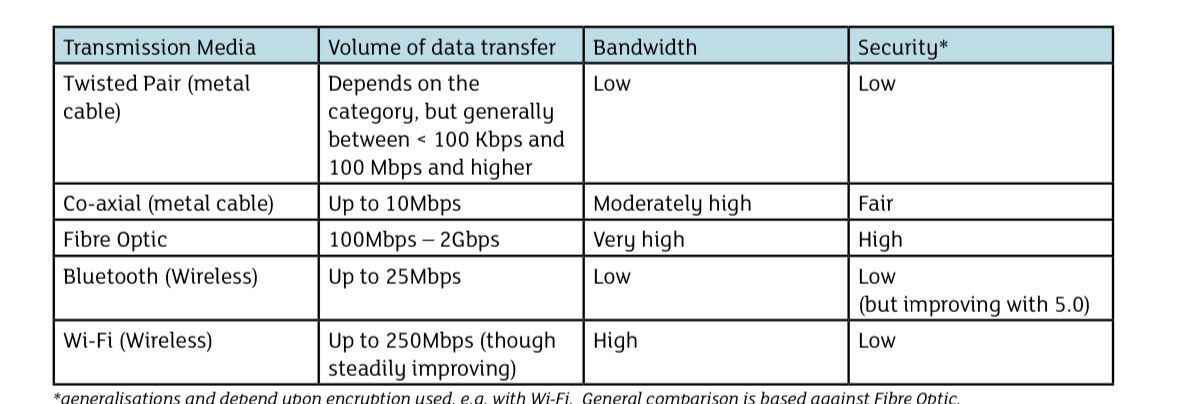
The popular name for Internet connection using DSL/co-axial/fibre Used to describe a bandwidth in excess of 3 kHz/more commonly in excess of 300 MHz - 38Metal cable?Different types of copper cabling is used to transmit electrical signals over relatively short distances. Coaxial cable/twisted pair/unshielded twist pair. Shielding protects from interference. security weak- data can be intercepted via listening devices without affecting transmission.
- 39Fibre optic?Uses very fine glass strands to transmit modulated light beams at very high speed over long distances providing interference-free, secure data transmission. A single cable consists of multiple strands in 2 bundles one for forward pulses, one for return pulses. each strand is unidirectional.
- 40Wireless?Wireless covers a range of possible methods of data transmission using radio waves. Bluetooth for short ranges using low power radio waves to connect devices. Wi-Fi to connect to a LAN. Encryption and the use of passwords can ensure security.
- 41Evaluate these transmission media in terms of volume of data transfer, bandwidth and security?
- 42Describe the main features of a relational database?aAllow data to be stored across a number of tables. Tables are linked or related together, using relationships,
on common fields. A relational database is a much more powerful way of storing data as the relationships allow data to be retrieved from a number of tables using a single query and there is less data redundancy. - 43Describe the difference between a logical data model and a physical data model?LDM - Produced during the design stage It identifies the entities the relationships for each entity the keys for each entity and the attributes for each entity. PDM - Produced during implementation. It creates the table column, the column names, the data type of each field, the keys for each table and the validation rules
- 44Define the term attribute?A data item within an entity.
- 45Define the term Entity?An object of which data is stored.
- 46Define the term Primary key?Uniquely identifies a record in a table/tuple in an entity.
- 47Define the term Composite key?Consists of 2 or more data fields which can be a primary key that uniquely identifies an entity occurrence
- 48Define the term Foreign key?A key field in a table which is not the primary key in this table but which defines a link to another table.
- 49Define the term Relationship?A link of 2 entities established using a foreign key in one entity to a primary key in another E.g. 1 to 1 1 to many many to many
- 50Define the term Referential integrity?Ensures data in one table doesn't contradict data in another table e.g. foreign key must relate to a valid primary key.
- 51Define the term Data duplication?A non key attribute is stored more than once in the database.
- 52Define the term Data inconsistency?An attribute for an entity has more than one value.
- 53Describe the characteristics of first normal form (1NF)?All attributes are atomic and entities do not have repeating groups.
- 54Describe the characteristics of second normal form (2NF)?The data must be in 1 NF aLL repeating groups have been removed and all non-key attributes are dependent on the primary key.
- 55Describe the characteristics of third normal form (3NF)?The data must be in 2nf, There are no partial dependencies, There are no non-key dependancies.
- 56Describe the advantages and disadvantages of normalisation?Databases take up less space due to not having as much data duplication. Databases are more efficient as they are structured more effectively; queries are faster, Fewer data redundancies means fewer inconsistencies Data integrity will be improved Complex process Maybe more tables than un-normalised data Queries may run slower as there are more tables Queries are more complex to create Have to assign more relationships.
- 57What is ER modelling?It uses er diagrams to represent real-world objects and the links between them, it is used in the design stage, it identifies the entities and relationships it's a graphical approach to a database design
- 58Describe the components of a data dictionary?Field name, Field size, Data type, Indexes, Input mask Validation rules, Table name and format
- 59Evaluate Query By Example (QBE) as an alternative to SQL?QBE - A visual way of querying a database, the user inputs data using a wizard to create a query (User Requires minimal technical skill) SQL - A programming language that provides a set of commands to create queries (High-level technical skill required-Experienced programmers can create complex queries efficiency-It provides good facilities for creating complex query.
- 60Describe Parity Bits?A specific bit in a byte is the parity bit/the 8th bit /MSB in a byte is the parity bit.
The sum of the bits in a byte is odd if odd parity is being used/even if even parity is being used.
When a byte is received its parity is checked. If the parity of the byte has changed an error has occurred/at least one bit has flipped - 61Describe Check Sums?An algorithm is applied to a block/packet of data to create a checksum
The checksum is appended to the block/becomes part of the block. When the block is received the checksum is recalculated using the same algorithm
If it differs, an error has occurred. - 62Describe Echo Checking?When data is received a (copy) is transmitted back to the sender/source where it is compared with the original. If it differs the original data is retransmitted.
Echo checking is an automatic process. - 63Describe CRC (Cyclic Redundancy Check)?A checksum is appended to a block of data before transmission and recalculated after transmission. The data block is divided by a fixed number/a hashing algorithm is used. Th remainder is the checksum. if the checksum is incorrect, the source of the error may be detected and corrected automatically or the data may need to be re-transmitted.
- 64Explain what is meant by artificial intelligence (AI)?It's the study of all aspects of intelligence and this is modelled by computer systems. The aim is to create intelligent machines which can react and think like humans by learning and adapting.
- 65explain the significance of the Turing test in defining what is meant by AI?To determine if a machine's behaviour is indistinguishable from human's response.The test involves a player, human and a machine. The player does not know which is the human and which is the machine. The player asks questions of the human and the machine and tres to discover which is the human.
- 66Explain neural network modelling?Model of the human brain. It consists of a collection of nodes linked by 1 way or 2-way connections. Each node calculates the weighted sum of its inputs and provides an output Propagation may be used.
- 67Describe the structure of an expert system?An application of artificial intelligence. In this case, the knowledge of a human expert is made available through a computer package. An expert system is almost always used in a narrow field of knowledge. The field of knowledge is called the knowledge domain of the system.
- 68Describe the purpose of the knowledge base in an expert system?G
- 69Describe the purpose of an inference engine?F
- 70Describe the purpose of the user interface?The user will input information, they will answer questions here and get a solution
- 71Explain the term Shell in relation to expert systems?Software development used to create an expert system. It's a skeleton expert system which for a particular application they will add relevent rules and information it contains the components of an expert system
- 72Explain the term heuristics?Rules of thumb derived from human experience/intuition not purely from logic
Requires judgement/estimation/evaluation - 73Explain the term fuzzy logic?It uses probabilities instead of true/false. It can be used with incomplete data computers can mimic human reasoning Fuzzy logic was created to solve problems by making the best possible decsion given the input
- 74Explain the term knowledge engineer?Acquires the knowledge for an expert system through structured and unstructured interviews concept maps etc. It is then put into a database and the knowledge is verified
- 75Evaluate the use of expert systems in medicine, car engine fault diagnosis and life insurance?Contains the knowledge for a medical/car/life insurance on ect from doctors manufactures ects -refects the knowledge of a number of __experts -ES Accurate and consistent diagnosis/.. -It can provide reasonings for diagnosis -can capture the knowledge of personnel who are moving to different areas etc - can be used as a training aid An efficient way of answering quires HOWEVER - it cannot use intuition -Over-reliance on ES can lead to loss of human expertise - its Not as good as having a human expert instead -Most ES are menu-driven and cant deal with ambiguous problems -Cant learn from feedback unless it's a part of the development -It's expensive in time and money to create a good expert system.
- 76Describe the technology required for natural language?Used for Spam filters-identifies sentences used in spam etc. Part-of-speech tagging is a self-learning algorithm that tags words with multiple meaning Parse trees - It breaks the sentence down into noun and verbs phrases Semantics - If a word has multiple meanings then it will tag the words before and after the words e.g board MEMBER, BREAD board.
- 77Describe the technology required for voice recognition systems?A device with a sound card is needed and microphone/headset-mobiles have this inbuilt. Pattern matching - words are recognised in their entirety-yes/no Pattern and feature analysis - spoken language is digitised using an analogue to digital converter atd and compared to a stored dictionary Statistical analysis - uses grammar to predict words. Artificial neural networks - using examples to identify language.
- 78Evaluate the use of natural language systems?No training is necessary -Makes it more accessible -paired VR can leave hands free to do other tasks HOWEVER -applications can be complex to complete and therefore expensive -Commands will not always be recognised correctly.
- 79Evaluate the use of voice recognition systems?No training required -accurate spelling for people with literacy problems An accessible way of input HOWEVER Users may need to speak slower/louder May need to train it to peoples voices Prone to interference.
- 80Describe the technology involved in the use of robotics?Computer controlled machines the design functionality etc. Controller - Coordinats operation of other parts Arm - Positions the end effectors End effector - Carries out specific function Drive - Moves the parts of the robot into an appropriate position when completing a task Sensors - Feeds back to the controller the environment the end effector is interacting with.
- 81evaluate the use of robotics in a range of commercial situations?Spray painting, surgery, welding, product assembly, aerospace robots -Reliable consistant and accurate -Can work in hazardous conditions -Can preform repetitive tasks withoit making mistakes or getting tired -Can work long hours -Can be precise(make incisions small) -Can be reprogrammed HOWEVER -Cannot use judgement/intuition, humans can -Humans are more flexiable -May take time to reprogram -Humans need to be trsined to use the robots
- 82What is meant by cloud computing?The use of the internet/server farms by large computing companies to provide services normally provided by a LAN
- 83What is virtualisation?A number of virtual servers each running on a physical server platform
Separates the physical infrastructures to create dedicated resources running multiple OS and applications on the same server - 84What is hosted instance?The virtual server for a particular client with its own allocation of processing and storage
- 85What is hosted solution?Any hardware and software made available to a client is reserved for the servicing of that individual client’s needs and no one else. That one client pays for all of the resources made available to them regardless of whether they are used or not.
- 86What is clustering?Groups of dedicated hardware will be hosted at each data centre and used to provide specialised services and processes for clients.
- 87Email?Web based email services allow users to access their email from the cloud using any browser or hardware platform
Emails sent and received via the client's account are stored on the service provider's server rather than being stored on the user's own computer - 88Backup?Clients can store their data on the internet using a storage service provider rather than storing data locally on a physical hard drive or other device. Data can be stored to the cloud on a scheduled basis or cloud syncing can be used to ensure files will automatically be backed up any time changes are made to them
- 89Virtualised software?many applications are now available to users via the web. Users are able to access application hosting and not having to give consideration to the storage space taken up on their own personal devices. Software is accessible without the need to consider installation and updates are immediately made available to the user.
- 90Data storage?Data is saved on an off-site storage system in a remote database provided by a third party and accessed via the Internet instead of on the users’ storage
- 91Remotely hosted applications?Clients can access their business applications as an instance on a virtual desktop which supports multiple concurrent access by the client’s
employees. The relevant software and data are stored on a remote server - 92Benefits of cloud computing?• Providers can react more responsively to changes in user requirements
• Collaboration using a wide range of devices from a wide range of locations can be supported
• Updates can be readily made available to all users
• Increased security and system reliability as the supplier only needs to maintain one system
• All users are accessing one software system
so cross-compatibility issues are no longer a concern.
• Reduced costs as the client does not have
to consider the expense of purchasing and configuring hardware and software to help them meet their business needs.
• Increased flexibility in work arrangements. Most cloud computing services are provided on demand so even vast changes in demand for computing resources can be provided for
• Increased reliability - cloud computing makes data backup, disaster recovery and business continuity easier and less expensive, because data can be mirrored at multiple redundant sites on the cloud provider’s network. - 93Drawbacks of cloud computing?• You trust someone else to look after your data and supporting applications as the service provider takes responsibility for performing all updates, backups, restorations and the management of security.
• Cyber attacks are problematic where large amounts of data are stored by a wide range of users, often on the same cloud system.
• Insider threats can also pose a problem. Employees with access to your cloud data
can often go undetected. By gaining access
to the virtual machine hosting your data they do not only have access to your organisations information but they could potentially destroy the entire cloud environment hosting your data or application.
• Many users remain concerned over loss of confidentiality of data which can legally be accessed by government surveillance programs.
• Legal liability remains an issue for organisations who rely on cloud based services with concerns over who becomes liable after a data breach! - 94What is data mining?The automatic analysis/sorting of large data sets/big data in a data warehouse.
Pattern recognition/algorithms used to identify patterns/correlations and to predict trends/relationships.
Data is combined from multiple sources - 95Data Protection Act?Personal data should be processed fairly and lawfully with the consent of the data subject.
Personal data should be used for the specified purpose only.
Personal data should be adequate and relevant for its intended purpose.
Personal data should be accurate and up to date.
Personal data should not be kept for longer than necessary.
Personal data should be processed in accordance with the rights of the data subject.
Personal data should be held securely, with no unauthorised access.
Personal data should not be transferred outside the EU. - 96Describe the purpose of the knowledge base?The knowledge base holds knowledge about the domain. This can be stored as a series of IF-THEN-ELSE rules.
- 97Factual Knowledge?Factual information acquired by the Knowledge Engineers from the human experts, relating to the subject domain. This type of information would be widely agreed.
- 98Heuristic Knowledge?captures information about accurate judgement and the ability to estimate and evaluate. Such rules are not derived from logic alone but are derived from a person’s experience. They could be described as ‘rules of thumb’. A heuristic system is designed to work with uncertainty and to simulate producing decisions based on experience.
- 99inference engine?Once the knowledge base has been created, a system for consulting it must be put in place.This software interrogates the knowledge base and draws inferences and conclusions based on the rules stored about the subject domain. The inference engines poses questions to the user and uses
the answers provided by the user to determine a suitable response. - 100User interface?allows a user to communicate with the system. Requests for information or advice are passed from the user interface to the inference engine. The request is processed by
the inference engine which applies rules to the knowledge base and then returns a response to the user. - 101Describe how technology supports mobile phone communication: mobile phone masts, cells, hands-off, base station controller, mobile switching centre and public switched telephone network (PSTN) telephone system?Mobile phone uses low intensity microwave signals in order to transmit and receive voice and data information.small radios embedded with mini transmitters. The mobile phone transmits radio signals when switched
on enabling it to broadcast its radio location so that calls can be diverted to it. Mobile phones communicate using a network of cells to transmit data.phone is powered up it listens for an
SID on the control panel. - 102The use of digital technology in data mining? Big Data Gathering
- 103The use of digital technology in data mining? Big Data Storagecan handle very large amounts of data and keep scaling to keep up with the growth of data sets, provide high speed Input/Output operations necessary to support the delivery of data analytics as they are carried out. Big data practitioners such as Google run what are known as hyperscale computing environments. Each unit will generally have PCIe flash storage devices to support data storage and high speed access to data sets.
Smaller organisations can support the storage of big data through the use of clustered Network Attached Storage devices. This is file access shared storage which can easily be scaled out
to meet the increased capacity or computing requirements required for big data analysis. As NAS systems scale outwards they can be difficult to manage as they tend to span out in a hierarchical manner. Object-based storage systems offer an alternative to NAS devices and the problems it can lead to. Each file stored in a obs system will be given its own unique identifier and index to support high speed access to a particular data file or data set. - 104The use of digital technology in data mining? Big Data Processing and Analysis• Cluster analysis – where groups of data records are identified;
• Classification – where the data mining process is used to determine an appropriate structure to new data, in the way for example an email application may classify some emails as spam;
• Anomaly detection – where unusual records
are identified. Such anomalies may merit further investigation as a point of interest to the organisation or they may be representative of data errors;
• Association rule mining and sequential – where dependencies between data items can be identified, for example the use of data sets by a supermarket to determine which patterns of products are purchased together;• Regression – where relationships between data variables are investigated to help how a change in an independent variable can impact upon a dependant data variable; and
• Summarisation – where data is summarised in a visual format . - 105The importance of big data to organisations? Finance• Ensuring they are complying with regulations
– using traditional data processing platforms to support this objective has become increasingly expensive and unsustainable.
• Improving risk analysis
• Understanding customer behaviour and transaction patterns – customer data can be consolidated from a variety of sources and analysed to predict customer spending, mortgage defaults.
• Improving Services - 106The importance of big data to organisations? HealthSmart phones which enable us to measure steps walked, diet and sleep patterns can now also allow us to upload our data for compilation and tracking against other user. high volume of data can also be analysed alongside other clients to help identify health patterns and threats using sophisticated modelling processes while on an individual level the treatment programmes can be developed based on reliable and real-time data collected with regards the patients genetic makeup and lifestyle.Telemedicine allows patients to receive treatment remotely using internet connections. All of these interactions leave a data trail which can be analysed to provide insight into trends in health and healthcare provision. Big data can also be used to support clinical trials to allow researchers to select the best subjects
- 107The importance of big data to organisations? RetailPredicting trends and forecasting demand - retailers today make user of a wide range of data to help identify trends in products. Trend forecasting algorithms comb social media posts and ad-buying data is analysed to help determine what products will be pushed forward by marketing organisations.
Identifying potential customer - Data collected through transactional records and loyalty programs allows demand to be forecast on the basis of geographic areas
Price optimisation - Once there is an understanding of the products people are interested in buying, retailers are able to use big data to determine where the demand will be. - 108The impact of Data Protection legislationprotect the rights of individuals who have data held on them by organisations. Under its terms the organisation is held responsible for the security, accuracy and conditions of use of the data it holds. Organisations that do not comply with the terms of the DPA
can be prosecuted. It is therefore critical that
all data-using organisations have procedures in place to ensure that data is held securely, that its accuracy is maintained and that it is used by the organisation correctly. - 109The Copyright Designs and Patents Actprotect the “intellectual property” rights of those individuals and organisations that create and produce material based on original ideas.Software piracy is a concern as this involves
the illegal copying, modifying or downloading of software. By doing this they are avoiding the price of buying the software. It can also be the ‘theft’ by one company of the ideas and methods of other ICT companies. - 110The impact of Copyright Designs and Patents legislationindividual users using the Internet to copy a
piece of software to their own computers without permission to professional criminals making copies in bulk and selling them through illegal outlets.
The software industry believes that there are two negative effects of piracy. Firstly, it results in higher prices for those customers who are buying software legally and secondly, it discourages software houses from being innovative in creating new software.
When organisations that use computer networks to purchase a piece of software, they also purchase a software licence for one or more users. They are then legally permitted to distribute the software
to that number of users. If the organisation wants more users to access the software, then they have to pay for more licences.
For an organisation to enforce this law they have - 111Computer Misuse Actprevent computer crimes involving unlawful access to information systems or data files.It identifies specific crimes such as deliberately planting viruses in a computer system hacking into someone’s computer system.
- 112The impact of Computer Misuse legislationndividual employees may use company resources to hack into other systems. If it were shown that the organisation was negligent in taking steps
to prevent this, it could be held partly liable for
the actions of its employees. The organisation should put policies should be in place to ensure that employees are aware of the terms of the Act and the consequence of being in breach of it This would include an “Acceptable Use” policy including organisational disciplinary procedures.
Computer use by employees should be audited regularly and suspect access activity be fully investigated, through examining parts of the system that have been accessed by different employees at specified times. Implementing a username and password system will mean access to different areas of the system is tightly controlled meaning employees should have only access rights that are necessary for the completion of their work. - 113Carrier Sense Access with Collision Detection?set of rules determining how network devices respond to a collision which occurs when 2 devices attempts to use a data channel simultaneously.
uses to [hysically monitor the traffic on the line at participating station - 114Compare the ring and star topologies with regards to adding a new node.Ring
Each node is connected to two other adjacent nodes The node in procession of the token can transmit data The token is passed from node to node
Data travels in one direction only - no collision risk Star
There is central fileserver
Each node is connected to the fileserver by its own cable
The file server controls all communication on the network
A node communicates with another node via the fileserver Comparison – adding a new node
Ring
Adding a new node is relatively complicated
An existing cable has to be severed and the new node inserted Star
Adding a new node is straightforward - 115Explain how error such as this will be detected if a parity bit is usedThe leftmost bit is the parity bit
It is set to 0 or 1 to make the number of bits in the byte even The received byte has odd parity so the error is detected - 116state the components of an expert system1. Knowledge base
2. User interface
3. inference engine - 117Evaluate the use of expert system in diagnosing illnessThe expert system
The knowledge base contains facts and rules about a wide range
of illnesses gathered by the knowledge engineer from medical consultants/doctors/physicians
The user interface will query the patient’s symptoms
The inference engine will apply the rules to the user’s responses and suggest a range of diagnoses
Evaluation
The knowledge base will contain the knowledge of many experts including facts about rare illnesses which individual doctors cannot have
The expert system will justify its conclusions
The knowledge base can be regularly updated efficiently
Its use may lead to deskilling
An incorrectly designed ES will produce incorrect results which may be difficult to detect - 118what is pattern matchingThe words spoken are digitised using ADC The digital data is analysed
... and compared to a stored dictionary
... to activate options/programs/tasks - 119identify 2 ways in which voice recognition can be achieved1.Statistical analysis
2. Artificial neural networks - 120Describe the main features of the computer misuse actg
- 121Explain the impact of data protection legislation on members of the pubicg
- 122—
Information
- Description
- Flashcards on A2 Digital Technology , created by Robyn Cosgrove on 27/05/2024.
- Created by
- Robyn Cosgrove · May 2024
- Updated
- Jun 7, 2024
- Views
- 4
- Rating