
Flashcards
RISK INTRO
Cards in this deck (44)
- 1What is risk?RISK = likelihood of harmful consequence.
"likelihood" = the ‘uncertainty’ of risk with (probabilities of occurence).
"harmful consequence/impact" = 'the outcome' & 'severity'.
These two dimensions summed in a "distribution of profit and
losses, or returns".
For a complete description of risk, "the attitude towards risk" (risk appetite) matters too. - 2difference: risk and uncertainty? (Knight)Uncertainty = fact that we have multiple possible outcomes
Risk = uncertainty where probabilities are assigned to those possible outcomes
+
Risk also = possibility of being harmed - 3OpportunityLikelihood of a favorable/positive outcome
- 4What dual focus is needed for a successful risk mgt strategy?1. Limiting risk = limiting opportunities
2. Exploiting opportunities = exploiting risk
a balance between risk and opportunities is needed - 5difference : Severity & LikelihoodSeverity – How bad is the outcome likely to be i.e. the severity of accidents?
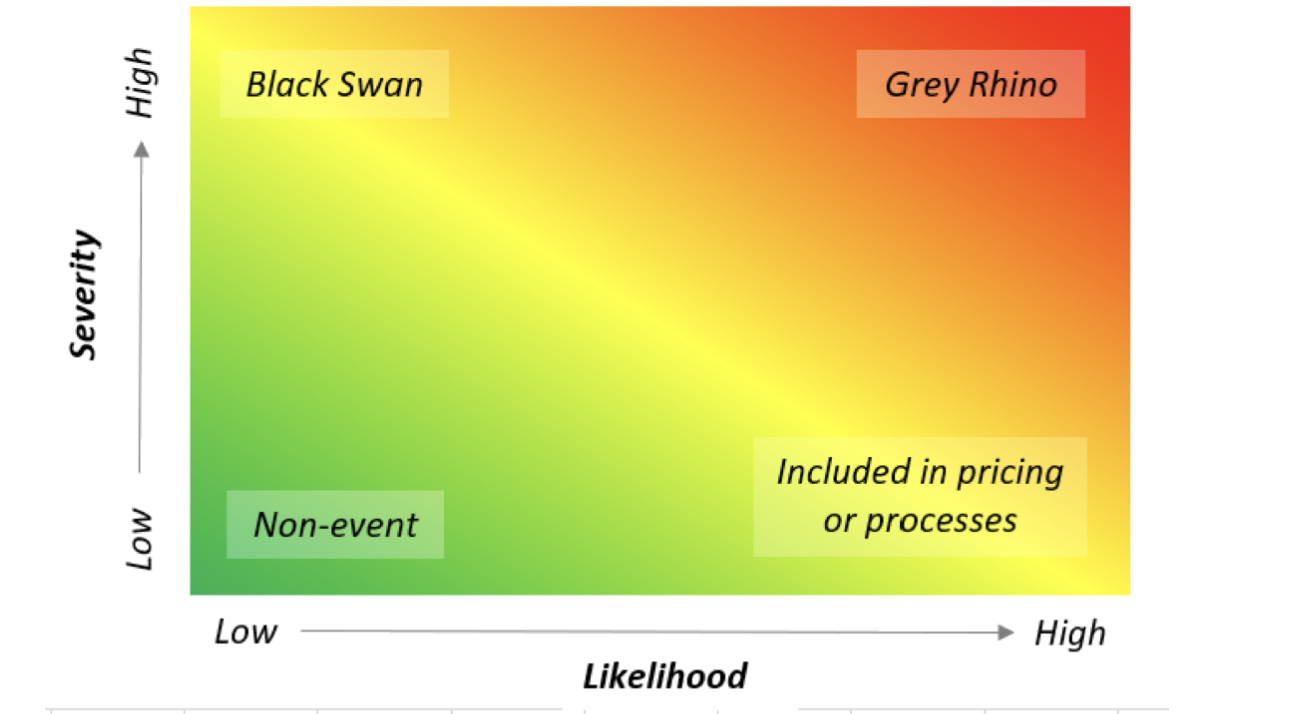
Likelihood – What are the chances of it happening with the current controls in place? - 6Categorise risk in likelihood and severity1. "L likelihood - L severity" : non-events, not to worry about.
2. "H likelihood - L severity" : well-known events included in pricing of products or mitigated by controls in processes.
3. "L likelihood - H severity" : Black-swan events like pandemics, bad AI are events you never assume to occur until they occur with a high impact.
Difficult 2 approach with normal stats but "Extreme value theory" is better suited.
4. "H likelihood - H severity" : well- known & high impact like risk mgt in normal times.
normal stats works well. - 7How does volatility fit in the def of risk?Risk "in investing" = price volatility
(Higher volatility = is associated with higher risk)
Volatility accounts for the
"utility of each of the outcomes"; not each outcome is perceived
equally harmful (different utilities) - 8Return R - risk tradeoffLow risk (known risk) = low R
High risk (unknown risk) = high R due to uncertainty
risk-averse => prefer outcomes w low risk
risk-taker => outcomes with high risk - 9financial institutions types/kinds?1. BANKS:
Retail, Corporate, Investment, Private bank
2. INSURANCE :
a) life, health, property and casualty
b) direct insurance and reinsurance
3. INVESTMENT funds - 10What's the goal of risk mgt in financial institutions?goal = keep firms solvent i.e have sufficient capital to cover the unexpected losses
What abt the expected losses? => included in pricing and mitigated by processes - 11Why risk mgt is important to financial institutions?It is due to their unique characteristics:
1. their business model is all about taking risks
2. failure (esp.banks) = high costs due to contagion effects ; effects on other fin. institutions (- externalities)
Contrast w how non-fin. institutions are exposed/deal w risks: risk is a result of their business; they focus on avoiding it, NOT taking it! - 12Explain the banking business model. RISK is central to banking Banks are in the business of taking risksBalance sheet shows these risks:
1. Loans (LR) = retail, corporates, gvt
2 Investment in B. B. are to keep until maturity = corporates, gvt bonds
3. Investment in T. B. are to create trading income = bonds, equity, ...
4. Financial instruments = bonds issued, subordinated loans, ...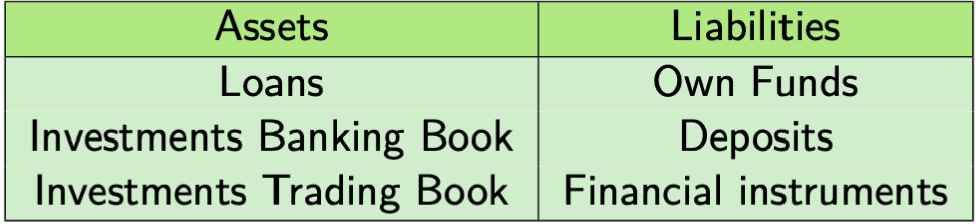
- 13What risks are reflected in the balance sheet of banks? !!! Monitoring these risks is crucial 4 fin. institutions !!!1. Production of "loans" = credit risk
2. "Investment portfolio" = credit & market risk
3. Transform "deposits" (SR) => "loans" (LR)
= liquidity risk (maturity transformation) and market risk (interest rate risk)
4. "Running the business" = operational risk e.g. fraud
5. Production of "deposits" = leverage wc intensifies the other risks - 14“A change in the price of a corporate bond is a reflection of market risk.” Discuss this statementThe market price of a corporate bond can change due to market risk (i.e. change in level of interest rates as summed in the yield curve), but also due to credit risk (i.e. change in the creditworthiness of the issuer)
- 15What is a leverage ratio?It is the bank capital to assets ratio
It follows from the production of deposits
Low ratio intensifies the bank is exposed to - 16Failure of a bank: contagion effects ?The failure of a single bank = costly 4 society due 2 contagion effects
i.e. failure of 1 institution = impact other institutions.
Thus: risk management and regulation aim at financial stability in order to internalise the externalities of a bank failure.
A well functioning financial system is key to economic growth and welfare. - 17Risk Management Regulation Micro-prudential VS. Macro-prudential regulation1. Micro-prudential regulation (our FOCUS)
= concerned w stability of an individual institution: it evaluates the response of an individual institution to exogenous shocks.
2. Macro-prudential regulation
= abt the stability of the financial system as a whole: it monitors the response of the system to endogenous risk. - 18“Micro-prudential regulation is focussed on monitoring idiosyncratic risks.” True or false? Motivate briefly.True. Idiosyncratic risk arises within an individual institution and is under
direct control of the management of the firm. Micro-prudential regulation targets this
individual-specific risk-taking behaviour. This contrasts to macro-prudential regulation that
aims at monitoring systemic risks that are shared across firms. - 19idiosyncratic shock (exogenous shocks) vs Systemic risk (endogenous risk)Idiosyncratic shock will affect only a single institution or asset and will not ripple out into the rest of the system.
Systemic risk focuses on the danger of the entire financial system collapsing, causing a major downturn in the real economy. - 20Insurance business model In insurance, risk is central the businessIt takes over a risk from a policy holder and manage it via mutualization of similar risks.
Mutualizing risk lowers the overall potential for significant financial loss to any one entity.
Investments = bonds (government / corporate), equity, real estate, loans, infrastructure investments, . . .
Reinsurance recoverables = payments from a reinsurance company that is taking over the risks that are not sufficiently mutualised in the portfolio.
Policy holder liabilities = the payments to policyholders (claims, reserves of life investment insurance, aging reserves, . . . ).
- 21Risk in the insurance balance sheetProduction of insurance policies loans = underwriting risk.
Investment portfolio = credit and market risk.
The investment of insurance premiums in investments = market risk (interest rate).
Running the business = operational risk (e.g. fraud). - 22The risk management process2 ensure solvency, a fin. institution sets internal boundaries ("company’s risk appetite") in its risk management process. To avoid conflicting individual pref. of employees/management.
These int. boundaries in line with external regulatory restrictions: capital adequacy/disclosure/governance requirements,... - 23How is managing risk is distinct from measuring risk?Managing risk is about the strategic and tactical decisions to develop a business: one needs to control people, IT, infrastructure, processes, measure risk.
Measuring risk is about quantifying risk (both the nature and size). - 24Risk management cycle: A sound risk management system consisting of consecutive steps: name. Important is that top management is end accountable for the Risk Management, not the Risk Management function in the financial institution1. Identify risks: spot risks.
2. Measure risks: quantify potential for deviations from a target/expected value.
3. Control risks: take actions to bring risk exposures in line with risk appetite.
4. Monitor risks: ensure that the steps taken are effective.
5 Report risks: report the risks & effectiveness of actions taken to mgt. - 25Key elements of good risk management processThe risk mgt processes typically define "per risk type" in the "risk appetite"
1. "Alarm levels" for a risk measure – if breached more attention paid to that risk type & first mitigating steps can be taken,
2. "Limits" for a risk measure that the company does not want to breach by all means (if so, strong immediate mitigating steps are taken).
The risk measures and their "status" accor. to alarm level and limit => periodically reported to top mgt. WHY?
1. to ensure they are continuously aware of the status (periodicity of reporting can vary by risk measure),
2. to get buy-in on the risk appetite and risk management processes. - 26What are the different answers to control a risk?1. Ignore: NOT an option.
2. Exploit: part of the business model of financial institutions.
3. Accept: within risk appetite.
4. Reduce: take mitigating steps.
5. Avoid: do not take the risk.
6. Transfer: (re)insurance or similar mechanisms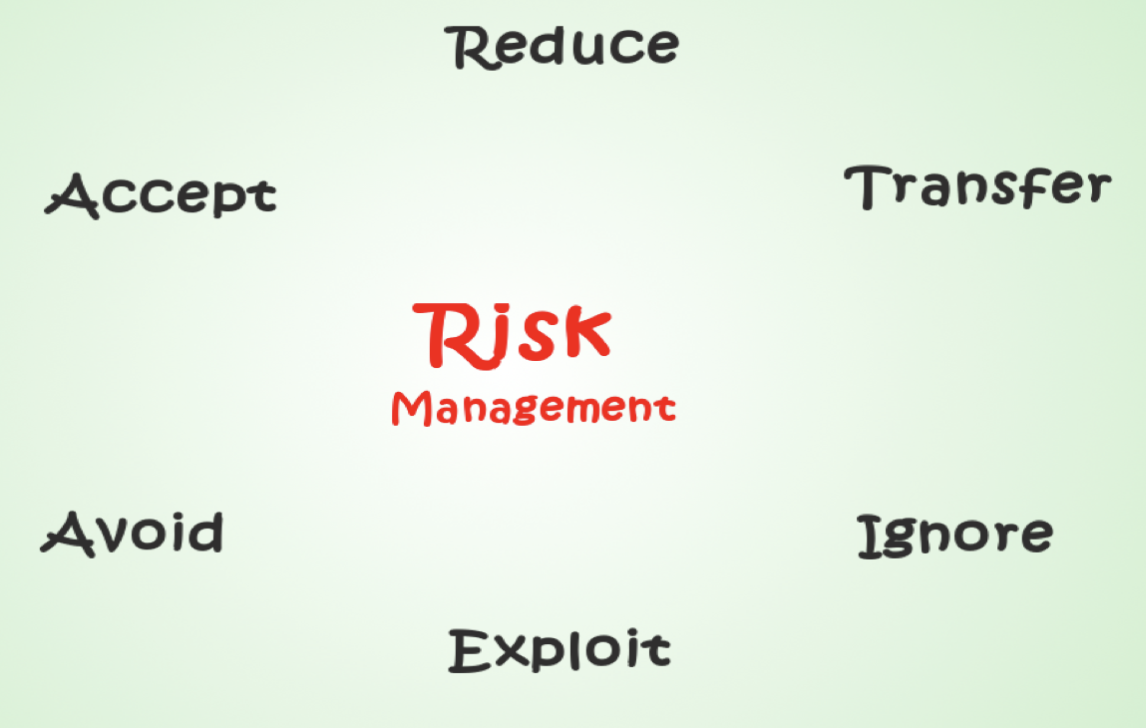
- 27Link the above answers with severity and likelihood Accept: L severity - L likelihood Reduce: L severity - H likelihood Avoid: H severity - H likelihood Transfer: H severity - L likelihood
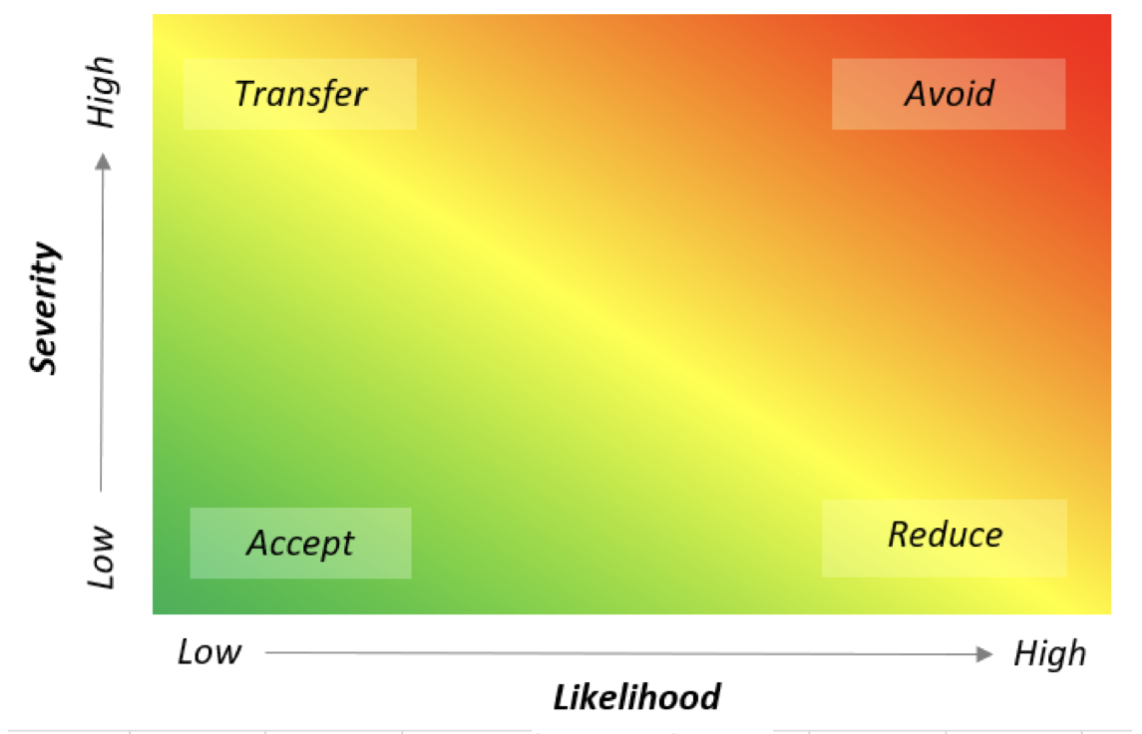
- 28How do we measure risk in financial institutions?This evaluation of risk is improved by considering multiple measures of risk:
1. volatility (dispersion), skewness, kurtosis;
2. value-at-risk (VaR);
3. expected shortfall (ES). - 29Risk as Value-at-Risk (VaR) Value-at-Risk (VaR) is a measure of risk commonly used in a financial context.Value-at-Risk (VaR) = amount of money at stake in an extremely bad scenario.
VaR = the loss we are fairly sure will not be exceeded if the current portfolio is held over a period of time.
Compute VaR = a probability distribution of P&L/returns over period of time. - 30What are the Benefits to study historical failures? Listing and studying risk events is beneficial for 2 main reasons:1. Reminds of the likelihood of big losses.
Ppl subject to disaster myopia: tend to underestimate major risk events if things go well & forget quickly after a disaster.
+ feedback is therefore needed to accurately estimate the chance of disaster.
2. It provides an instructor manual for better risk management process.
It triggers questions as: "What happened?" "How did it happen?"
"Could it happen to us?"
It allows us to categorise loss events
(fraud loss events = immoral and need to be ruled out and penalised,
while losses from legitimate business development = harder to deal with). - 31What are the key elements of good risk management?1. It should "learn from past failures" : process adapted on a constant basis.
2. Risk mgt process should be "effective".
Risk limitations translated => to particular boundaries within which employees act: they should be "closely monitored" and "evaluated".
One needs to "treat opportunities in the same way as risks": penalize violations of limits even if they result in profits.
One needs to have appropriate systems in place to detect problems timely: this includes a separation of tasks (front, middle, backoffice), validation, effective board,... - 32What is the main challenge of a good risk management?Main challenge = control risk wout limiting business dvpt.
Risk-free banking/insurance does not exist.
!Balance "taking risk" and "controlling risk"!
The "clearly formulated risk appetite" is crucial => bring everyone on the same page. - 33Business risk versus non-business riskBusiness risk refers to the risk that any firm faces: these are firm-wide risks (e.g. product risk, business cycle risk, legal and regulatory risk, strategic risk).
Non-business risk or financial risk are the specific risks that financial institutions face: - 34What are the specific risks a financial institution is exposed to?1. Liquidity risk;
2. Credit risk;
3. Operational risk;
4. Market risk;
5. Underwriting risk. - 35Financial risks explained Market risk ?Market risk = risk of loss due to unfavorable changes in mkt variables:
A short-lived risk: easily take corrective actions when losses are incurred;
If long-lived: has substantial effects on the profitability of financial institutions
Several subtypes: interest rate risk, exchange rate risk, equity risk, commodity risk, property risk, . . . - 36Financial risks explained Credit risk ?Credit risk = the risk of loss due to reduced credit quality: driven by probability 2 default (PD), loss given default (LGD) & exposure at default (EAD);
this risk is longer lived as many of the credit instruments are more illiquid.
When is a decrease in the price of a bond; considered a credit risk?
→ When not related to interest rate changes, but due to specific bond spread changes. - 37Financial risks explained Liquidity risk ?Liquidity risk = the risk of loss from not having the necessary liquid means:
For very long time been ignored, but a main source of risk in the credit crisis;
Distinction between funding liquidity risk and asset liquidity risk;
funding liquidity risk is the inability to find necessary funds to pay obligations;
asset liquidity risk is the inability to trade at market price;
Distinct, but crucially intertwined:
asset liquidity problems can translate into funding liquidity problems; this is called a liquidity blackhole (liquidity evaporates). - 38Financial risks explained Underwriting risk ?Underwriting risk = the risk of underwriting parameters not in line with reality.
Specific for insurance.
E.g. deviation in future versus past claim experience.
Deviations in mortality, expense, . . . assumptions.
In this, insurance companies are afraid of anti-selection: by setting a specific price, attracting the more risky customers. - 39Financial risks explained Operational risk ?Operational risk = the risk of loss from inadequate systems, human performance and external events.
Includes legal risk, BUT excludes reputational and strategic risk.
Typical examples are internal/external fraud, failed processes, cyberattacks, fat finger (typing a zero too much in an order)
It is a crucial risk being mitigated in processes, via the so-called Internal Control System wc defines per process (step):
1. the required controls to avoid operat. risk,
2. how the controls are effective to migitate the risk (design),
3. whether these controls are effectively executed and documented (performance). - 40Financial risks explained A number of other risks can be important, which ones?Model risk & parameter risk: the use of models in itself carries a risk of them being wrong.
Customer behaviour risk: early repayment of mortgage loans, lapse of life insurance policies. - 41Strategic risk ?Strategic risk = the risk of loss from wrong business decisions.
It is inherent to any business,& also relevant 4 financial institutions.
E.g. a risk for a bank is to invest less/more in digital channels,
less/more attention for sustainability, choices on distribution channels, . . .
In Belgium:
1. KBC/Belfius heavily focusing on mobile apps with third parties, while BNP Paribas/ING putting less focus on those.
2. BNP Paribas taking a decision that free services will need to be done via their Bpost Bank channel, services at BNP Paribas channel will need to be paid for.
3. Triodos Bank putting a lot of emphasis on sustainability. - 42Reputational risk ?Reputational risk = the risk of the impact of the reputation on the business operations
Can be towards any stakeholder: regulator, general public, target customers, employees, . . .
Towards customers typically via press, but also failed operations could be a reason.
Could lead to significant consequences: customer loss, run on the bank, ... - 43Sustainability risk ?Sustainability risk = the risk that long-term business model is not sustainable:
Can be related to Environmental (climate change) risks, Social risks, or Governance risks (ESG).
Sometimes looked at as separate risk, but can be debated to be a component of the other risks.
A hot topic today. - 44Food for thought Risk comes from ... It takes 20 years to build a reputation and ...Warren Buffet
Risk comes from not knowing what you’re doing.
It takes 20 years to build a reputation and five minutes to ruin it.
Information
- Description
- ADVANCED RISK MANAGEMENT Flashcards on RISK INTRO, created by Lola Keza on 21/06/2024.
- Created by
- Lola Keza
- Views
- 1
- Tags
- Rating