
Flashcards
Endodontics
Cards in this deck (70)
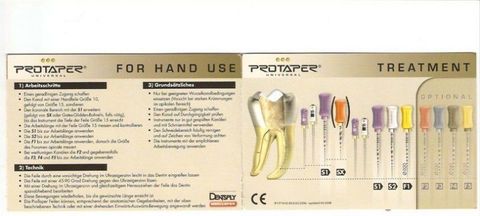
- 1Describe the ProTaper sequence
- 2What are the indications for endodontics?Caries
Trauma
NCTSL
Pulpitis
Resorption
Periapical periodontitis - 3What are the aims of endodontics?Remove canal contents
Eliminate infection
Seal canal space to prevent reinfection - 4What are the design objectives of endodontics?1. Continuously tapering funnel shape
2. Maintain position of apical foramen
3. Keep apical opening as small as possible - 5What gram negative bacteria are involved in endodontics?More in necrotic cases
Veillonella cocci
Prevotella
Fusobacterium
Porphyromonas - 6What gram positive bacteria are involved in endodontics?More in failed and persistent cases
Enterococcus faecalis
Actinomyces - 7What are the signs and symptoms of reversible pulpitis?Short, sharp pain
Goes away once stimulus removed
No TTP
No peri-radicular changes - 8What are the signs and symptoms or irreversible pulpitis?Spontaneous, intermittent pain
Dull throb/ache, prolonged
TTP
Worse at night
RADS -> only if advanced - PDL widening and source e.g. caries
Not capable of healing ∴ endo indicated - 9What is asymptomatic irreversible pulpitis?Rare form of pulpitis
Still requires RCT - 10What are the signs and symptoms of a necrotic pulp?No blood or nerve supply
Asymptomatic until periodontium involved
May have had previous symptoms
Negative sensibility test
TTP
Responds to heat, relieved by cold
RADS -> PA radiolucency and PDL widening - 11How is periapical/periradicular disease classified?Acute/Chronic
Peri-radicular periodontitis/abscess - 12What are the signs and symptoms of acute peri-apical periodontitis?+++TTP
Pain on biting
RADS -> PDL widening but no PA lucency
Rx - RCT/XLA - 13What are the signs and symptoms of chronic peri-apical periodontitis?Asymptomatic
No TTP
RADS -> PDL widening and PA lucency
Rx - RCT/XLA - 14What are the signs and symptoms of an acute peri-apical abscess?Rapid onset
+++TTP
Pain
Mobile
Swelling
Lymphadenopathy
RADS -> PDL widening
PA lucency
RX - RCT/XLA - 15What are the signs and symptoms of a chronic peri-apical abscess?Asymptomatic
Draining sinus
RADS -> PA lucency
RX - RCT/XLA - 16What are cautions/considerations for endodontic treatment?MH - CVD (bacteraemia), allergies, special care, behaviour/psychiatric problems, diabetes, blood disease, immunosuppression, pregnancy
DH - perio.disease, unrestorable tooth, no isolation, poor crown:root ratio, dilacerated roots
SH - poor coop, poor attendance, cost, age - 17What is the general 10 year prognosis for: Irreversible pulpitis? Necrosis?Pulpitis - 90%+
Necrosis - 80%+ - 18What are the risks of endodontic treatment?Pain
Failure
Instrument separation
Perforation
'mishaps' - ledges, zipping, apical transportation, blockage - 19What factors are involved in endodontic referral?American Association of Endodontics Case Difficulty Form
MH, LA, Pt mgmt, Gag/Opening, Access, Isolation, Morphology - 20What are the 7 stages of mechanical preparation?1. Tooth preparation
2. Access Cavity and RC Location
3. Straight Line Access
4. Initial Negotiation
5. Coronal Flare
6. Working Length Determination
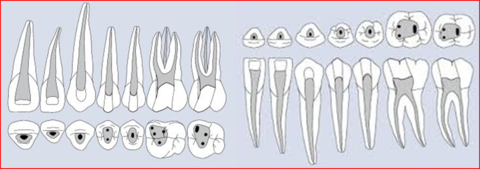
7. Apical Flare - 21Draw access cavities for all teeth
- 22What are the laws of symmetry?1 - orifices lie equidistant from MD line through chamber
2 - orifices lie on a line perpendicular to the MD line through the chamber - 23What is the law of colour?The pulpal floor is ALWAYS darker than the walls
- 24What are the laws of orifice location?1 - Always at the floor and wall junction
2 - Always at angles in the floor/wall junction
3 - Always at the terminus of developmental fusion lines - 25What are the aims of chemomechanical disinfection?Remove canal contents
Eliminate infection
Seal canal to prevent reinfection - 26What is manual dynamic irrigation?Agitation of irrigant with a file/GP to allow irrigant to reach working length and accessory canals
- 27What kind of syringe is used for irrigation and how is it used?Luer lock side venting needle
2mm short of WL
Copious irrigation and always with a reservoir in the chamber - 28What do you need to discuss for informed consent?Procedure
Prognosis
Alternatives
Risks -> doing and not doing Rx
Allow pt to ask questions
Agree to a Rx plan - 29How does sodium hypochlorite work?NaClO -> dissociates into OCl and NA
OCl + H = HOCl
HOCl is acidic and antibacterial
Dissolves pulp remnants and collagen
Dissolves necrotic and vital tissue
Disrupts smear layer but DOES NOT remove it
Requires >10 mins to work - 30What concentration of NaOCl is used?(0.5-6%)
Commonly 3% - 31What are the advantages of NaOCl?Antibacterial and acidic
Dissolves necrotic and vital tissue
Dissolves pulp remnants and collagen
Disrupts smear layer - 32What are the disadvantages of NaOCl?Toxicity
Taste/smell ∴ pt comfort
Removes organic material
Does not remove smear layer
May affect dentine properties - 33What is the smear layer? How is it removed?Inorganic and organic debris created during preparation
Interferes w/disinfection and sealer penetration
Removed by EDTA (17%) /Citric Acid (10%) /Ultrasonic irrigation - 34What is EDTA?Ethylenediaminetetracetic Acid
Chelating agent
17% used
Removes smear layer
Aids negotiation of calcified roots
Applied for 1 minute
Do not mix w/NAOCl - 35What is an alternative to NAOCl?Chlorhexidine
Cationic bisguanide ∴ antimicrobial
Alters cell membranes and causes lysis
Bacteriostatic and bactericidal
DO NOT MIX w/NAOCl - cytotoxic
Not as good as NAOCl - 36Detail a final irrigation protocol1x syringe:
NAOCl
EDTA -> 1 minute
NAOCl
Dry and agitate between syringes and filling - 37What is the purpose of intracanal medicaments? Give 2 examplesUsed between apts to:
Kill of remaining bacteria and prevent further reinfection
Reduce inflammation and exudate
Control root resorption
e.g. Ledermix
Non-Set CaOH - 38What is Ledermix and how does it work?Antimicrobial paste -> corticosteroid and tetracycline
Reduces inflammation
Good for 'hot pulps'
Works for 5-7 days - 39What is non-setting calcium hydroxide and how does it work?Antibacterial paste
pH 12.5
Decreases bacteria
Works for 7 days
Can make root brittle if left long term - 40What are the aims of instrumentation?Remove infected tissue
Allow irrigant access to apex
Make space for medicaments and obturation
Retain root structure and integrity - 41Describe 4 envelopes of motionFiling - simple motion
Reaming
Watch winding -> 30˚-60˚ back and forth - good for passing files
Balanced Force -> 60˚-120˚CW-ACW - engages and breaks dentine - 42What is always carried out during instrumentation?After each removal:
Clean files
Irrigate
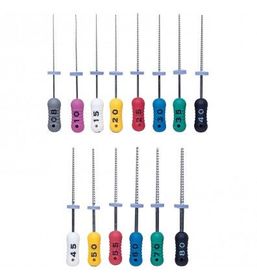
Recapitulate - 43What is the K-file sequence?WYRBGB
- 44What 'mishaps' can occur during instrumentation?Perforation - bleeding
Ledges - due to poor WL
Zipping - teardrop shape, uneven sides prepped
Apical transportation - no resistance for GP
Blockage - recapitulate to prevent - 45Name 4 disadvantages of conventional instrumentation1. 'Mishaps'
2. Time consuming
3. Debris extrusion
4. Less predictable canal shape - 46What is the anatomy of a stainless steel K-file?21-31mm with 16mm cutting flute
2% taper per mm - 47What are the advantages of nickel titanium instruments?Shape memory ∴ hyperelasticity
∴ High Young's modulus - 8-12% taper
Prevent 'mishaps'
Better cutting efficiency
Keep canal shape
User friendly ∴ quicker and easier - 48What are the disadvantages of nickel titanium instruments?Cost
Can still separate in extremely curved canals
Access can be difficult in post teeth
Not suitable for complex canal anatomy - 49How can instruments separate?Cyclic fatigue - tension vs compression
Torsional fatigue -
Flexural stress - Repeated cyclic fatigue - overuse
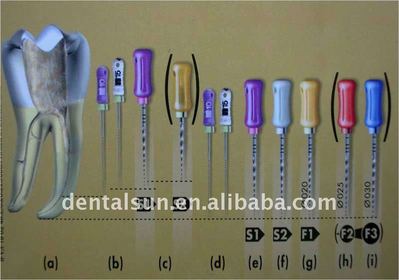
Torsional stress - extensive friction - torque exceeds critical level - 50Describe the ProTaper sequence
- 51What are the aims of obturation?Entomb remaining bacteria
Seal entry/exit to the root canal system
Prevent reinfection - 52Should obturation be carried out at the 1st or 2nd visit?Depends
Vital pulp - ok to obturate
Necrotic/Symptomatic - delay
However, no real evidence on post op pain and success - 53What is the apical limit?Found at dentino-cemental junction
Approx 0.5-2mm from radiographic apex
Varies w/age, anatomy, health etc - 54What are the properties of an ideal sealer?Good adhesion
Hermetic seal
Radiopaque
Slow set
No shrinkage
Bacteriostatic
Soluble on retreatment
Biocompatible
Non- toxic
Easy to use - 55Give an example of a sealer What properties does it have?AH Plus - epoxy resin
Slow set ≈ 8hrs
Initial toxicity decreases by 24hrs
Good seal
Good flow - 56What are the properties of an ideal obturation material?Radiopaque
Hermetic seal
Seals all canals
Bacteriostatic
Do discolouration
Easily removed if needed
Good working time
Biocompatible
Easy to use - 57What is gutta percha? What are its components?Natural isoprene rubber
Heated and cooled rapidly to make β phase used in RCT
20% GP
65% ZO
10% radiopacifiers
5% plasticisers - 58How is cold lateral compaction carried out?Insert master GP
MGP should be same as master apical file
Check 'tug back'
Adjust if needed
Mark CWL
Cone fit radiograph if needed
Dry canal
Sealer
Insert MGP
Set finger spreader 2mm short of CWL
Compact laterally for 30s
Insert accessory GP as needed
Finish @ ECJ or below ging.margin (stops fluid via dentinal tubules and better aesthetics)
Post-Op radiograph - assess length, density, voids etc - 59What are the advantages and disadvantages of cold lateral compaction?ADV - Good WL control
DISADV - poor adaptation to irregular canals - 60Name 2 other types of obturation other than cold lateral compactionWarm vertical
Carrier based - 61How is a failed RCT assessed radiographically?Increase in PA area after Rx
Development of PA area after Rx
'mishaps'
Under/over/poorly compacted obturation - 62How is RCT judged to be a success?No symptoms
Tooth back to function
Radiographic evidence
Retention
Can monitor for up to 4 years before failure - 63What are the reasons for RCT failure? Before/during/after?BEFORE - misdiagnosis
Poor Rx plan and Pt selection
DURING - 'mishaps'
Missed canals
Inadequate obturation
Iatrogenic damage
AFTER - recurrent caries
*Coronal leakage* -> most important factor in success - 64How are failed RCTs managed?Fix vs Refer
Fix - re-RCT -> Protaper D files
Apicectomy
Monitor?
XLA
Refer to specialist - 65What is needed for endodontic pre-treatment?Radiograph - root and 2-3mm of surrounding tissue
Pathology, anatomy, calcification, angulation and length
LA
Dental dam - pt comfort, safety, bacterial invasion, inhalation risk, retract and protect ST - 66How is access achieved and a cavity prepared for endodontic treatment?Remove ALL caries and defective restorations
Can prep w/out dam if orientation poor
Remove ALL pulp chamber roof
Remove ALL pulpal tissue
Gain straight line access
Smooth walls and remove overhangs - 67What are the aims of irrigation?Flush out debris
Disinfect root canal
Disrupt/Remove smear layer
Lubricate instruments
Dissolve debris - 68How is working length determined?Estimated WL -> 2mm short of radiographic apex
CWL ->
RADS -> insert ISO 10-15 to EWL and take RAD
If <2mm OK to new CWL
If >2mm adjust and retake
EAL -> hook to pts lip, attach a file and insert to canal
0 reading = @ PDL
take away 1mm to find CWL
Paper points - insert and measure to blood - 69In conventional endodontic treatment, what is the step back technique?Joins coronal and apical flares
MAF set as largest file binding at CWL
Go 1 ISO size up and REDUCE 1mm length
Repeat until flares continuous - 70—
Information
- Description
- Flashcards on Endodontics, created by Michael Brown on 08/11/2015.
- Created by
- Michael Brown
- Views
- 2
- Tags
- Rating