
Flashcards
BioPsych E3 P3
Cards in this deck (46)
- 1Learningthe process of acquiring new information
-often produces lasting changes in behavior - 2Memorythe ability to store and retrieve learned information
evidence that once has experience something - 3amnesiathe loss of memory formation and retrieval functions
- 4Anterograde amnesiathe inability to form long term memoriesrere
- 5retrograde amnesiadifficulty recalling memories of the past, usually those from before the memory changing event
- 6Digit span testlist red aloud slowly to patients
- 7Primacytendency to remember things first exposed (early items on a list)
- 8Recencytendency to remember things learned recently
- 9Explicitrequires conscious awareness (memory that we usually think of as a memory)
Requires conscious awareness - 10Semantic memoryfacts and general knowledge
- 11Episodic memorypersonally experienced events
- 12Implicit memorymemories you can show by "doing" (riding a bike using a word heard recently, liking coffee) does not require conscious awarness
- 13IM Procedural memorymotor and cognitive skills
- 14IM primingenhanced identification of objects or words
- 15IM learning through classical conditioningHe did
- 16ToM: Digit spanexplicit memory (episodic)
- 17ToM: Block tappingexplicit memory (episodic)
- 18ToM: Mirror Tracingimplicit memory (procedural)
- 19ToM: incomplete picturesimplicit memory (procedural)
- 20Memory consolidationmove from short term memory to long term memory
- 21What kind of surgery did patient HM have? What parts of the brain did it most noticabl effect?medial temporal lobes are crucial for memory
temporal lobe cortex excision
Hippocampus - imprtant for the consolidation of memory - 22Donald Hebbshort term storage of memories facilitated y neural "revereration" (synchronous activites)
-"cells that fire together, wire together" - 23LTPLong-term potentiation - when certain synapses are used repreatedly to produce action potentionals in the post-synaptic neuron, the connection between pre-and post-synaptic neurons becomes stronger
- 241. low-frequency electrical pulsesthe "population spike" (EPSP of many neurons) has a baseline level
- 252. Wtih long bursts of high-frequency electrical stimulationthe post-synaptic neuron fires repeatedly
- 263. stimulate the same pathway with the same low frequency pulse as in step 1the post-synaptic response has increased
- 272 ionotropic glutamatergic receptorsAMPA - ligand gated channels
NMDA voltage and ligand gated channel conditions a Mg2+ to block calcium channels - 28Ca induce protein synthesisgenerates new dendrtitic spines to enhance connections between presynaptic axons and postsynaptic dendrites
- 29Memory and LTP occur on similar time-sclaescan be induced in seconds, and last das/weeks/years
- 30BLcoking NMDA receptors impairs memory functiontraining animals (behaviorally) to do something (run a maze, learn an association between two stimuli) increase LTP in their brains
- 31Memory blackouts from alcohol intoxication-bouts of heavy drinking often associated with little/no memory of events that occured during intoxication
- 32memory blackoutanterograde amnesia (episodic memory especiall fails)
failure of memory consolidation
not the same as passing-out - 33Alcohol is a GABA agonistduring alvoholl intoxication, alcohol opens GABA receptors and enables hyperpolarization of gluametergic neurons by allowing Cl- influx
- 34Alcohol is an NMDA receptor antoagonistalcohol binds, and stops the NMDa channel from opening
-during intox, alcohol blocks Ca2+ ions from entering glutamaterfic neurons, especially in the hippocampus - 35alcohol withdrawlmay kill brain cells in the long-run through a process called excitotoxicity
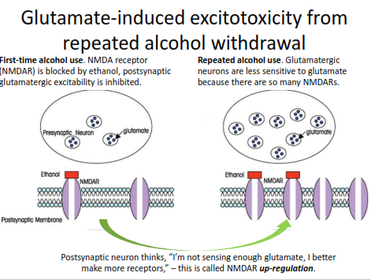
- 36excitotoxicity from repeated alccohol withdrawalincreased alcohol use, glutamatergic neurons are less sensitive to glutamate, so NMDA receptors up-regulate
-when alcohol is withdrawn, an unsafe amountof Ca2+ is released, and may enter cells. Very high levels of apoptotic Ca2+, apoptotic genes will be expressed and the cell will die - 37Wernicke;s encephalopathybecause of NMDa receptor up-regulation, glutamatergic brain networks are injured
symptoms: visual problems, especially eye-movements
atxia- dyscordinated muscle movements
confusion (not knowning how to leave a room) - 38Korsakoff's syndromemedial diencephalon
symptoms: severe amnesia, personality changes, physical problems
Progressive nature: ES: anterograde episodic amnesia
LS: severe retrograde amnesia
(severe thiamin vitamin B1 deficiency) - 39Alzheimer's diseaseneurdegenerative disease
most dementia onset 65% years of age
earliest symptoms occur before it is known to be AD - 40AD early symptomsshort-term memory problems - difficulty remembering recently-learned information
worsened attendtion and planning, inflexibility
begining of apathy, which tends to last duration of illness
depression symptoms - 41AD intermediate symptomsDecline of vocabulary (word sub)
motor slowing and reduced coordination
failed recognition of well-known family/friends
wandering (bus stop) , "sun downing", resistance to caregivers - 42Advanced ADlanguage is mostly gone
totally dependent on caregivers
interestingly ,emotional signs are intact - 43Cholinergic hypothesis of ADDementia symptoms of AD arise from reduced synthesis of neurotransmitters acetylcholine (Ach)
Additional neurodegeneration changes include neurofibril tangles and plaques - 44Drugs prescribed to an individual with Alzheimer's?Acetylcholinesterase Inhibitors (AChEls)
The front line treatment for AD
Slow dow nthe synpatic break-down of acetylcholie
modest benefits - 45Side effects of AChEls-bradycarida
-nausea & abdominal pain, diarrhea
-anorexia
-muscle spasms (neuromuscular juntion)
RARER SID EFFECTS
-nightmoares
-mania & depression
-vision problems - 46Nootropic"Mind bender" / "'smart pill"
pharmaceutical, ntrient, or supplement for the purpose of improving cognition
Brain altering: chemistry, metabolism, structure
origionally developed to treat disease, options have been limited in their success in helping "healthy normal"
Information
- Description
- University BioPsych Flashcards on BioPsych E3 P3, created by halle074 on 23/11/2015.
- Created by
- halle074
- Views
- 1
- Rating