
Flashcards
Lecture 4 - Respiratory System 1

Cards in this deck (53)
- 1What is the primary function of the respiratory system?Gas exchange.
- 2What is the 'conducting part' of the respiratory system made up of?- Upper respiratory system.
- Lower respiratory system. - 3What occurs in the respiratory part of the respiratory system?Gas exchange between blood and air.
- 4What makes up: - The upper respiratory tract? - The lower respiratory tract?a) Nose, nasal cavity, paranasal sinuses and the pharynx.
b) Larynx, trachea, bronchi and lungs - 5What are the components of the respiratory part of the respiratory system?Respiratory bronchioles and alveoli.
- 6What allows mechanical ventilation to occur sufficiently?The musculoskeletal system.
- 7List 4 extra function of the respiratory system aside from gas exchange.- Guard the airway during swallowing - preventing food from entering the trachea at the larynx.
- Phonation - producing sounds.
- Protective reflex - sneezing, coughing.
- Assistance in abdominal compression during urination, defecation and child birth. - 8What separates the left and right nasal cavity?The nasal septum - made up of bones and cartilage.
- 9How many nasal conchae do we have? What is the other name?3
Nasal turbinates - 10Where are the nasal conchae positioned?At the lateral wall of the nasal cavity.

- 11What is the purpose of the nasal conchae?To increase the surface area of the nasal cavity (curved bones); helping to humidify and warm up the air.
- 12Where is the nasal meatus?The space under each concha.

- 13What are the nasal meatus?The openings to the paranasal sinuses and lacrimal duct.
- 14List 4 ways in which the nasal cavity achieves its function in filtrating, warming up and humidifying the inspired air.- Nasal hairs - vibrissae.
- Pseudostratified respiratory epithelium containing mucus-secreting goblet cells (for moisture) and ciliated columnar cells (for particulate matter).
- High vascularture on the lateral walls and septum.
- Increased surface area by concha. - 15How does the nasal cavity carrying out its smelling function?- At the olfactory epithelium located at the roof of the nasal cavity,
- 16Where does the nasal cavity receive drainage from?From the paranasal sinuses and nasolacrimal duct.
- 17Name the following bones of the nasal cavity.
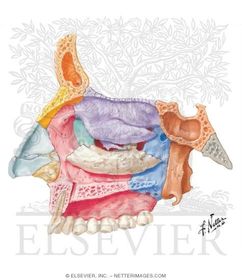

- 18What are paranasal sinuses?- Air-filled spaces in skull bones.
- They are continuous to the nasal cavity. - 19Name an infection which demonstrates that the parasasal sinuses are continuous to the nasal cavity.Sinusitis...
Goblet cells of the nasal cavity secrete mucus and any infection can thus pass into the parasasal sinuses. - 20What can also drain from the parasasal sinuses into the nasal cavity?Mucus.
- 21Are there any additional functions of the parasasal sinuses?- Phonation
- Reducing skull weight - 22Name the following parasasal sinuses.- Frontal sinus
- Ethmoid sinus
- Sphenoid sinus
- Maxillary sinus
- 23What are ethmoid air cells?The cavities in the lateral masses of the ethmoid bone - partly completed by adjoining bone and are in contact with the nasal cavity.

- 24Where is the pharynx located?It is the space between the nasal/ oral cavity and the larynx/ oesophagus.

- 25List the 3 different types of Pharynx.- Nasopharynx
- Oropharynx
- Laryngopharynx - 26Where are each of the following components of the pharynx found: - Nasopharynx? - Oropharynx? - Laryngopharynx?- Nasopharynx = Posterior to the nasal cavity.
- Oropharynx = Posterior to the oral cavity.
- Laryngopharynx = Posterior to the larynx.
- 27What are the 2 main functions of the pharynx?- Preventing food from entering the trachea.
- The voice-producing part. - 28What is the nasopharynx lined by? What is this the same as?Pseudostratified ciliated columnar epithelium.
> Same as the nasal cavity. - 29What opens in the nasopharynx to allow communication with the middle ear?The auditory tube.

- 30Whereabouts in this diagram are the pharyngeal tonsils?


- 31Where is the soft palate on this diagram and what is its purpose?The soft palate is raised during swallowing to prevent food entering the nasopharynx.


- 32What is the oropharynx lined by?Non-keratinised stratified squamous epithelium.
- 33What is the oropharynx's non-keratinised squamous epithelium resistant to?Resistant to the passage of foods.
- 34What resides in the oropharynx?Palatine tonsils.

- 35What sits posterior to the palatine tonsil?Palatopharyngeal arch

- 36What is the main function of the oropharynx?To allow the passage of air and foods.
- 37What lines the laryngopharynx?Non-keratinised stratified squamous epithelium.
- 38What is the laryngopharynx's non-keratinsised squamous epithelium resistant to?The passage of foods.
- 39What does the laryngopharynx open up into?The oesophagus and the larynx.

- 40What is the main function of the laryngopharynx?To allow the passage of air and food.
- 41What are the primary functions of the larynx?- Permit passage of air during breathing.
- Prevent food or fluid from entering the trachea.
- Production of sounds - voice box. - 42Label the following laryngeal skeleton with: - Hyoid bone - Epiglottis - Thyroid cartilage - Cricoid cartilage


- 43What occurs during swallowing in the larynx?- Larynx is elevated.
- Epiglottis holds back over the glottis.
- Food is prevented from entering the airway. - 44What part of the thyroid cartilage is palpable?Laryngeal prominence.

- 45What cartilage of the larynx is attached to the vocal cords?Thyroid cartilage
- 46What is the purpose of the epiglottis?To cover the airway during swallowing.

- 47Whereabouts is the cricoid cartilage located in the laryngeal skeleton?Just above the trachea.

- 48Whereabouts is the arytenoid cartilages of the laryngeal skeleton located?- On top of the cricoid cartilage.
- Attached to the vocal cords.
- 49What controls the movement of laryngeal cartilages for phonation?Muscles supplied by recurrent laryngeal nerve (a branch of Vagus nerve).
- 50What causes the opening/ closing of the glottis?The rotation of arytenoid cartilages.
- 51What changes the pitch of our voice?Stretching the vocal cord.
- 52What occurs when the: - Glottis is open? - Glottis is closed?Open glottis = Cords are stretched & vibrate rapidly = high pitched.
Closed glottis = Cords are slack & vibrate slowly = low pitched. - 53What is true about a men's vocal cords in comparison to a woman's?- Thicker and longer
Information
- Description
- Upper Airways
- Created by
- Afronewtzz · Feb 2016
- Updated
- May 30, 2016
- Views
- 11
- Rating