
Flashcards
FIRST EVALUATION REVIEW: MATERIALS BEHAVIOR
Cards in this deck (72)
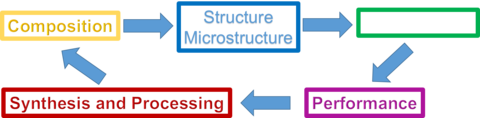
- 1MSE (Materials Science and Engineering)Field of science and engineering that studies and manipulates the composition and structure of materials
- 2Missing partProperties
- 3Materials Selection tetrahedron parts:Composition
Structure/ Microstructure
Synthesis and Processing
Performance/cost - 4Materials Used in a carMetals: Iron, aluminum, copper, lead
Plastics: PET, PP, PS
Ceramics
- 5Materials classifiation by type:Metals and alloys
Polymers/Plastics
Ceramics, Glasses, and Glass-ceramics
Semiconductors
Composites - 6Example of Non ferrous alloysAluminum
Zinc
Nickel
Titanium
Copper
Gold
Silver, etc - 7Example of ferrous materialsIron
Steel
Stainless Steel - 8What element makes the steel resistant to corrosionCr
- 9Steel is an alloy with:Fe+C
- 10Bronze is an alloy made of:Copper+Tin
- 11Most used ceramic materialGlass
- 12Type of plastics that can be heated and melted to be reshaped a lot of times.Thermoplastics
- 13Type of plastics used in high temperature applications.Thermosets
- 14ElastomersType of plastics that can be deformed and return to its original shape
- 15Why composites are created?To blend the properties of differents materials
- 16Atomic structure in metals.Crystalline structure
- 17Amorphous structureAtomic structure where the atoms are arranged randomly
- Glass, polymers, plastics. - 18Nanostructurex10^(-9)
- 19Negative charge part of the atom.Electrons
- 20Part of the atom that defines the properties of the material.Protons
- 21Atomic numberis equal to the number of protons in each atom
- 22Atomic Massis equal to the average number of protons and neutrons in the atom
- 23Isotopesatoms elements
having 2 or more different
atomic masses . - 24The p sublevel in the electronic energy level can hold:6 atoms
- 25Valence electronsnumber of electrons in an atom that participate in bonding or chemical reactions.
- 26Describes the tendency of an atom to gain an electron.Electronegativity
- 27More electronegativity materialsNon metals
- 28Atomic bond present in bronze:Metallic Bond
- 29Most resistant atomic bonding, in which electrons are shared.Covalent bond
- 30Atomic bond between a no metal and a metal.Ionic Bond
- 31Weak atomic bond without ithout electron transfer.Van der Waals Bonds
- 32The arrangement of the atoms extends only to the atom´s nearest neighbors.Short-range order
- 33Unit CellA subdivision of the crystalline lattice that still retains the overall characteristics of the entire lattice.
- 34Atomic packing factorThe fraction of space (volume) in a unit cell occupied by atoms.
- 35Most compact cubic crystalline structureFCC
- 36Most compact crystalline structureFCC
HCP - 37Large coordination number cubic crystalline structure:FCC
- 38Atoms inside a BCC unit cell8 atoms
- 39Crystalline structure in TitaniumHCP
- 40Crystalline structure in iron, chromium, steelsBCC
- 41Examples of FCC materialsAluminum, copper, gold, silver
- 42AllotropyThe characteristic of an element being able to exist in more than one crystal structure
- 43Compounds exhibiting more than one type of crystal structurePolymorphism
- 44DensityMass per unit of volumen
- 45Direccions in miller indices are denoted by:Denoted by [ ] brackets
- 46Planes in atomic structure are denoted by:Denoted by ( ) parentheses
- 47The crystal structure of a crystalline material can be analyzed using :x-ray diffraction (XRD) and electron diffraction.
Transmission electron microscope - 48Point DefectsAre localized disruptions in otherwise perfect atomic or ionic arrangement in a crystal structure.
- 49DopantsElements or compounds added, in know concentrations, to improve the properties or processing.
- 50ImpuritiesElements or compounds that are present from raw materials, mold walls or processing.
- 51Defect in which an atom or an ion missing from its regular crystallographic siteVacancy
- 52This type of point defects increase with temperatureVacancy
- 53Interstitial DefectsAn extra atom or ion is inserted into the crystal structure at a unoccuped position (interstitial space).
- 54Substitutional DefectsAn atom or ion is replaced by a different type atom or ion
- 55Defect that is produced when an ion jumps from a normal lattice point to an interstitial site, leaving behind a vacancy.Frenkel defect
- 56Schottky defectthe same number of anions and cations must be missing from regular atomic positions if electrical neutrality is to be preserved.
- 57Types of line defects (dislocations)Screw
Edge
Mixed - 58A dislocation produced by skewing a crystalScrew dislocation
- 59A dislocation introduced into the crystal by adding an ‘‘extra half plane’’ of atoms.Edge dislocation
- 60Burgers vectorA mathematical vector that represents the magnitude and direction of the distortion in a dislocation in a crystal lattice.
- 61Types of normal stressesTension
Compression - 62Shear stressforce required to move a plane
- 63Etch pitsTiny holes created at areas where dislocations meet the surface. These are used to examine the presence and number density of dislocations.
- 64Irreversible deformationPlastic deformation
- 65Elastic deformationTemporary change in shape that ocurrs while the force or stress remain applied to a material.
- 66Surface defectAre boundaries, or planes, that separate a material into regions
- 67Portion of the material within which the arragement of the atoms is identical but the orientation of the atom arragement or crystal structure is differentGrains
- 68Grain Boundarysurface that separates the individual grains.
- 69Optical MicroscopyIs one technique to reveal the microstructure of the materials, feactures like grain, grain boundaries.
- 70Steps in the metallographic processSelection
cutting
Mounting
sanding
Polishing
Etching
Observation - 71Magnification needed for ASTM grain size100X
- 72Solid solution strengtheningIntentionally introducing substitutional or interstitial atoms.
Information
- Description
- Flashcards on FIRST EVALUATION REVIEW: MATERIALS BEHAVIOR, created by euribelam on 11/02/2016.
- Created by
- euribelam
- Views
- 33
- Rating