
453174
Description

Flashcards by emma_moran, updated more than 1 year ago

|
Created by emma_moran
almost 13 years ago
|
|
| Question | Answer |
| What are the monomers that form polypeptides? | Amino acids |
| How many different amino acids are there? | 20 |
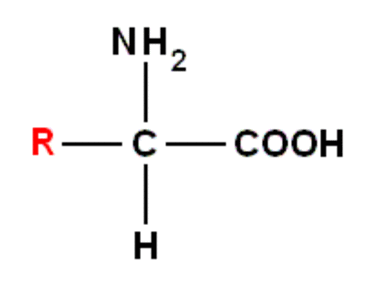
| Draw the general formula of an amino acid |
Image:
aminoacid.gif (image/gif)
|
| Which is the only amino acid that isn't chiral? | Glycine |
| What is an amino acid called if it has a positive and negative charge? | Zwitterion |
| What is the pH if both functional groups are protonated (NH3+ and COOH)? | Acidic |
| What is the pH is both functional groups are deprotonated (NH2 and COO-)? | Alkaline |
| What bond is formed between two cysteine molecules? | Disulphide bridge |
| Cysteine + Cysteine = ? | Cystine |
| What type of reaction occurs in the formation of cystine? | Oxidation |
| Which amino acid is always the first in a polypeptide chain? | Methionine |
| What bonds link amino acids together? | Peptide bonds |
| In which direction in a polypeptide sequence read? | From the N terminal (amino terminal residue) to the O terminal (carboxyl terminal residue) |
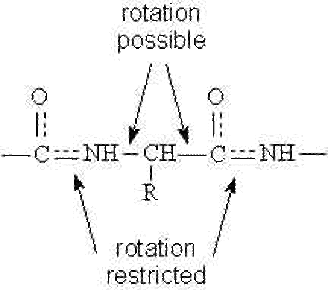
| What causes peptide bonds to be rigid and planar? | Bond resonance |
| Where is rotation possible in a polypeptide? |
Image:
rotat.gif (image/gif)
|
| Why is the trans- form most common? | Rotation at C is limited due to steric clashes between R groups |
| When does the cis- form occur? | Glycine and 0 |
| What are the four levels of protein structure? | Primary, Secondary, Tertiary and Quaternary |
| What is the primary structure? | The sequence of amino acids |
| What is the secondary structure? | The formation of alpha helices, beta sheets and loops/random coils due to the formation of hydrogen bonds |
| What is the tertiary structure? | Attractions cause the polypeptide to fold |
| What is the quaternary structure? | A protein consisting of two or more polypeptide chains assembled together |
| Why is the primary structure so important? | It dictates final protein structure because sequential arrangement of R groups will influence subsequent secondary, tertiary and quaternary structures. The protein structure then dictates the function. |
| What can lead to a change in the primary structure? | Genetic mutation |
| Feature of the alpha helix | Coiled like a spring, hydrogen bonds and amphipathic |
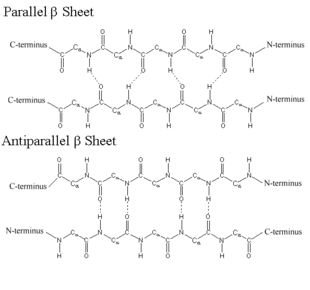
| Features of the beta sheet | Flat sheets, pleated, short runs of 5-10 amino acids, parallel or anti parallel, sheets held together by hydrogen bonds, the sheets are often connected by hairpin loops or turns |
| The difference between parallel and anti parallel beta sheets? | |
| What are loops? | They connect secondary structure elements, not connected by hydrogen bonds, frequently form part of active sites and the difference between structurally similar proteins occur almost exclusively in loops. |
| What are motifs? | They are particular arrangements of secondary structures that occur frequently within a polypeptide and can be associated with a particular biological function. |
| What are domains? | A poly peptide chain (or part of a polypeptide chain) that folds independently into a stable structure with its own hydrophobic core. They are formed fro several simple motifs. Each domain is associated with a distinct biological function. |
| What bonds are responsible for the tertiary structure? | Hydrogen bonds between R groups, ionic bonds between COO- and NH3+ of R groups, disulphide bridges between cysteine groups and hydrophobic interactions (hydrophobic R groups cluster inside proteins to shield themselves from water) |
| What are Fibrous Proteins (Scleroproteins)? | Long parallel fibres of secondary structures |
| The Features of Fibrous Proteins | Usually insoluble and important for support and strength. |
| Features of Collagen | Superhelices of glycine rich alpha helices, main protein in connective tissue, most abundant protein, strong and elastic |
| What are alpha-keratins composed of? | Composed of coiled-coils of two alpha helices that assemble together in larger fibres |
| What is the structure of Beta Keratins: Fibroin? | Layers of anti-parallel beta sheets rich in Ala and Gly, Small side chains interdigitate (interlock like fingers) which allows close packing |
| What are Globular Proteins? | Mixture of irregularly folded secondary elements to form a compact 3-D spherical shape |
| What are Fibrous Proteins? | Long parallel fibres of secondary structures |
| Features of Globular Proteins | Usually soluble with inner hydrophobic core, transported easily in body fluids. |
| What interactions are responsible for the quaternary structure of a protein? | van der Waals |
| What is haemoglobin constructed from? | 4 poly peptide chains (2 alpha, 2 beta) and 4 haem groups (porphyrin and Fe 2+) |
| What mutation results in sickle cell anaemia? | Beta chain mutation Glu becomes Val |
| What is Thalassaemia? | Underproduction of globin chains |
| What is Porphyria? | Underproduction of haem |
| What are immunoglobins? | Y-shaped proteins (antibodies) used by the immune system to identify and combat non-self . |
| What is the structure of immunoglobins? | 4 chains linked by disulphide bridges ( 2 large heavy chains and 2 short light chains). The chain tips have variable structure and form specific binding sites for antigens. |
| What is the role of chaperone proteins? | Chaperone proteins assist the non-covalent folding of a protein. |
| What can occur when proteins aggregate? | Diseases can occur such as prion and amyloid disease (where soluble proteins become insoluble) |
| Is the structure or sequence more strongly preserved in evolution? | Structure |
| What are the properties of alpha keratins? | Strong and inextensible, insoluble and chemically inert |
| What bonds form between the coiled coils of alpha-keratins? | Disulphide bridges |
| Where is fibroin found? | Fibroin is found in silk cloth and spiders webs |
| How are the beta sheets in fibroin joined together? | Sheets joined by amorphous stretches which confer elasticity |
| Give some examples of globular proteins | Examples include: myoglobin, haemoglobin and immunoglobins |
| What do chaperone proteins prevent? | They prevent aggregation, repair misfolded/heat damaged units |
| Do chaperone proteins require ATP? | YES |
Want to create your own Flashcards for free with GoConqr? Learn more.