
4630848

| Question | Answer |
| Developmental psychologist | study of how and why human beings develop over the course of their life |
| nature vs nurture | nature: heredity, genes nurture: experiences |
| Cross sectional research | observational study that involves the analysis of data collected from a population |
| longitudinal research | data is gathered for the same subjects repeatedly over a period of time |
| zygote, embryo, fetus | stages of child development in the womb |
| teratogens | something that will cause a birth defect. |
| fetal alcohol syndrome | when the mother drinks alcohol during her pregnancy, the baby turns out with birth defects |
| rooting reflex | babies turn the face toward the stimulus and make sucking motions with the mouth |
| moro reflex | moving the hand from under the neck causing the baby to stretch out its arms |
| babinski reflex | the sole of the foot has been firmly stroker, making the baby flail its toes |
| harry harlow's attachment research | tested the effects of attachment with replacing a monkey's mother with a wire mother and a soft cloth mother |
| contact comfort | a baby (monkey) must hold onto something that will comfort it |
| konrad lorenz and imprinting | coming to recognize as a parent or other object of habitual trust |
| critical period | period during someone's development in which a particular skill or characteristic is believed to be most readily acquired. |
| mary ainsworth | did the experiment Strange Situation, observes attachment relationships between a caregiver and child. |
| secure attachments | children who show some distress when their caregiver leaves but are able to compose themselves and do something knowing that their caregiver will return |
| avoidant attachments | emotionally unavailable or unresponsive to them a good deal of the time |
| anxious/ambivalent attachments | avoid or ignoring the caregiver |
| authoritarian | strict rules or guidelines to follow |
| permissive | lets the child do what they want |
| authoritative | less strict rules |
| sigmund freud | an austrian neurologist and the father or psychoanalysis |
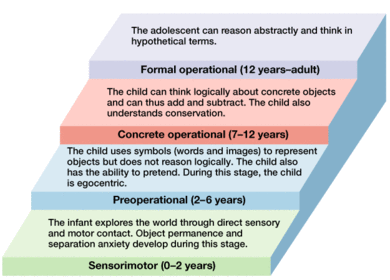
| jean piaget | a clinical psychologist known for his pioneering work in child development Cognitive development (four stages) |
| schemata | representation of a plan in the form of an outline or model |
| assimilation | making everything the same thing |
| accommodation | allowing to be with |
| sensorimotor stage | first two years of an infant's life |
| object permanence | objects continue to exist even when they cannot be observed |
| preoperational stage | begins around age two and lasts till you are age seven |
| egocentric | thinking only of oneself |
| animism | attribution of a soul to inanimate objects |
| concrete operations | stage of cognitive development |
| law of conservation | principle that in any closed system subjected to no external forces, the mass is constant irrespective of its changes in form |
| formal operations | begins at age 11 |
| deferred gratification | ability to resist the temptation for an immediate reward and wait for a later reward |
| Lev Vygotsky | made the Vygotsky's social development theory |
| Zone of proximal development | difference between what a learned can do without help and what he or she can do with help |
| Erik Erikson | personality develops in a series of stages |
| trust vs mistrust | first stage of erik erikson's theory |
| autonomy vs shame and doubt | second stage |
| initiative vs inferiority | third stage |
| industry vs inferiority | fourth stage |
| identity vs isolation | fifth step |
| intimacy vs isolation | 6th step |
| generativity vs stagnation | 7th stage |
| integrity vs despair | 8th stage |
| lawrence Kohlberg's theory of moral development | morality starts from the early childhood years and can be affected by several factors |
| preconventional stage | develop punishment obedience orientation and instrumental relativist orientation |
| conventional stage | good boy- nice girl orientation and law and order orientation |
| post conventional morality | social contract orientation and universal ethical principle orientation |
| primary sex characteristics | any of the body structures directly concerned in reproduction |
| secondary sex characteristics | features that appear at sexual maturity |
| menarche | first menstrual cycle |
| menopause | cannot bleed anymore |
| social clock | cultural specific timetable for events to occur |
| crystallized intelligence | ability to use skills, knowledge, and experience |
| fluid intelligence | Capacity to think logically and solve problems in novel situations, independent of acquired knowledge |
| Elizabeth Kubler Ross stages of grieving | study of death and dying |
| Four stages, Piaget |
Want to create your own Flashcards for free with GoConqr? Learn more.