
Flashcards
Cell Signalling Lecture 1
Cards in this deck (36)
- 1state the requirements for a communication system-reliability -minimal distortion -amplification -regulated cross talk
- 2give vague examples of how signalling is used in multicellular organismsto control cell development and to control the activity of cells specialised to perform diverse functions
- 3give the simple structure required for all systems for communication to take place.Transmitter -> Channel -> Receiver
1) Signal generated in response to a change in internal state
2)Signal carried to receiver
3)Arrival of signal coupled to a change in internal state of receiver - 4what properties in proteins do reliable communication systems result from?i) binding sites which can show high affinity and great specificity
ii) Conformational changes may occur when molecules bind to proteins which, with great reliability and specificity, alter the activity of the protein at another site. - 5target cells will only respond to a signal if:i) the signal is present ii) the target cell is expressing the receptor for the signal
- 6describe the 2 types of molecule which can be used for signalling (ie how molecule relates to cell position)-secreted molecules
-plasma-membrane bound molecules - 7describe the spatial organisation of chemical signals (eg which types of signals can work over what distances?)long distances (pheromones and hormones), intermediate distances (local hormones or very short distances (neurotransmitters, cell surface molecules and intercellular messengers)
- 8state 2 pheromones/chemoattractantsBombykol and Cyclic AMP
- 9Name 2 local hormonesnitric oxide
- 10what are pheromones?pheromones are chemical signals which are used to transmit informations between organisms. (frequently play a role in sexual reproduction)
- 11Describe an example of the action of pheromones in insectsBombykol- synthesised and released by female silkworm (scent glands on abdomen). Bombykol is a volatile molecule and is carried in the air and can attract male moths from a distance of up to 1km
- 12state the genus and species name for the slime mouldDictyostelium discoideum
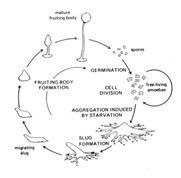
- 13state the 2 forms the slime mould exists inthe vegetative form and the fruiting body
- 14describe the vegetative statefree living amoebae move over the forest floor feeding on bacteria and dividing every few hours.
- 15What happens when food is scarce?the amoebae stop dividing nd begin to aggregate together to form a fruiting body, which develops to contain dominant spores/ in suitable environmental conditions, the spores germinate to form free living amoebae.
- 16Describe the aggregation processdependent upon chemotaxis. founder cells begin to secrete cyclic amp which functions as a chemoattractant to direct neighbouring cells to the aggregation centre.
- 17draw a life cycle of an slime mould amoebae
- 18describe how hormones are dispersed in plants and animalsplants- spread by bulk movement of water and photosynthate
animals- dispersed by circulatory systems - 19draw a diagram demonstrating local hormone action mechanisms
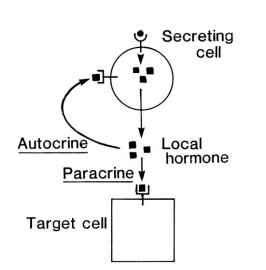
- 20describe in words the action of local hormoneslocal hormones act only in the immediate vicinity of the secreting cell and transmit information either to immediate neighbours (paracrine) or back to themselves (autocrine).
- 21how are local hormones limited?spread by diffusion and their affect is limited due to rapid inactivation.
- 22describe an example of a local hormoneNitric oxide- paracrine system. made in epithelium of blood vessels and act of smooth muscle.
- 23What are neurotransmitters?chemical signals which are released from nerve endings to activate target cells.
neurotransmitter is synthesized and packaged at the nerve terminal - 24describe 2 important roles of cell surface molecules which function in cell-cell and cell-matrix interactions.function in cell adhesion by holding cells together and attaching them to the extracellular matrix
also some cell surface molecules have signalling functions, thereby allowing cells to communicate with each other (cell-cell) or to receive information from the cell matrix - 25describe an example of cell-cell signallingnotch delta system during development of neural cells from epithelial cells in drosophila. A developing neural cell presents a transmembrane protein
(Delta) that acts as a ligand for receptors (Notch) on neighbouring epithelial cells. Activation of receptor prevents the cell from developing in to a neurone. - 26how are cells able to transfer intracellular messengers directly from one cell to another?through specialised junctions- the gap junction of animal cells and the plasmodesmata of plant cells.
- 27how are gap junctions formed?where membranes of opposing cells are joined by cylindrical channels of 1.5-2nm (connexons)
- 28Describe some roles of the gap junction-play a role in metabolic co-operation (sharing of metabolites) and signalling (due to transfer of messengers such as cyclic AMP, IP3 and CA2+ which can diffuse from one cell to the next.
- 29how is the permeability of gap junctions regulated?a decrease in cytosolic pH, or an increase in cytosolic free Ca2+, reversibly decreases permeability.
- 30why are such changes in permeability important?important to minimising damage caused by cell death
- 31what is the gap size in a gap junction?can be big or small. usually ranges from 2-4nm.
- 32what is the connexon composed of?6 subunits organised into a hexagon.
- 33what are plasmodesmata?specialised junctions found in plant cells. they consist of tubular extensions of the plasma membrane called plasmodesma (40-50nm in diameter)
- 34describe the organisation of the endoplasmic reticulum in this structureextensions of the endoplasmic reticulum called desmotubules pass through the plasmodesma- endoplasmic reticulum essentially continuous throughout organism except stomata.
- 35state the size limit of molecules through the plasmodesmata and which molecules can pass throughallows diffusion of molecules up to about 1000 daltonsm which allows intercellular transport of metabolites, signalling molecules and proteins.
- 36why are plants unable to have gap junctions?cell wall