
Flashcards
Describe - Practice questions and answers for AS Physics A
Cards in this deck (10)
- 1Describe an experiment to determine the acceleration of free fall g using a falling body.Measurements: Height (distance)
Time (of fall)
Instruments: Stop watch/timer/clock/video
Ruler/tape (measure)
Calculation: g = 2s/t2 or g = 2 gradient of . s-t2 graph
g is an estimate: air resistance / drag
parallax (landing time)
starting/stopping the clock
((v+u)/t = s/t, v=u+at, u=0)
(s=ut+1/2at^2 (ut=0), s = at^2/2, a(g)=2s/t^2). - 2Describe the motion of bodies falling in a uniform gravitational field with drag.Acceleration:
Terminal velocity:
Net / total / resultant force (on drop) is zero
‘upward force = downward force’ /
‘weight = drag’ / ‘weight balances drag’ - 3Describe a simple experiment to determine the centre of gravity of an object.Suspend object from a point and then) mark a vertical line on the object
Plumb line / ‘pendulum’ (used to find the vertical line)
Hang from another point / place (and draw another vertical line) (wtte)
Where the lines intersect gives position of centre of gravity (wtte). - 4Describe the factors that affect thinking distance and braking distance.speed, mass, condition of tyres/tread, condition of brakes, condition of road (surface), gradient of road
For each factor, correct description of how braking distance is affected :
Greater speed means greater distance OR distance ∝ speed2
Greater mass means greater distance OR distance ∝ mass
Worn tyres / brakes implies less friction therefore greater distance
Bald tyres
Wet / slippery / icy road means less friction therefore greater distance
Uphill means shorter distance. - 5Describe and explain how air bags, seat belts and crumple zones in cars reduce impact forces in accident.Prevent collision with steering wheel / windscreen /dashboard
Time for stopping is more / distance for stopping is more / seat belt ‘stretches’
Smaller deceleration / acceleration (of person)
Reference to K.E.=Fs or ½ mv^2=Fs. - 6Describe how air bags work, including the triggering mechanism.Large deceleration / rapid decrease in speed (triggers the air bag).
- 7Describe how the trilateration technique is used in GPS.(Several) satellites used
Distance from (each) satellite is determined.
Time taken for signal to travel from satellite to car/‘delay’ time for signal is determined.
Distance = c x ‘delay’ time
Position / distance is determined using c / speed of e.m waves / radio waves / microwaves and delay time
Trilateration is used to locate the position of the car OR position of car is where circles/spheres cross/intersect. - 8Describe the behaviour of springs and wires in terms of force, extension, elastic limit, Hooke’s law and the force constant (ie force per unit extension or compression).Measurement:
original / initial length (Not: final length)
extension / initial and final lengths, weight / mass
Equipment:
Micrometer / vernier (calliper) (for the diameter of the wire)
Ruler / (metre) rule / tape measure (for measuring the original length / extension)
Travelling microscope (for measuring extension)
Scales / balance (for measuring the mass & mg equation is used or for measuring weight) / Newton meter (for the weight of hanging
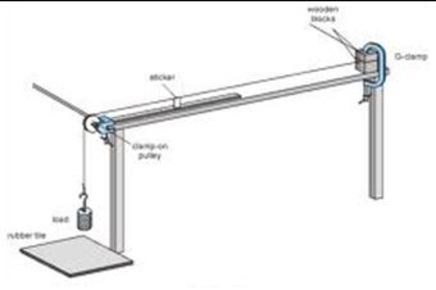
masses) / ‘known’ weights used. - 9Describe an experiment to determine the Young modulus of a metal in the form of a wire.
- 10Describe the shapes of the stress against strain graphs for typical materials.

Information
- Description
- Describe - Practice Questions and answers for AS Physics A OCR - Mechanics G481
- Created by
- nikeishabk
- Views
- 1,862
- Tags
- Rating