
Flashcards
Memory AS questions
Cards in this deck (86)
- 1Name the three types of memorySENSORY REGISTER
SHORT TERM MEMORY
LONG TERM MEMORY - 2What is capacityTHE AMOUNT OF INFORMATION THE STORES CAN HOLD BEFORE FORGETTING
- 3What is durationHOW LONG INFORMATION CAN BE STORED FOR WITHIN THE STORES WITHOUT BEING FORGOTTEN
- 4What is codingHOW INFORMATION IS STORED, CREATING A 'TRACE'
- 5Describe the Sensory registerThe sensory register temporarily stores the information from the senses (smell)
The sensory register is coded differently depending on the sense (tactile auditory)
Unless info is paid attention to the info is lost through spontaneous decay
It has and limited duration and capacity - 6Describe the STMThe STM is coded for acoustically and has limited capacity and duration
- 7Describe the LTMThe LTM has unlimited capacity and duration. It codes things acoustically. Things can be temporarily forgotten but are usually retrieved through cues. There are 3 types of LTM
- 8What are the 3 LTMsSemantic
Episodic
Procedural - 9Describe the semantic memorySemantic memories are those which are factual and remembered due to their factual relevance. No extra information is stored apart from the fact e.g Paris is the Capital of France, the fact is there however where the fact was learnt is not. Conscious recall.
- 10Describe the episodic memoryEpisodic memory is where all the events are stored in the LTM, such as dates, times, smells and events (such as concerts)
- 11Describe the procedural memoryThe unconscious behaviours, things which we are so used to doing and our now natural such a brushing your hair
- 12STM Duration expPeterson and Peterson
- 13The method of the peterson and peterson expPearson and Peterson used non-sense trigrams which P had to memorise and then had 3,6,9,12,15,18 second interval which included an interference task where they were asked to count back in 3s from any given number. After this they were to recall the non-sense trigram
- 14Results of PP3 second interference = 80% accuracy on recall
18 seconds interference = 10% accuracy on recall - 15Conclusion of PPThe idea that the longer the interval the less accuracy found. Therefore explaining that the STMs capacity isn't much higher than 18 seconds
- 16who investigated into the sensory register.Sperling
- 17The method of the Sperling exp4 letters in 3 rows. P asked to recall words which has been memorised. either all words or just one line which was indicated by a high, medium or low sound
- 18Results of Sfree-recall = 4 or 5 words
set line = 3 words per line - 19Conclusion of SperlingThe idea that when p had to recall only one line recall was better and the letters were available on each line therefore this shows that all had been retained in the STM but the free recall meant that the letters were fading as there was too much info to retain
- 20Who did the Exp into the duration of LTMBahrick et al.
- 21Method of Bahrick et al.392 pupils were called back to school who had left either 15,30 or 48 years ago. They were asked to either recall all the names they could remember (free recall), given names and asked to match it to a photo or given a photo and asked to say the name
- 22Results of B15 yrs = 90% photo recog
60% free recall
30 yrs = 30% free recall
48 yrs = 40% free recall
80% name recon - 23Conclrecog is better than recall and therefore proves that the LTM has a huge store however it contains so much information that we may need a little information to access it all.
- 24Who did an experiment on the Capacity of the STMJacobs
- 25Method of JParticipants were asked to memorise a list of letters and numbers. The list of numbers and letters increased until the P could no longer remember them all.
- 26Results of JJ found that participants could remember 5 letters and 9 numbers. Of course variations were found. It can also be said that age affects the amount we can retain as seen as we could possibly use the technique ch
- 27What is Millers magic number and what is it to do with?Millers magic number = 7+- 2
this means that Miller believes that a person has the capacity to hold 7, 2 below or above items. IN THE STM - 28How can we increase the number of items that can be retained in the STMBy using the technique of chunking which involves grouping a bunch of letters or numbers together to make something that is more relatable
- 29Who did an exp on coding within the STM and LTMBaddeley
- 30Method of Bs expP were asked to memorise either semantically similar words, semantically dissimilar words, acoustically similar, acoustically dissimilar words. Either had to recall the words immediately or after a 20 minute task
- 31Results of Bs expStraight away recall = has issues recalling the words which were acoustic simi
After 20 mins = issues recalling the semantically similar words - 32Conclusion of Bs expThat the STM is more likely to code acoustically and therefore as seen as it relies on acoustic coding when words were similar they got confused. The LTM is more likely to code semantically and therefore similar words caused confusion
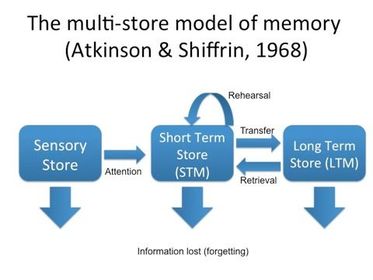
- 33Who designed the MSMATTKINSON AND SHIFFRIN
- 34Describe the MSM and what it does
- 35Give three strengths of the MSM1. Primacy effect
2. Recency effect
3. HM = Brain damaged, severe damage to the hippocampus. Struggled with memory loss. Still form ST memories but not LT memories - 36Weaknesses of the MSM1. It is too reductionist - proven by several other brain damaged patients which have suffered only certain parts of their STM being damaged
2. It cannot b proven that we rehearse everything within the STM before it goes to the LTM - 37What other model is there which explains memoryWorking memory model
- 38Who designed and tested for the WMMBaddeley and Hitch
- 39Describe the WMM outline
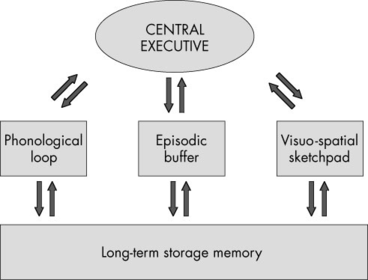
- 40Describe the Central executiveKnown as the key component and described as attention. Has limited capacity and has 'slave' systems below it which it controls
- 41What is the phonological loopThe phonological loop holds speech based info. It has two parts to it...
1. The articulatory process = the inner voice, rehearses info by repeating it
2. the phonological store = the inner ear - 42What is the visit-spacial sketch padDeals with the temporary visual and spacial info
- 43How have B and H used experimental evidence to prove their theory of the WMM is valid?B and H based their results on studies which involved interference tasks. The found that when people did tasks where they were asked to use the same part of their STM they struggled to carry out the task e.g saying 'the the the' whilst reading silently. Therefore when tasks are carried out in the same system which in this case was the phonological loop due to limited capacity only one thing can be done at a time, this may affect both or just one of the tasks being carried out.
- 44Strengths of the WMM1. KF = a brain damaged patient who had a damaged STM. He has an issue with immediate recall is words were presented verbally but not with visual information. Therefore proving how the visit-spacial sketch pad was still in place yet the articulatory loop was impaired. Therefore proving the idea of having different separate systems within the STM.
- 45Weaknesses of the WMM1. Does not provide any information as to how the information passes from the STM to the LTM
2. The idea of the central executive is simple and vague
3. The majority of the research for memory was done in a lab and therefore lacks ecological validity. - 46What is forgettingforgetting is when the information which has been learnt cannot be retrieved.
- 47How does forgetting happen within the STMThere is an accessibility problem usually due to limited capacity and duration therefore causing information to be displaced or faded away (decayed)
- 48How does forgetting happen is the LTMLikewise information can be lost due to an accessibility problem therefore it is hard to retrieve and info may have decayed. However it may also be due to other information which is very similar and therefore has caused confusion.
- 49Give an explanation to forgettingInterference
- 50What types of interference are thereretroactive and proactive
- 51What is retroactive interferenceWhen the new information affects the old information and therefore confuses it
- 52What is proactive interferenceWhen old information interferes with the new info
- 53What main experimenter looked into pro and retro interferenceUNDERWOOD
- 54What exp did underwood carry out for retroactiveA lab study was carried out with some p they were split into two groups and given the same list of paired words e.g cat-tree
The control group were only given the first list. The critical trial group were given a second list of words with the first word being the same and changing the last e.g cat-mat
Both groups were then tested to see if the new information had affected the old. The control group could recall the words better than the critical group therefore proving the new information can affect old info - 55What exp did underwood carry out for proactiveLooked at results of studies into forgetting over a 24 hour period. If people had previously learnt 15 or more word lists during the same exp, the next day the recall of their last word list was around 20% however if the people hadn't learnt any word lists earlier on their recall was 80%
- 56Strengths and weaknesses to the interference theory1. As seen there is evidence to support the interference theory, for example Underwood.
2. The theory can be proven in real life to e.g may struggle to remember french if you later start learning german
The theory explains why we forget but does not give us the biological or cognitive explanations - 57How can we help our recall if something has been forgotten?Cues
- 58Who did exp into forgetting in the LTMTulving and Psotka
- 59Outline T and Ps experimentEach p given either 1,2,3,4,5 or6 lists of 24 words. Which was divided into 6 categories or 4 words. In first condition participants had to simply recall all the words the could remember from the lists (free recall)
The second group had to recall the lists but were given the category headings as cues. - 60ResultsThose in experiment 1 who had one or two lists did better than those with more lists as they showed signs of retroactive interference.
However those in experiment 2 who had cues, the retroactive interference seemed to disappear. No matter how many lists were to be recalled the amount recalled was the same for every list (about 70%) - 61ConclusionTherefore this proves that interference did not cause forgetting as seen as when cues were there the information could still be retrieved and therefore the type of forgetting shown in this exp was cue-dependent forgetting
- 62What are the strengths and weaknesses of t and ps cue-dependent theory1. Cue dependent forgetting is supposed to be the best exp for forgetting in the LTM as it has the strongest evidence. Most forgetting is seen to be caused by retrieval-failure. Therefore also proving the idea that the LTM does have unlimited capacity its just we need the right cues to retrieve the information.
2. However the experiments were all artificial and lacked ecological validity due to being controlled lab studies.
3. The cue-dependent theory may not relate to all memories for example it may have nothing to do with the procedural memory - 63Why is EWT not always reliableAs it can be inaccurate and distorted
- 64What is EWTEWT is the evidence provided by people who witnessed an event or crime. It relies on recall from memory
- 65which two people investigated into how EWT can be distortedLoftus and Palmer
- 66Method 1Participants were shown a film of a multiple car crash and asked several questions after the film. These included 'how fast do you think the cars were going when the car hit' the word hit was replaced in different conditions with the word 'collided,smashed,bumped or contacted'
- 67Results 1depending on the word used in the question the speed estimates changed. The ps with the word smashed estimated the highest speed and those with the word contacted predicted the lower speeds.
- 68Method 2P were were split into three groups and asked the same qs however the word within the question changed from 'hit' to 'smashed' and lastly one group were given to indication of the action. A week later they were asked if they saw any glass.
- 69Results 2Although there was no broken glass within the video they watched participants were more likely to say there was glass if within the information given to them the word 'smashed' was used.
- 70What is the overall Conclusionleading questions can affect EWT
- 71Give 5 evaluation points for this question1. This exp will now have implications for police interviews and will help to improve the way interviews are carried out
2. A video would not have been as emotionally arousing as a real life event and therefore means it could effect the recall results.
3. The experimental design may have led to design characteristics, the p may have guessed the characteristics of the test due to the questions (misleading questions) and therefore acted accordingly and this also may have reduced validity and reliability of the experiment - 72Which other two people looked into leading questions HINT: one is the same as the previous expLoftus and Zanni
- 73What did Loftus and Zanni do within their expMethod: P were once again asked to watch a short film on a car crash. P wee asked either 'did you see a broken light?' or 'did you see the broken light"
- 74What did Loftus and Zanni find within this exp17% of P who were asked if they saw 'the' broken headlight said they saw one compared to only 7% when they were asked if they saw 'a' broken headlight
- 75What is Post-event discussionThe discussion which is taken place before an EWT and what effects it can have on recall
- 76Which two psychologists did exp into post- event discussions1. Shaw et al
2. Gabbert et al - 77Briefly explain Shaw et als expPaired Ps with a confederate. The pairs were shown videos of a staged robbery and were interviewed. They were to take in turn to answer questions. When the P answered the question first accuracy was 58% of the time. When the confederate answered accurately recall was accurate 67% of the time. When confederate answered inaccurately recall declined to 42%
- 78Briefly explain Gabbert et als expGabbert investigated how misleading a conversation could be before an EWT and whether or not it affected the recall. This was done by two groups of Ps, Young adults (17-33) and older adults (58-80) they were both asked to watch a video of a staged crime. They were then exposed to misleading information in one of two ways - either through a convo with a confederate who pretended to be a p, or reading a written report also written by a c pretending to be a p. Ps were then given a recall test. Results found that in both groups of adults those who were exposed to a misleading conversation scored lower accuracy on recall than those who read the article.
- 79What does the affect of age have on EWTChildren = not very good accuracy
Young adult = good accuracy
Elderly / older adults = not very good accuracy - 80How can you prove that yound adults have better accuracy than the rest using an experimentValentine and Coxon investigated age on EWT
- 81How did Valentine and Coxon do this3 groups of P (C, YA and E) watched a video on a kidnapping. Asked a series of leading and non-leading questions about what they had seen.
Results showed that both elderly and young children gave more wrong answers to non-leading questions than the YA. Children also gave the most wrong with leading questions however elderly did not give as many wrong answers to leading qs. - 82How does anxiety affect focusPsychologists believe that a small increase in anxiety and arousal may increase the accuracy of recall however to little or too much anxiety and arousal can decrease the recall of a person
- 83What happens when anxiety is too high? Take the example of a violent crimeIn a violent crime the anxiety and arousal levels of a person would be extremely high and therefore peoples accuracy would decrease. Whilst watching the crime people may focus more on central details i.e. the knife and neglect any peripheral details i.e what the criminal was wearing
- 84What information can we use to evaluate the effect of anxiety on EWT?1. Misleading questions and anxiety does not always affect EWT... A field study by Yuille and Cutshall showed that the witnesses of a real incident (shooting) had high EWT accuracy.
A thief was shot and killed my a policeman and witnesses were interviewed. 13 of them were asked to return 5 months later to be reinterviewed. Even after this time period the accuracy of recall was very high.
Yuille and Cutshall even incorporated two misleading questions which seemed to have no effect on the accuracy of recall.
The study has high ecological validity as it was based on a real life event. However the witnesses who experienced the highest levels of stress were also the closest to the event - therefore it is difficult to determine whether it was the proximity or the stress which contributed to the accuracy of recall. - 85outline the cognitive interviewTo increase EWT during police questioning, the cognitive interview was developed by Geiselman et al. The cognitive interview is a set structure of what is to be included in the interview process. Firstly the interviewer tries to make the witness relaxed and alters the language within the interview to suit the witness.
Secondly the witness mentally recreates the environmental context (sight and sound etc) then creates the internal context (mood) of the crime scene.
After this the witness reports everything they can remember about the situation even if the information is irrelevant.
The witness is then asked to report the details of the crime in different orders to make sure no information is left out.
After the witness must recall the situation from someone else's perspective
The interviewer avoids any judgemental and personal comments. - 86Evaluate the cognitive interview for EWTGeiselman et al. Carried out an exp in a staged situation where an intruder entered a classroom wearing a blue rucksack and stole of projector. Two days later Ps were tested using the independent group designs measure. One group used the standard interview procedure and the other group were interviewed using CIT. Early in questioning Ps were asked 'was the guy with the green rucksack nervous?'
Results showed that those which were asked using the standard interview technique were more likely to recall the rucksack as being green instead of blue. Which means that the CIT does improve accuracy.
However techniques used within the CIT can cause deep exploration into the situation and may cause a high level of stress if not careful and may decrease EWT, therefore causing ethical issues.
All experiments carried out to prove CIT is effective were lab studies and therefore lack ecological validity.
Information
- Description
- Flashcards on Memory AS questions , created by Sophie Rew on 14/05/2016.
- Created by
- Sophie Rew
- Views
- 3
- Rating