
Flashcards
Exam two set
Cards in this deck (44)
- 1The _____ is also called the steady-state response or particular solution.forced response
- 2A pole of the input function generates the form of the _____.forced response
- 3A pole of the transfer function generates the form of the _____.natural response
- 4The farther to the _____ a pole is on the negative _____, the faster the exponential transient response will decay to zero.left, real
- 5The _____ generate the amplitudes for both the forced and natural responses.poles and zeros
- 6The real part of a pole generates what part of a response?The time constant of an exponential response
- 7In a system with an input and an output, what poles generate the steady-state response?The input poles
- 8In a system with an input and an output, what poles generate the transient response?The system poles
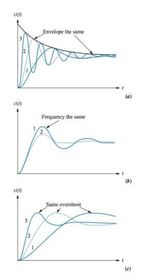
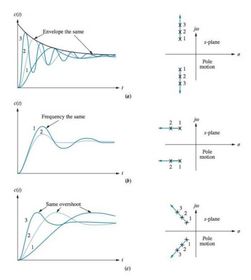
- 9If a pole is moved with a constant imaginary part, what will the responses have in common?The damped frequency of oscillation
- 10If a pole is moved with a constant real part, what will the responses have in common?They will exist under the same exponential decay envelope.
- 11If a pole is moved along a radial line extending from the origin, what will the responses have in common?They will have the same percent overshoot and the same shape.
- 12What are two conditions under which the response generated by a pole can be neglected?1) Pole's real part is large compared to the dominant poles,
2) Pole is near a zero - 13Name three basic forms of interconnecting subsystems.Cascade, parallel, feedback
- 14For each form of basic interconnecting subsystem, state how is the equivalent transfer function is found.cascade - product of individual transfer functions; parallel - sum of individual transfer functions; feedback - forward gain divided by one plus the product of the forward gain times the feedback gain
- 15What part of the output response is responsible for determining the stability of a linear system?Natural response
- 16Why are marginally stable systems considered unstable under the BIBO definition of stability?Sinusoidal inputs of the same frequency as the natural response yield unbounded responses even though the sinusoidal input is bounded.
- 17Under what conditions would the Routh-Hurwitz criterion easily tell us the the actual location of the system's closed-loop poles?If there is an even polynomial of second order and the original polynomial is of fourth order, the original polynomial can be easily factored.
- 18Does the presence of an entire row of zeros always mean that the system has jw poles?No; it could have quadrantal poles.
- 19Increasing system gain has what effect upon the steady-state error?Decreases error.
- 20For a step input, the steady-state error is approximately the reciprocal of the static error constant if what condition holds true?Static error coefficient is much greater than unity.
- 21For a step input disturbance at the input to a plant, describe the effect of controller and plant gain if each transfer function has no pure integrations on the effect of the disturbance.Disturbance is minimized by decreasing the plant gain and increasing the controller gain.
- 22Define system type.the number of pure integrations in the forward path
- 23Is the forward-path actuating signal the system error if the system has nonunity feedback?no
- 24How are nonunity feedback systems analyzed and designed for steady-state errors?A unity feedback is created by subtracting one from H(s). G(s) with H(s)-1 as feedback form an equivalent forward path transfer function with unity feedback.
- 25What are two methods for calculating the steady-state error for systems represented in state space?final value theorem and input substitution methods
- 26What does a root locus represent?the paths of the closed-loop poles as the gain is varied
- 27What does the number of branches of the root locus equal?the number of closed-loop poles
- 28Describe two ways of obtaining the root locus?1) Finding the closed-loop transfer function, substituting a range of gains into the denominator, and factoring the denominator for each value of gain. 2) Search on the s-plane for points that yield 180 degrees when using the open-loop poles and zeros.
- 29Do the zeros of a system change with a change in gain?no
- 30Where are the zeros of the closed-loop transfer function?At the zeros of G(s) and the poles of H(s)
- 31What are two ways to find where the root locus crosses the imaginary axis?1) Apply Routh-Hurwitz to the closed-loop transfer function's denominator. 2) Search along the imaginary axis for 180 degrees.
- 32How can you tell from the root locus if the settling time does not change over a region of gain?If the branch of the root locus is vertical, the settling time remains constant for that range of gain on the vertical section.
- 33How can you tell from the root locus that the natural frequency does not change over a region of gain?If the root locus is circular with origin at the center.
- 34Describe the conditions that must exist for all closed-loop poles and zeros in order to make a second-order approximation.1. Poles must be at least five times further from the imaginary axis than the dominant second order pair. 2) Zeros must be nearly canceled by higher order poles.
- 35What rules for plotting the root locus are the same whether the system is a positive- or a negative-feedback system?Number of branches, symmetry, starting and ending points
- 36Describe how the zeros of the open-loop system affect the root locus and the transient response.The zeros of the open loop system help determine the root locus. The root locus ends at the zeros. Thus, the zeros are the closed-loop poles for high gain.
- 37Closed-loop poles change with changes in _____.system gain
- 38What kind of compensation improves the steady-state error?PI or lag compensation
- 39What kind of compensation improves the transient response?PD or lead compensation
- 40What kind of compensation improves both the steady-state error and transient response?PID or lag-lead compensation
- 41Name three advantages of feedback compensation.1) Response of inner loops can be separately designed; 2) Faster responses possible; 3) Amplification may not be necessary since signal goes from high amplitude to low.
- 42Cascade compensation to improve the transient response is based upon what pole-zero placement of the compensator? What are the reasons for this placement?The zero is placed closer to the imaginary axis than the pole. The total contribution of the pole and zero along with the previous poles and zeros must yield 180 deg at the design point. Placing the zero closer to the imaginary axis tends to speed up a slow response.
- 43Cascade compensation to improve the steady-state error is based upon what pole-zero placement of the compensator? What are the reasons for this placement?A pole is placed on or near the origin to increase or nearly increase the system type, and the zero is placed near the pole in order not to change the transient response.
- 44—
Information
- Description
- Undergraduate Controls Flashcards on Exam two set, created by David Smith on 24/06/2016.
- Created by
- David Smith
- Views
- 0
- Rating