
Flashcards
Chapter 2 Sigmund Freud

Cards in this deck (46)
- 1Sigmund Freud-Created psychoanalysis, a unique method of research for understanding the human individual.
- Discovered psychological processes such as:
Repression, resistance, transference, resistance, infantile sexuality - 2NeurosisAn emotional disturbance, but the disturbance is usually not so severe as to prevent the individual who has it from functioning in a normal society
- 3CatharsisEmotional release
- 4Unconscious ProcessesForces of which a person is unaware of
- 5Wishes-Ideas or thoughts that would be repressed and rendered unconsciously
*during traumatic events a wish arose that went against ego-ideal
*acceptance of reality = pain ➡️ repressed wish - 6RepressionThe blocking of a wish or desire from consciousness, is unavoidable and necessary in order for a civilized society to exist.
*Eject painful wishes, not permitting them to enter consciousness, but the repressed wishes refuse to behave accordingly causing problems
* Then restore the wishes to consciousness in order to deal with them realistically - 7Free AssociationA patient is asked to verbalized whatever comes to mind, no matter how significant, trivial or even unpleasant idea, thought, or picture may seem.
- 8Freudian SlipsBundled acts: slips of a tongue, slip of the pen, or a lapse of memory
*Freudian theory = There is a motive for everything. - 9Cause vs MotiveCause: implies the action of a material, impersonal force that brings something about
Motive: refers to personal agency and implies an emotion or desire operating on the will of a person and leading him or her to act - 10Dreams*royal road to unconscious
- 11Children DreamsOften easier to understand because their defenses have no yet masked their motives.
-They dream very simply of the fulfillment of unsatisfied wishes from the day before.
EX: No candy in the day = Abundance of candy dreams - 12Adult Dreams*Manifest Dream: the dream as it is remembered the next morning
-frequently appears incoherent and nonsensical, the fantasy of a mad person
*Latent Dream: the meaning or motive underlying the manifest dream - 13LibidoTo refer to the emotional and psychic energy derived from the biological drive of sexuality
- 14Drive*a psychological or mental representation of an inner bodily source.
Characterized in 4 Features:
-Source: bodily stimulus/need
-Impetus: amount of energy or intensity of the need
-Aim: the goal and purpose to reduce excitation
-Object: the person or object in the environment through which the aim may be satisfied - 15ErosRefers to life impulses or drives, those force that maintain life processes and ensure production of the species.
- 16Thanatosencompassing death impulses or drives is a biologically reality and the source of aggresiveness a d reflects the ultimate resolution of all life's tensions in death.
- 17Polymorphous Perversethe child who seeks pleasre from mnay areas of the body
- 18AutoeroticThey seek pleasure from their own bodies rather than from the body of another person
- 19Erogenous ZonesAreas of the body that provide pleasure
- 20The Psychosexual Stages of DevelopmentHe believed that by passing through a series of psychosexual stages in which differet erogenous zones are important, children move from autoeroticism to reproductive sexuality and develop their adult personalities.
- 21Oral Stages-Birth to 1 year
-Major source of pleasure and conflict is the mouth
-2 types of oral activity: Ingestion and Biting first types of character/traits that may develop later one - 22Anal Stage-1 year- 2 years
-Pain/Pleasure from pooping and peeing
-Retention and expulsion are further models for future character traits - 23Phallic Stage-3 years to 6 years
-The child's interest in the genitals is not with their reproductive function but with their ability to give pleasure in autoerotic activity and their significance as a means of distinguishing between the sexes. - 24Latency Period-7 years to Puberty
-sexual impulses, which are unacceptable in their direct expression are channeled and elevated winto more culturally accepted activities. - 25Genital Stage-Adolescence when genital organs mature
-Rebirth of sexual desire and seek for gratification deom someone else. - 26Freud used sexuality as a model for a person's style of lifeCharacter is built up by responding to one's sexuality; the way in which persons revolves the Oedipus complex is crucial to adult personality; neurosis represents a fixation at an earleir stage of sexual development.
- 27ID"Core of our being"
-it represents our basic drives, needs and wishes - 28Pleasure Principle-Seeking immediate tension reduction
-When libido builds up it reaches an uncomfortable level of energy. It then finds a way to release the energy to not feel pain and recceive pleasure.
-It does not care about the consequences of its action - 29Ego-emerges in order to realistically meet the wishes and demands of the ID i accorance with the outside world.
- 30Super- Ego"Innermost core"
Represents internalized values, ideals, and moral standards. - 31Super-Ego 2 Systems-Conscious: capacity for self-evaluation; criticism and reproach
-Ego-Ideal: an ideal self-image consisting of approved and rewarded behaviors (source of pride and a concept of who we think we should be) - 32The Relationship of the ID, Ego, Super-Ego to Consciousness-ID: seeks pleasure
-Ego: seeks reality
-Super-Ego: seeks perfection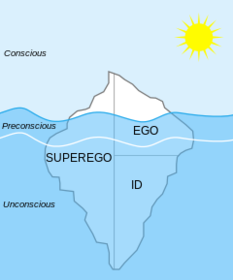
- 33Reality Anxietyfear of a real danger in the external world
- 34Neurotic Anxietyfear that one's inner impulses cannot be controlled
- 35Moral Anxietyfear of the retributions of one's own conscience
- 36Defense Mechanisms-Procedures that wod off anxiety and prevent our conscious perception of it.
1. occur on an unconscious level so that we are not aware of what we are doing
2. they deny or distort reality so as to make it less threatening. - 37Denial-refusing to acknowledge an unpleasant reality or fact of life.
-" That's not going to happen to me" - 38Projection-Unconscious attribution of an impulse, attitue or behavior onto someone or something else in the environment
- 39Reaction Formation-Expresses an impulse by its opposite
EX: Disliking someone but when in person you pretend to like them - 40RegressionPerson moves backward in time to a stage that was less anxious and had fewer responsibilities
- 41Rationalizationdealing wit an emotion or impulse analytically and intellectually in order to avoid feeling it.
- 42Identificationreducing anxiety by modeling our behavior on that of someone else.
- 43Displacementif an object that would satisfy an impulse of the ID is unavailable, we may shift our impulse onto another object
- 44Subliminationrechannels an unacceptable impulse into a more socially desirable outlet.
EX: sexual curiosity may be directed into intellectual research, sexual activity into athletics - 45Transference-a process whereby the patient transfers t the analyst emotional attitudes felt as a child toward important persons.
- 46Postive vs. Negative TranferencePositive: friendly, affectionate feelings toward teh physician
Negative: characterized by the expression of hostile angry feelings
Information
- Description
- Flashcards on Untitled, created by Ivet Trinidad on 01/13/2017.
- Created by
- Ivet Trinidad
- Views
- 6
- Rating