
Flashcards
6. DNA and aa seq. evolution, self-study 1
Cards in this deck (30)
- 1A major divide in evolutionary theory (particularly in the 1970s and 1980s) was regarding the..relative importance of random genetic drift versus natural selection
- 2What did selctionists believe?That gene substitutions occur as a result of positive selection whereby an allele predominates only if it improves fitness
- 3What was the alternative view?KIMURA (1968) proposed alternatively the neutral evolution theory whereby RANDOM GENETIC DRIFT was the main factor controlling evolutionary change.
- 4Evidence for selectionist view?-Sickle-cell anaemia; evidence for balancing selection?
-Caused by a SNP in the β-globin gene
-Results in red blood cells that become sickle-shaped under oxygen stress
-mutation expected to be lost from popn through natural selection, but the traits confer resistance to malaria, -> increasing life-expectancy – so in malaria-prone areas balancing selection promotes the polymorphism - 5What is a way of testing neutral theory?-look for differences in the ratios of synonymous and non-synonymous mutations (differences) between species that are either polymorphic or invariant (fixed) within each of the two species. Neutral theory would predict these ratios to be the same as fixation or elimination is viewed as the end result of random drift.
- 6Results of a test for neutral theory?Drosophila study indicated significant differences, refuting the neutral theory, but other studies (e.g. mouse, humans) have found no differences (Graur)
- 7nucleotide substitution models: issue?cannot observe the process of nucleotide substitution in nature as it occurs too slowly
- 8How do we get around this issue?- inferred by looking at DNA sequence differences between related taxa
- 9Simplest model:-Assume that the evolutionary distance between two sequences is equal to the number or (better) proportion of differences between sequences
-This is the assumed minimum ‘degree of divergence’, ‘percent identity’, ‘Hamming Distance’ or ‘p-distance’: - 10Issue with this simplest model?-number of nucleotide differences in a sequence is likely to be an UNDERESTIMATE
Because: Mismatches ≠ substitutions
However the ancestral sequence is normally unknown - 11The p-distance is likely to be the most appropriate model forcases where the sequences are very similar (have diverged little)
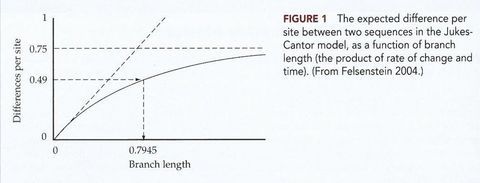
- 12Why is this model not appropriate after longer time?As the divergence between sequences increases, the number of substitutions (K) increases exponentially and reaches saturation when the number of nucleotide differences per site approaches the maximum of p = 3/4 = 0.75
- 13Therefore..impossible to determine the genetic relatedness or estimate K at higher degrees of divergence (p-distances)
- 14Other nucleotide substitution models therefore work best at..lower p-distances although they become less necessary at very close similarities.
- 15Jukes-Cantor one-parameter model- historically the most commonly used model
- Uses a single parameter α = the substitution rate - 16Assumptions of Jukes-Cantor model?- Assumes the rate α is equal for all types of substitution
-Assumes equal base frequencies (p = 0.25 for each of the 4 nucleotides - 17What does the Jukes-Cantor model calculate?-don’t normally know the time since divergence between different sequences
-SO find K, the estimated number of substitutions given the proportion of differences between sequences - 18K= −3/4 ln(1−4/3 p) What are K and p?K = number of substitutions since divergence between two sequences
p = observed proportion of different nucleotides (p-distance) - 19What does branch length show?
- 20The key assumption of the Jukes-Cantor model, that the substitution rate is constant is incorrect: which model corrects this?Kimura 2-parameter (K2P) model
- 21What is it correcting for?The K2P model corrects for the fact that there will be different rates for transitions (purine-purine or pyrimidine-pyrimidine) and transversions (purine-pyrimidine) as there are different mechanisms governing these different mutations.
- 22What is added to equation to account for this?P = observed proportions of transitions
Q = observed proportions of transversions - 23In addition to transition/transversion: what are the effects on substitution rate?1. Rate variation among sites (within a gene)
2. Invariant sites - 24What is rate variation among sites?-2nd and (especially) 3rd bases of codons are more variable, because mutations more likely to be silent so less likely to be selected against because they are less likely to change the function of the expressed protein.
-Similarly, sequences at active sites within the protein are more likely to affect function --> are more likely to be eliminated/less likely to be variable - 25An example of rate variation among sites?16S ribosomal RNA gene, has 9 ‘hypervariable’ regions. These have been shown to have less impact on the function of the ribosome in gene expression.
- 26Can we account for this rate variation in models?-Not routinely calculated BUT
-variances among the sequences in a comparison can be modelled/accounted for using the gamma distribution
-the effect of variations between sequences in more variable regions of the gene are given less weight than less variable regions (and vice versa) when calculating evolutionary distances. - 27What are invariant sites?-a special case of rate variation among sites
- E.g. start codon of a protein is normally a methionine residue. If this were changed, then the protein will not be transcribed, so this codon cannot vary (Met = CTG) - 28Can this be accounted for in a model?The proportion of invariant sites in a set of sequences to be compared can be used to adjust the site variation model
- 29If a figure legend says: "Using substitution model K2P + InvGamma" What would it mean?Kimura 2-parameter model with invariant sites and variable rate sites modelled with the gamma distribution
- 30Best way to choose the right substitution model when contructing trees?estimate which model fits your data the best (e.g. model-fitting, usually via Maximum Likelihood analysis)
Information
- Description
- BSc Molecular Evolution and Systematics (Based on Lab) Flashcards on 6. DNA and aa seq. evolution, self-study 1, created by Phoebe Stockton on 13/01/2017.
- Created by
- Phoebe Stockton
- Views
- 0
- Rating