
Flashcards
PARTICLE PHYSICS
Cards in this deck (97)
- 1Evidence for the existence of atoms: Brownian motion- Smoke particles are bombarded by atoms and molecules in air.
- The atoms and molecules have momentum and exert a force on the smoke particle.
- The collisions are random and the smoke particles are small.
- At any time a resultant force exists as there are more collisions taking place on one side of the particle that the other.
- The direction of the resultant force continually changes direction and produces the 'jerky' random motion. - 2Evidence for the existence of atoms: Diffusion- If the space in the tube is evacuated the brown colour of bromine immediately filled the tube showing that the atoms move at a high speed.
- If the space contains air the colour spreads slowly because the bromine atoms collide with the atoms and molecules which make up air so hindering their progress. In a gas there is space for atoms and molecules to move in between each other - 3Evidence for the existence of atoms: Chemical combination: The law of constant composition (Proust)The ratio of the masses of elements in a compounds is the same, however much of it there is
- 4Evidence for the existence of atoms: Chemical combination: The law of multiple proportions (Dalton)When two elements combine to produce different compounds the mass of one element that combines with a fixed mass of another element is in a simple ratio
- 5Evidence for the existence of atoms: Basic Kinetic theoryA model used to explain the physical properties of matter based on the motion of its constituent particles
- 6Evidence for the existence of atoms: IndivisibilityThe early philosophers thought that atoms were indivisible blocks of matter
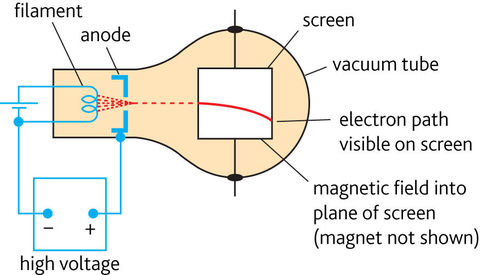
- 7Key experiments and models: Electron deflection apparatus
- 8Key experiments and models: Electron deflectionThermionic emission of a heated cathode. Different accelerating voltages caused a change in speed of the electrons. Electrons were shown to have a negative charge because they could be deflected towards a positively charged plate.
- 9Key experiments and models: Alpha scattering apparatus
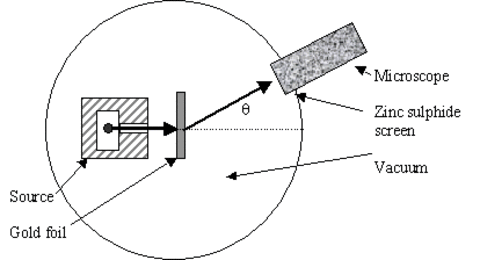
- 10Key experiments and models: Alpha scattering method and observationsAlpha particles were fired at a thin gold foil, based on the predictions of the plum pudding, only slight deflections were expected. However it was found that most of the alpha particles passed through with small deviations and around 1 in 8000 particles was scattered more that 90 degrees
- 11Key experiments and models: Plum pudding modelTiny negatively charged electrons move around inside a cloud of massless positive charge and the mass of a hydrogen atom is due to the mass of thousands of electrons
- 12Key experiments and models: Results of the alpha scattering experiment
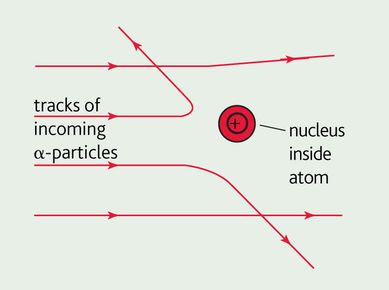
- 13Key experiments and models: Conclusions from the alpha scattering experimentMost of the atom is empty space. The atoms must have a small nucleus containing most of the mass of the atom. The nucleus is positively charged with the electrons in the space around it.
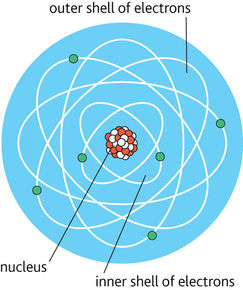
- 14Key experiments and models: Bohr's model of the atom
- 15Key experiments and models: Estimating the size of the nucleusRutherford predicted the distribution of deflected alpha particles however when high energy alpha particles were used this prediction was wrong. This is because close to the nucleus the strong nuclear force dominates. Using the rules that govern forces between charged particles, the radius of a gold nucleus can be show to be around 7x10(-15)m and the radius of a hydrogen atom to be around 1.2x10(-15)m
- 16Key experiments and models: Discovery of the proton - Rutherford's apparatus
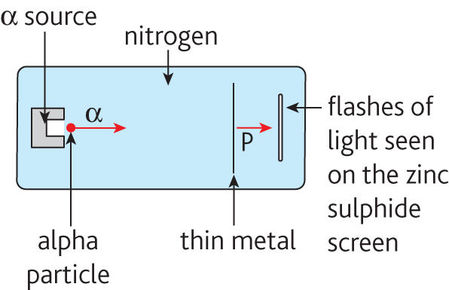
- 17Key experiments and models: Discovery of the protonRutherford bombarded nitrogen with alpha particles. The metal film, placed in front of the zinc sulphide detector, absorbed alpha particle and the film ejected a new more penetrating particle, which was the proton. As a result of the emission of the proton, nitrogen was changed to oxygen
- 18Key experiments and models: mass and charge of a protonFrom the tracks formed in the cloud chamber it was deduced that proton charge is +1.6x10(-19) C and proton mass is 1.673x10(-27)kg
- 19Key experiments and models: Neutron discovery - Chadwick's apparatus
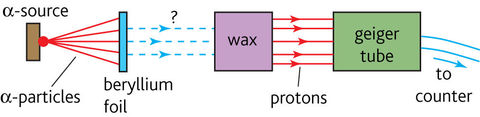
- 20Key experiments and models: Neutron discoveryAlpha particles bombarded beryllium and the result was radiation that had a weak ionising effect. When this radiation was incident on paraffin wax the radiation knocked protons out of the wax. One suggestion for this effect was extremely energetic gamma radiation, however Chadwick went on to conclude that it was in fact a stream of neutrons
- 21Key experiments and models: Proton discovery - Nuclear equation

- 22Key experiments and models: Neutron discovery - nuclear equation

- 23Key experiments and models: Nuclear structureA nucleus consists of protons and neutrons called nucleons. Each type of nucleus is referred to as a nuclide. The number of protons in the nucleus is the proton number, or Z number and it defines the element. The number of protons AND neutrons is the nucleon number, or A number and it defines the isotope of the element. A neutral atom has the same number of electrons surrounding the nucleus as there are protons. The number of nucleons is Z-A.
- 24Radioactive decay: Spontaneous decayNothing outside the nucleus caused the nucleus to emit particles
- 25Radioactive decay: Rules of decay reactionsCharge is conserved - the sum of the Z numbers on each side must be the same.
Nucleon number is conserved - the sum of the A numbers on each side must be the same - 26Radioactive decay: AlphaWhen an alpha particle is emitted the Z number decreases by 2 and the A number decreases by 4
- 27Radioactive decay: Alpha equation
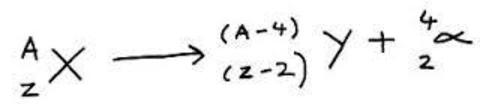
- 28Radioactive decay: Beta-When a beta- particle is emitted, a neutron effectively becomes a proton, so the Z number increases by 1 and the A number stays the same. An electron anti-neutrino is emitted at the same time
- 29Radioactive decay: Beta- decay equation
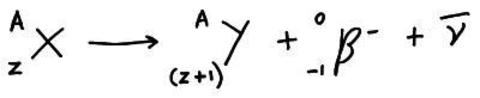
- 30Radioactive decay: Beta+When a positron is emitted the Z number is reduced by 1 and the A number remains the same. An electron neutrino is emitted at the same time
- 31Radioactive decay: Beta+ decay equation

- 32Evidence for the Big Bang: Red ShiftWavelengths of light from galaxies are longer than expected if they were stationary and suggests that the galaxies are moving further apart
- 33Evidence for the Big Bang: Chemical composition of the galaxiesThe composition of stars, galaxies and the material between them at different stages of evolution is consistent with the Big Bang theory. The composition and physical processes changes as the temperature fell due to the expansion of the universe
- 34Evidence for the Big Bang: Cosmic Microwave Background RadiationThe theory predicts that very short wavelength photons produced in the early stages of the formation of the Universe lose energy as the Universe expands. Lower energy photons have a longer wavelength and the theory predicts that the wavelength should now be in the microwave region. The distribution of microwave energy is consistent with radiation from a black body at a temperature of 2.7K as predicted.
- 35Evidence for the Big Bang: discovery of CMBRA new microwave receiver was being set up, a signal with wavelength 7.4cm was detected which was not an equipment fault. It was coming from space and equally strong in all directions. To confirm the Big Bang theory, the Cosmic Background Explorer Satellite looked for the energy distribution of other wavelengths, which did not penetrate the Earth's atmosphere. It showed that the radiation was black-body radiation at a temperature of around 2.7K.
- 36Eras of the Universe: The beginning of time10(-43s) - this is the smallest unit of time measurable. The laws of Physics cannot describe what happened before this. All the energy of the Universe was squeezed into a point.
- 37Eras of the Universe: 10(-43) - 10(-34) sTemperature: 10(32)K. Matter and energy squeezed together and continually interchanging. Energy was converted into particle and antiparticle pairs which continually annihilated to produce radiation. A rapid expansion caused the temperature to fall.
- 38Eras of the Universe - Grand Unification era - 10(-34)s10(27)K. The Universe expanded very rapidly. the four forces began to separate, Gravity separated first but the other forces were indistinguishable. Quarks and leptons were also indistinguishable. It it thought at this time more particles than antiparticles were being created, the surplus particles formed our present Universe.
- 39Eras of the Universe - Heavy particle era - 10(-10)sTemperature: 10(15)K. The strong force separated from the weak force. Heavy particles like W and Z particles existed and decayed. The Universe was still to hot for quarks to combine to form hadrons. Quarks and gluons moved around in a plasma.
- 40Eras of the universe - light particle era - 10(-7) to 3sTemperature: 10(12) Some quarks and anti-quarks annihilated but 3s after the big band the excess quarks and gluons combined to form hadrons. The isotopes of hydrogen and helium formed. After 30min only protons, neutrons and helium-4 nuclei remained.
- 41Eras of the Universe - radiation era - 10 000 yearsTemperature: 10000K. Most of the energy is electromagnetic radiation in the form of X-rays, light, ultraviolet or radio waves and eventually this became cosmic background radiation
- 42Eras of the Universe - matter era - 300 000 yearsTemperature: 3500K. Electrons were captured by the nuclei forming atoms of hydrogen and helium. Early stars began to form. The Universe was 'transparent' meaning that light could now pass unimpeded through the Universe. The expansion continued and the CMB radiation comes from this time.
- 43Eras of the Universe - galaxies formed - about 10(8) yearsTemperature: 10K. Galaxies started to form. The sun formed the milky way galaxy and the earth appeared as a satellite to the sun about 5 x 10(9) years ago
- 44Eras of the Universe - present - about 1.5 x 10(10) yearsTemperature: 2.7K. As we see it!
- 45Key Questions about the Universe: Are quarks and leptons really fundamental?Research suggests that there are 12 fundamental quarks and 12 leptons, but it was previously suggested that protons and neutrons were fundamental, so it may be possible that quarks and leptons can be broken down into yet smaller particles
- 46Key Questions about the Universe: What is mass?Why do some particles have higher masses than others? The theory is that mass is caused by particles interacting with another particle called the Higgs Boson. Massive particles interact more strongly with the Higgs particles than lighter ones. Mass is a measure of a body's intertia, therefore a more massive object finds it harder to move because it is interacting more strongly with the particles in the Higgs field that fills space
- 47Key Questions about the Universe: What is dark matter?So for only about 4% of the matter in the Universe has been accounted for. The motion of the stars and galaxies suggests that there is much more mass but what form this takes is still a mystery; 20-25% is thought to be non-baryonic dark matter, weakly interacting massive particles. The rest is dark energy which is only know to exist because it is continually increasing the rate at which the Universe is expanding.
- 48Key Questions about the Universe: Why is there only matter in the Universe?During the Big Bang, matter and antimatter should have been created equally and they should have annihilated each other. So how did our matter Universe come about? There must have been an imbalance during the early stages of the Big Bang, with more matter than antimatter being created, but why did this happen?
- 49Key Questions about the Universe: Will the Universe expand forever?There are three possibilities of the Universe depending on the density of the Universe. The density can be defined in terms of the density parameter, Ω where: Ω = actual density of the universe / critical density.
- 50Key Questions about the Universe: possible fates of the the UniverseThe critical density is the density for a flat Universe in which there is just enough matter for the Universe to expand to a maximum limit but the rate of expansion would decrease with time. This is thought to be the least likely scenario. If Ω<1 the Universe would be open and continue to expand forever. If Ω>1 then the Universe would be closed. It would eventually stop expanding and then collapse to end with a 'Big Crunch' Dark energy may raise other possibilities.
- 51Quarks: DiscoveryPhysicists bombarded protons with very high energy electrons which therefore had short wavelengths. At low energies the proportion of the electrons scattered at any angle was as predicted by assuming the proton to be a fundamental particle. However, as the energy was increased, the proportion scattered at large angles increases, showing that there are particles inside the proton.
- 52Quarks: Deep Inelastic scattering: Elastic collisionsThe total kinetic energy of the electron and recoiling atom is equal to the kinetic energy of the incident electron.
- 53Quarks: Deep inelastic scattering: inelastic collisionsThe kinetic energy after the collision is less that the kinetic energy before the collision. This is caused by electrons in the atom becoming excited
- 54Quarks: deep inelastic scattering: liberation of an electronAn electron is liberated so kinetic energy is lost in ionising the atoms
- 55Quarks: Comparison of deep inelastic scattering with Rutherford's experimentRutherford's experiments using alpha particles probed further into the atom.
The results of Geiger and Marsden's experiment were consistent with elastic scattering of the alpha particles but higher energy alpha particles probed further into the nucleus and suggested an internal structure. - 56Quarks: chargeQuarks with charge -1/3: down, strange, bottom
Quarks with charge +2/3: up, charm top - 57Quarks: massLowest mass: down/up
Medium mass: strange/charm
Highest mass: bottom/top - 58Quarks: Baryon numberQuarks have a baryon number of 1/3. Anti-quarks have a baryon number of -1/3.
- 59Quarks: strangenessStrangeness is a property that leads to particles with unusually long lifetimes.
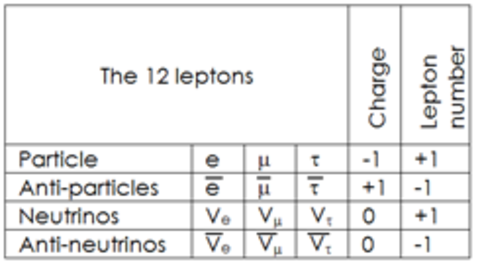
The strange quark has a strangeness of -1 - 60Leptons
- 61Forces of nature: Strong force: FactsOccurs in the nucleus between quarks and hadrons. The responsible particle is gluons. The relative strength is 1. The range is 10(-15)m
- 62Forces of nature: Strong force: theoryThis is the strongest of the force, it acts between quarks and therefore between nucleons. The strong force is strong enough to overcome the large repulsive forces acting between the charged protons in the nucleus or between the quarks that make up the protons. The exchange particles responsible are positive and negative pions. It is attractive at nuclear distance but if distances are very small, the strong force becomes repulsive.
- 63Forces of nature: Electromagnetic force: the factsOccur in charged particles. The responsible particle is photons. The relative strength is 10(-2). The range is infinite
- 64Forces of nature: electromagnetic force: the theoryThis is exerted between charged particles at rest or in motion. It therefore affects the charged quarks and leptons. Photons have no mass which leads to an infinite range.
- 65Forces of nature: Weak nuclear force: the factsOccurs in the beta decay of nucleus. The particles responsible are the bosons (W+, W- and Z0) The relative strength is 10(-6) the range is 10(-18)m
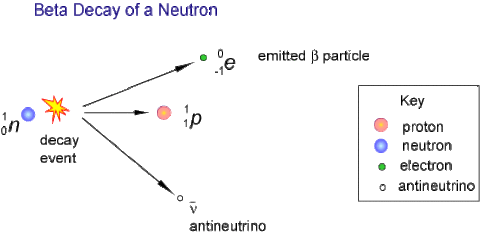
- 66Forces of nature: weak nuclear force: the theoryResponsible for radioactive decay by beta emission. In beta decay a neutron decays to a proton. In this process a W-boson is exchanged as a quark changes from down to up. The W boson then immediately decays into an electron and an electron anti-neutrino. The W and Z particles responsible for weak interactions are very massive, leading to the force having a very short range. The weak interaction is the only was which a park can change into another quark or a lepton into another lepton.
- 67Forces of nature: gravity: the factsOccurs due to mass. The particle responsible may be gravitons. The relative strength is 10(-40). The range is infinite.
- 68Forces of nature: gravity: the theoryThis is by far the weakest of the forces. It has a long range and is the dominant force that operates within and between galaxies. Theory suggests the existence of a particle called a gravitation which acts as the exchange particle for gravitational force but such particles have not yet been found.
- 69Force of nature: Unifying theoryAt high energies the electromagnetic force and weak nuclear force cannot be distinguished, the merge to form the single, electroweak force. At the time of the Big Bang, none of the forces could be seen as separate, but the forces separated out as the Universe cooled.
- 70Neutrinos: DiscoveryThe beta particles emitted in beta decay have a range of energies, anything from virtually nothing to a maximum value. The total energy of the beta particle and recoil nucleus together was not constant. Since there is a set amount of energy available for decay, a particle that would carry away the energy and momentum was predicted. The properties of these neutrinos are still under intensive investigation.
- 71Classification of particles: HadronsThe particles formed from quarks comprise a class of particles called hadrons. These are particles that experience the strong force and can be further subdivided into two classes; baryons and mesons.
- 72Classification of particles: BaryonsBaryons are made from three quarks. The only stable baryon is the proton and all other baryons eventually decay, forming a proton and something else. Baryons have a baryon number of 1 or -1. Examples of baryons are neutrons and protons.
- 73Classification of particles: MesonsMesons are made up of two quarks. They have a baryon number of 0. Pions and Kaons are examples of mesons.
- 74Classifcation of particles: Decay of a neutron
- 75Classification of particles: Conservation LawsIn any decay momentum, energy, charge, lepton number, baryon number and strangeness must be conserved
- 76Wave or particle: The ultraviolet catastropheScientists developed theories to predict how the intensity of the electromagnetic radiation of a black body varied with wavelength. The theory developed worked well for long wavelength radiation but at short (ultraviolet) wavelengths the theory predicted that intensity would become infinite, which cannot be possible, in practice the intensity rises to a maximum and then falls again at short wavelengths. Scientists called the failure to predict what happened the ultraviolet catastrophe.
- 77Wave or particle: Max PlanckMax Planck suggested that the electron oscillations in hot bodies could only take certain (discrete) values given by nhf where n is an integer, h is the planck constant and f is the frequency of the radiation. These are called 'quanta'.This enabled Planck to produce a mathematical equation for the way intensity varied with wavelength for the black body radiation, which gave a theoretical prediction that matched the practical curve. This was not taken seriously until Einstein explained it with the quantum idea.
- 78Wave or particle: The photoelectric effect experimentThe photoelectric effect is the emission of electrons from a metal surface when electromagnetic radiation is incident on it. The clean zinc plate of the gold leaf electroscope is first given a negative charge. Electrostatic repulsion of like charges causes the leaf to rise. When ultraviolet radiation is incident on the surface the leaf falls showing that the electroscope is losing its negative charge; electrons are being lost from the surface of the zinc plate.
- 79Wave or particle: The photoelectric effect experimental observationsIf a glass plate is inserted between the ultraviolet lamp and the zinc plate, the electron emission ceases. If an ordinary filament lamp (emitting no ultraviolet light) is used, the electroscope does not discharge. Even is a very intense visible light is used, no electrons are emitted. If the ultraviolet radiation is very weak the discharge still starts immediately. The first and second observations show that there is a threshold frequency below which the photoelectric effect does not occur.
- 80Wave or particle: Einstein's explanation of the photoelectric effectElectromagnetic radiation can only be transferred in well defined 'lumps'. The energy is said to be quantised and a quantum of electromagnetic radiation is called a photon. Photon energy E=hf. For electromagnetic radiation c=fλ. It follows that photon energy E=hc/λ
- 81Wave or particle: Einstein's explanation in more detailElectrons are bound to a metal surface rather like gravity holds us to the earth. To remove an electron from a metal surface a minimum amount of energy is needed. This is called the work function φ. An electron that is more tightly bound to the surface needs more energy than this. Most importantly, the energy to remove an electron has to be delivered at one instant - an electron cannot store energy up a bit at a time
- 82Wave or particle: Einstein's explanation in more detailWhere hf < φ the photon has insufficient energy to liberate an electron. Where hf = φ the electron can just leave the surface and f in this case is the threshold frequency f0. If the hf > φ there is energy to spare and this becomes kinetic energy of the electron.
- 83Wave or particle: Einstein's photoelectric equationhf - φ + Ek(max). On a graph of EK(max) over frequency, the gradient is the Planck constant and the x intercept is the threshold frequency, the y intercept is -φ
- 84Wave or particle: Explaining the observations in the gold leaf electroscope experimentThe glass plate absorbs the high energy (uv) photons so that only low energy, visible photons remain. Ordinary visible light photon energies are below the work function of the zinc and do not release electrons. Although there are lots of low energy photons in intense light, each one alone is incapable of liberating an electron. Even if there are very few photons of ultraviolet light, each one can liberate an electron.
- 85Wave or particle: Work functionsWork functions are energies. The energies are small and for convenience they are usually given in a unit called an electron volt (eV). This is the energy gained by an electron when it is accelerated through a potential difference of 1V. 1 electron-volt = 1.6x10(-19)J
- 86Wave or particle: Why does the wave theory fail to explain the photoelectric effect?According to the wave theory, energy arrives at the surface continually. Low frequency light of high intensity should liberate electrons when it delivers sufficient energy per second, but it liberates none at all. Weak radiation should lead to an electron taking a long time to gain sufficient energy to become free but, provided the frequency is high enough, the emission starts almost instantly.
- 87Wave or particle: Wave-particle dualityLight is neither a wave nor a particle but the way electromagnetic radiation behaves can sometimes be explained by assuming wave properties and sometimes by assuming particle properties. It depends on the experiment being performed so it is said to show wave-particle duality.
- 88Wave or particle: Wave theoryIn wave theory the square of the amplitude of a wave is proportional to the wave energy arriving per square metre per second. This is the intensity of the wave. A(2) is proportional to the number of photons arriving at the point each second. The tie-up between waves and particles is that the square of the amplitude is related to the change of a photon arriving at a point. The greater the amplitude, the greater the probability of detecting a photon.
- 89Matter waves: de Broglie wavelengthLouis de Broglie thought that since a wave can behave as a stream of particles, perhaps particles can also behave like waves. He suggested that the wavelength Λ associated with a particle is given by Λ=h/mv. Where h is the Planck particle and mv is the momentum of the particle.
- 90Wave or particle: Electron diffractionElectrons from an electron gun pass through a thin sheet of graphite or aluminium. If electrons behaved like particles they would be only slightly deviated by collisions with the atoms and form a bright region in the center of the screen
- 91Wave of particle: Electron diffraction observationsIn practice bright rings are formed which identify where electrons land on the screen. The rings are the regions where the electron waves interfere constructively to form a maximum. This shows that the electrons are more likely to arrive at certain parts of the screen than they are at other and that there are parts where no electrons arrive at all. The same pattern builds up slowly even if there are only a few electron travelling in the tube at any one time.
- 92Wave or particle: Calculating wavelengthIncreasing the accelerating voltage, increases the energy and momentum of the electrons. The wavelength therefore decreases. Shorter wavelength blue light falling on a diffraction grating produces fringes that are closer together. In this case increasing the accelerating voltage produces smaller rings with smaller spacing between them.
- 93Wave or particle: Seeing small objectsThe wavelength of radiation being used determines the smallest object we can detect with it. This is known as the resolving power. The smaller the wavelength, the better the resolution. When probing matter in particle physics, to provide useful information the accelerated particle has to have a wavelength that is about the same size as the particle it is colliding with
- 94Wave or particle: Problems with the Bohr modelOne problem is that accelerating electrons radiate energy, as they do in an aerial that is transmitting radio signals. The orbiting electrons in Bohr's atom would be accelerating and so they would radiate energy. As they lose this energy electrons would spiral into the nucleus.
- 95Wave or particle: Improving Bohr's modelThe wave-particle model of matter was used to improve Bohr's model. It was suggested that the electrons could only have certain 'discrete' or quantised energies such that there was a stationary wave with a whole number of 'loops' in the electron orbit. To change from one energy to another, photons are emitted with energy equal to the difference between the electron energies, so explaining the existence of line spectra.
- 96Wave or particle: quantum mechanical modelIn a simplified view of a hydrogen atom, the electron would be detected somewhere between the nucleus and the outside edge of the atom. It is trapped in a three-dimensional 'well' of radius equal to the radius of the atom. The walls correspond to the nucleus and the edge of the atom. To escape from the atom, the electron has to get out of the well. Within the well, the electron energy must be such that the de Broglie wave is a stationary wave with nodes at the sides.
- 97Wave or particle: Further detail on the quantum mechanical modelIn the electron wave model the probabilities of finding an electron in the nucleus and outside the atom are both zero, so the wave amplitude is zero at these points. The electron is most likely to be found where the amplitude is a maximum - midway between the nodes
Information
- Description
- PHYSICS AQA B Flashcards on PARTICLE PHYSICS, created by Heather Mansfield on 30/04/2014.
- Created by
- Heather Mansfield · Apr 2014
- Updated
- Apr 15, 2016
- Views
- 44
- Rating