
Flashcards
P7: Studying the universe
Cards in this deck (105)
- 1What is a waxing moon?When the amount of moon visible increases
- 2What is a waning moon?When the amount of moon visible decreases
- 3What is a crescent moon?When the amount of moon that is visible is less than half
- 4What is a gibbous moon?When the amount of moon that is visible is more than half
- 5What causes the phases of the moon?The moon orbits the Earth, and only the side of the moon facing the sun is lit up and visible
- 6How does the moon appear to move every night?It appears to travel from east to west across the sky in about 25 hours. This is because the Earth rotates on its own axis every 24 hours, and the moon orbits the Earth every 28 days, so the moon will have moved on a few degrees by the time the Earth is back in its original position.
- 7What is a sidereal day, and how long is it?The time taken for the Earth to travel 360 degrees
It takes 23 hours and 56 mins, which is related to the movement of the stars - 8What is a solar day?The time taken for the Earth to rotate, so that it is fully facing the sun again
It takes 24 hours - 9What is a solar eclipse?It occurs when the moon blocks out the sun (when they are on one plane
- 10Why is a total solar eclipse very rare?The moons orbit is tilted, so the shadow doesn't always go directly over the sun
The distance of the moon to the Earth is always changing, as its orbit is elliptical (this can form a partial solar eclipse if the moon is further away)
The sun is only blocked over a small part of the Earth, so it's only visible over a small area - 11What is a lunar eclipse?This occurs when the moon moves into the Earth's shadow ( when the Moon, Earth and Sun are on one plane, with the Earth in the middle)
- 12What is retrograde motion?When planets appear to slow down, and move in the opposite direction, and reverse in direction.
It sometimes occurs with Mars as the Earth is closer to to the sun, and faster than Mars, so it overtakes it every 2 years, making Mars seem as though it is moving backwards - 13What is the celestial sphere?It shows the position of an object in space, and is measured in degrees
right ascension: latitude
declination:longitude - 14What affects the speed of a wave?The medium that it is travelling through
- 15How is a wave affected if it changes in speed?It will cause a change in the waves wavelength, as frequency isn't affected, and:
speed=frequency x wavelength - 16What causes refraction?When a wave changes its speed (when it travels from one medium to another) it can cause a change in direction, which is called refraction
- 17Describe a convex lensThey are fatter in the middle than at the edge, and bring parallel rays of light to a focus
- 18What is the power of a lens?It is the strength of the lens, and the more powerful the lens the quicker it can bring parallel rays of light to a focus
- 19How can the power of a lens be measured?Power (dioptres) =1/focal length (meters)
They are inversely proportional - 20How many lenses does a simple telescope use, and what are they called?Two convex lenses
The objective lens, and the eyepiece lens - 21What is the job of the objective lens in a telescope?It collects light from the distant object being observed, and forms an image
- 22What is the job of the eyepiece lens in a telescope?It magnifies the image for viewing
- 23What is needed for a telescope to work effectively?The two lenses need to be the correct distance apart
The eyepiece lens needs to have a greater power than the objective lens (in dioptres) - 24What is magnification?It is the size of the angle that the object takes up in our vision
- 25What does the angular magnification of an optical telescope depend on?The power of its two lenses, as
magnification=focal length of objective lens
focal length of eyepiece lens
The eyepiece lens must have a shorter focal length than the objective lens, so that the image is getting magnified/ larger - 26How will the images be that are produced by a good telescope?They will be magnified, bright, clear and sharp
- 27What is the aperture size of a telescope, and how does it affect the image?The diameter of the objective lens that is used to gather light
The bigger the aperture, the sharper the image, as there is less diffraction - 28What is diffraction?When a wave passes through a gap (e.g. an aperture) it spreads out
- 29What is dispersion, and where does it occur?A convex lens bends different colours of light to slightly different focal points, as every colour has a slightly different frequency, so are refracted by slightly different amounts; this is dispersion
- 30What are the two different types of telescopes?Telescopes, which use lenses refract light, so are known as refractors
Telescopes, which use mirrors reflect light, so are known as reflectors - 31What happens at a concave mirror, and what are the advantages of it in a telescope?When parallel rays of light hit a concave mirror they are all reflected to a focus in front of the mirror
There is no dispersion, and much larger apertures can be built, as mirrors aren't as heavy as lenses, and can have supports - 32What is parallax?It is the change in the apparent position of an object when viewed from different lines of sight
Closer objects appear to move further and faster - 33What are the units of a parallax angle?60 minutes in one degree
60 seconds in one minute
They are measured in seconds of arc - 34What is the main weakness of using parallax to measure the distance of stars?The parallax angle of even the closest stars are very small and difficult to measure accurately, so it can only measure the distance of very close stars
- 35What is a parsec?It is the distance of an astronomical object with a parallax angle of 1 second of arc
A larger parsec means that the parallax angle is smaller- they are inversely proportional - 36What is the luminosity of a star?It is the star's power output- the amount of energy given out per second as radiation and light
- 37What does the luminosity of a star depend on?Its temperature: a hotter star radiates more energy per second for each m squared of its surface
Its size: a bigger star has a larger surface area to release energy - 38What is the observed brightness of a star, and what does it depend on?It is the brightness of the star that the observer sees from the Earth
It depends on the star's luminosity, the star's distance from the Earth, and any interstellar dust or gas that may absorb some of the light - 39What are Cepheids?They are stars that vary from dim to bright and back again in a regular pattern
- 40What is the maximum luminosity of a Cepheid related with ?The length of its period- the longer the period the brighter the Cepheid
They are directly proportional - 41How can the distance of a Cepheid from the Earth accurately be measured?If its period in days is measured, its luminosity can accurately be calculated using the line of best fit on the graph. This can then be compared with the observed brightness, and then the distance can be calculated, without using the size or temperature of the Cepheid
- 42What are nebula?They were fuzzy looking objects that were found in the early 20th century using telescopes- they were circular, irregular or spiral shaped
- 43What did Shapely think about the universe, and Nebulae?Nebula were clouds of dust and gas inside the Milky Way (he thought that the universe is made up of one galaxy 100,000 parsecs across)
He also thought that the Solar system was far away from the center of the Milky Way - 44What did Curtis think about the universe, and Nebulae?Nebula were distant groups of billions of stars outside the Milky Way
He also thought that the universe was made up of lots of galaxies, each 10,000 parsecs across, and that the Solar system was close to the center of the Milky way - 45What did Hubble find out from his observations of Cepheids in the Andromeda galaxy?Shapely was right that the Solar system is far from the center of our Galaxy
Curtis was right that there are many galaxies in the universe, and that the spiral nebulae are very far away - 46What units do the distances between galaxies need to be measured in?Megaparsecs= 1 million parsecs
- 47How did Hubble find that all galaxies seemed to be receding from the Earth?He studied the visible light spectra of the stars in the galaxies, and found that the light had red-shifted. The further away the galaxy the larger the red-shift, so the faster it was moving away
- 48What does a star spectrum show?A spectrometer can be attached to a telescope to produce a spectrum showing the different frequencies of light that are being produced by the star
Star spectra contain black absorption lines, because elements in the star's atmosphere absorb certain wavelengths of light - 49What is the relationship between the speed of recession of a galaxy, and its distance from the Earth?Speed of recession (Km/s) =
Hubble constant (Km/s per Mpc) x distance (Mpc)
or
Speed of recession (Km/s) =
Hubble constant (s^-1) x distance (km)
So the relationship is directly proportional - 50What is a supernova?A stellar explosion that occurs at the end of star's life (stars that are many times larger than our sun)
- 51Why are scientists confident that the relationship between the speed of recession of a galaxy, and its distance from the Earth is correct?Lots of astronomers have taken lots of results that supports this theory
There is no contradicting evidence
There is a plausible mechanism to explain why this is occuring - 52Give examples of where the colour of an object is linked to its temperature/ the radiation that it emitsWarm objects release infra-red radiation
Red hot objects release red visible light
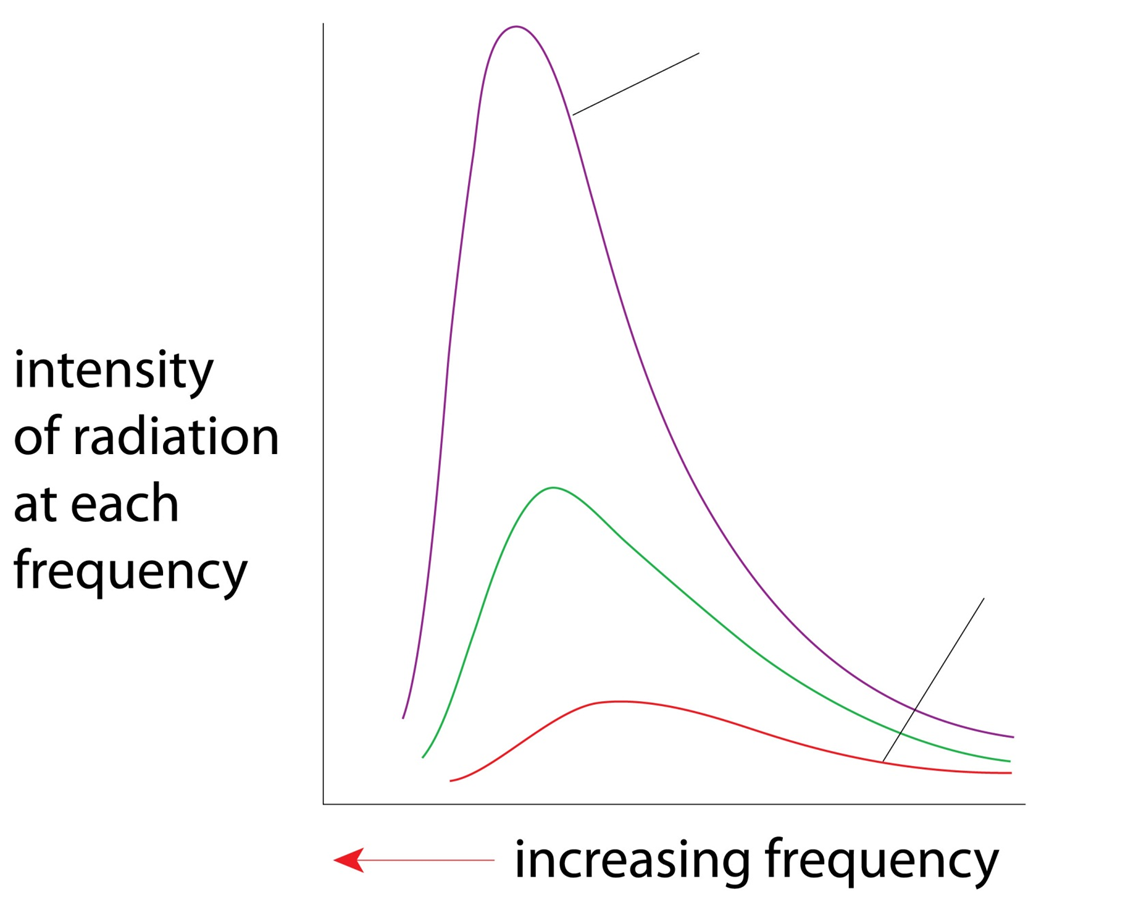
White hot objects release frequencies of light through the whole visible spectrum - 53On this graph, which colour of the line represents the hottest star?The purple line shows the hottest star, as it has the highest peak frequency
- 54On this graph, which colour of the line represents the brightest star?The purple line, because it has the biggest area underneath the graph
- 55What are Fraunhofer lines?They are the black lines on a spectrum of light that indicates that certain wavelengths are missing, because they get absorbed by elements present in the atmosphere of the star
- 56How was helium discovered?When a spectrum of light from a solar eclipse was analysed some absorption lines were found that didn't fit with any known element, so it had to be a new one
- 57What is the composition of most stars?They are mostly made up of hydrogen and helium, with small traces of other elements
- 58How do light spectra work?When an atom gives out light its electrons lose energy as a photon- these electrons can only have certain energy levels, and as the electron moves from one level to a lower energy level it releases one photon. The energy of the photon is equal to the difference between the 2 energy levels, so each element releases photons at different frequencies, so a different colour can be seen.
- 59How are stars formed?It begins as a cloud of dust and gas in space, and over a long period of time gravity acts to pull these particles together. Each particle in the contracting cloud attracts every other particle, so the cloud collapses towards its center, and starts to rotate. As the particles are attracted towards the center the cloud moves faster, so it gets hotter. It eventually gets hot enough to start nuclear fusion, so a star is 'born'
- 60What is a protostar?A star when it has just been 'born'- it is in its early stages
- 61What is a main sequence star?When a star fuses hydrogen in its core (during most of its life, so can last for millions or billions of years)
- 62What is the summary equation of nuclear fusion in a star?

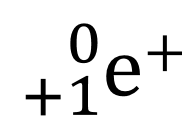
- 63What are the main stages in nuclear fusion?1.Two hydrogen nuclei (protons) fuse together to make an isotope of hydrogen with a proton and a neutron (deuterium) - as they fuse together one of them decays into a neutron, releasing a positron and a gamma ray
2. A deuterium nucleus and another hydrogen nuclei fuse together to form the nucleus of helium- 3, also emitting a gamma ray
3.Two helium-3 nuclei fuse to produce a helium-4 (normal isotope) nucleus and two hydrogen nuclei - 64What is a positron?An anti- matter equivalent of an electron
- 65What is a deuterium?It is a stable isotope of helium that contains one proton, and one neutron in its nucleus
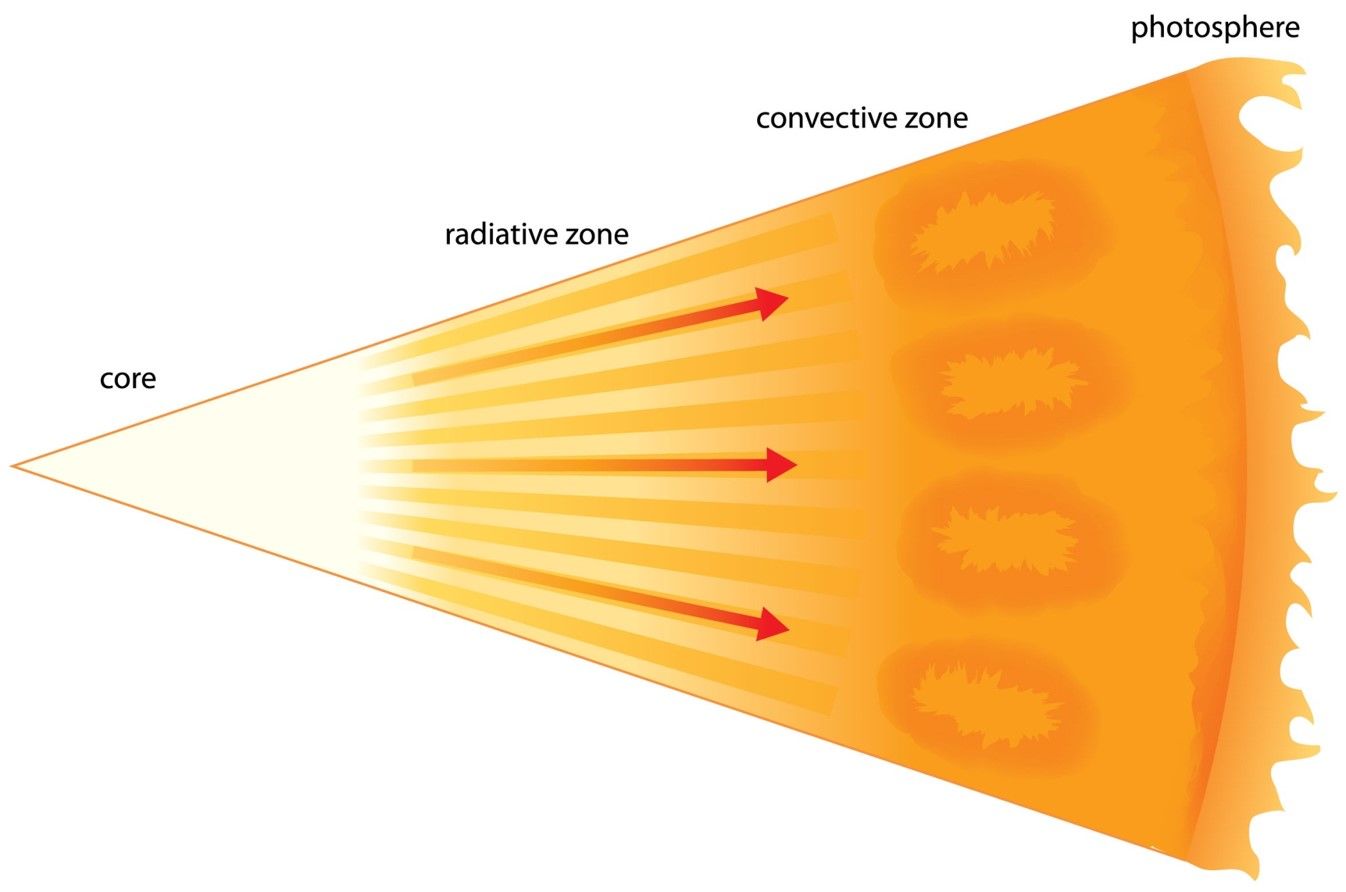
- 66What are the two main ways that energy is transported to the surface of the star?Radiation and convection
- 67Describe the structure of the sun
- 68How does a main sequence star turn into a red giant?As the star starts to run out of hydrogen for nuclear fusion, the core will cool down, reducing the amount of outward pressure on the star. This causes it to fall inwards, becoming hotter as is does so. This causes new fusion reactions, making the outer shell expand; this causes the surface temperature to decrease, so it turns into a red giant
- 69Why do helium nuclei start to fuse in a red giant?When it is formed the core contracts and heats up, so it is now hot enough how helium nuclei to fuse (they have a larger positively charged nucleus, so the electrical repulsion between them is greater- in order to fuse they need a larger momentum to overcome this repulsion, so is only possible in the higher temperatures).
- 70What is formed when helium nuclei fuse?Heavier elements e.g. carbon, nitrogen and oxygen
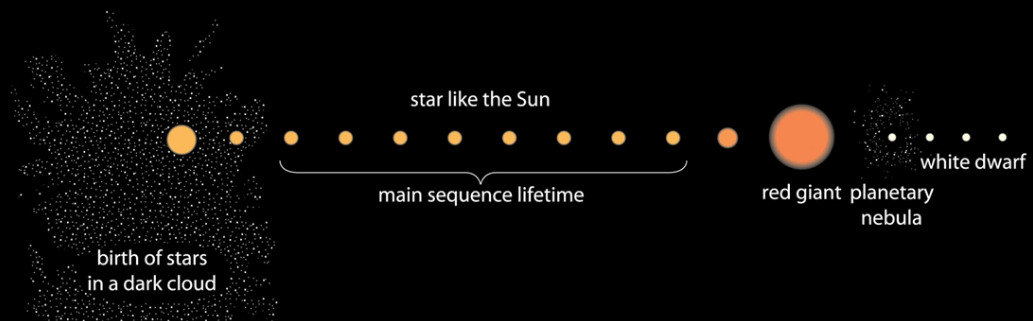
- 71What happens after the red giant in a star's lifecycle?After a few million years the outer layers of the sun will cool and drift into space. The collapsed inner core will remain as a white dwarf. As no fusion can occur it will gradually cool and fade, forming a black dwarf
- 72What is the heaviest element that the sun will be able to form through nuclear fusion?Carbon
as it is only a relatively small star - 73Name the different stages of a middle sized star's lifetimeProtostar, main- sequence star, red giant, white dwarf, black dwarf
- 74What do larger middle- sequence stars turn into when they run out hydrogen in the core?They expand to form red supergiants
These can get as hot as 3 billion degrees Celsius in the core, as they can fuse together all nuclei until iron, which means that they release even more energy - 75Why does a Red Supergiant collapse into a supernova?By fusing lighter elements together over its lifetime, a red supergiant's core will be largely composed of iron. Iron nuclei absorb energy, rather than releasing it when they fuse, so the star will no longer have a source of energy to maintain the outward pressure. When fusion stops gravity pushes the outer layers of the star into the center, forming a supernova
- 76What happens during a supernova?Temperatures rise to 10 billion K; this is hot enough to cause further fusion among the present elements- forming the heaviest naturally occurring element :uranium
- 77What is a neutron star?It is formed after a supernova, as the core of the star still remains intact, and is made almost entirely of neutrons compressed together. They are around 30 km wide.
- 78What happens with massive remnants of a star after a supernova?It collapses even further under the pull of its own gravity to become a black hole
- 79What does a H-R (Hertzsprung- Russell) diagram show?The relationship between the luminosity and temperature of a star in different stages of its life
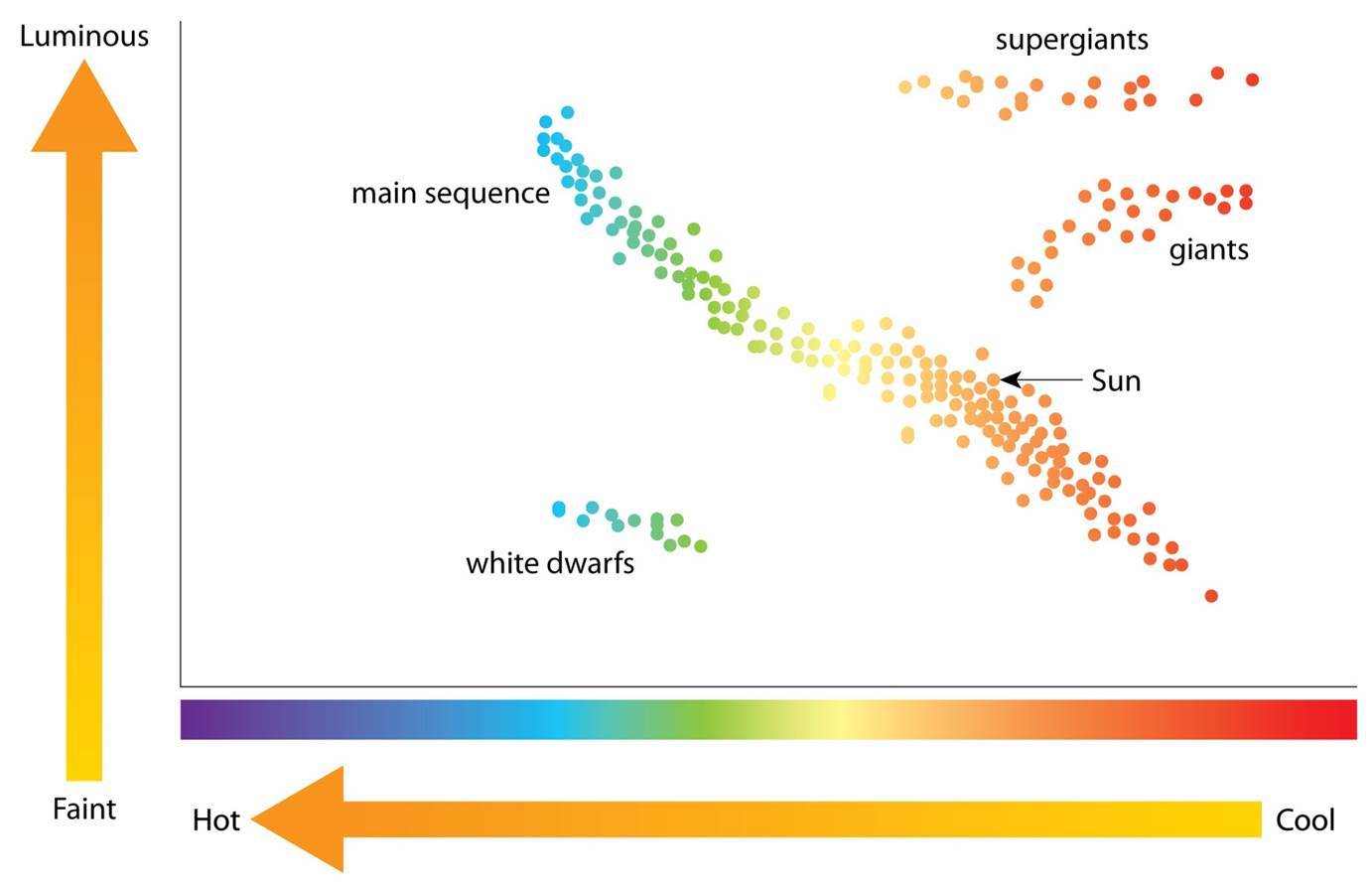
- 80Why is energy released during nuclear fusion?There is a slight loss in mass
E=mc^2 - 81What is the pressure law?It connects pressure and temperature together
P / T (K)= constant
Pressure and temperature are directly proportional - 82What is Boyle's law?It links together pressure and volume in a inversely proportional relationship with the equation:
P x V = constant - 83What is Charles' law?Volume is directly proportional to the temperature if the pressure is constant
V / T (K) = constant - 84When the graph of the pressure law and Charles' law where extrapolated backwards to meet the x- axis, which temperature did it meet?-273 degrees Celsius
0 K
Absolute zero - 85How do you convert between degrees Celsius and Kelvin?T (Kelvin)= T (degrees C) +273
T (degrees C) =T (Kelvin) -273 - 86What do Ground- based observatories do?They make observations of the electromagnetic spectrum that are transmitted through the Earth's atmosphere e.g. light, using an optical telescope
- 87What two key factors need to be taken into consideration when choosing the site for a ground- based observatory?Light pollution and atmospheric conditions, as the affect the quantity and quality of the observations
- 88Why are ground- based observations usually away from densely populated areas?The light (from streetlights, home etc.) shines upwards and is scattered by the atmosphere, making it much harder to detect the radiation from space
- 89What is scintillation, and why is it caused?It is the apparent twinkling of stars
It is caused, because the Earth's atmosphere has some areas that are denser than others; this can cause distortion due to the refraction of the light - 90What are the best atmospheric conditions for ground-based observatories?A high % of clear nights every year
Dry air
Low atmospheric pollution - 91Why are observatories usually found on the top of mountains?Scintillation occurs the least where the Earth's atmosphere is thin i.e. at high altitudes
- 92Why do areas of differing densities in the atmosphere constantly move?The atmosphere is constantly moving due to wind and convection currents
- 93Name a few areas of the world that match the criteria needed for good obervations of the nights skyChile, Hawaii, Australia
- 94Name some other factors that need to be taken into account when looking for a site for a ground- based observatoryCost
Environmental and social impacts it could cause
Working conditions- high altitudes can cause altitude sickness - 95What are the symptoms and causes of altitude sickness?Headaches, memory loss, shortage of breath
This can be due to the low levels of oxygen present in the air - 96What are the advantages of a space telescope?It can make observations of distant astronomical objects without the distortion of the earth's atmosphere
The atmosphere absorbs some of the radiation emitted in space e.g. infra-red, UV and gamma rays
Light pollution and bad weather doesn't interfere
There is a larger base line (as it is on the outside of the Earth), so there will be a larger parallax angle - 97What are the disadvantages of space telescopes?It is very expensive to send such a sensitive object into space
Maintenance, repairs and updating required is very difficult and expensive
Any space program can be subject to changes or major delays
Global politics can be volatile, making international projects unpredictable - 98What are the advantages of international collaboration with space projects?It can bring scientific expertise together
Countries can share the financial cost
They could create opportunities to share facilities
Cultural exchanges can be beneficial on a scientific and personal level - 99Give an example of were international collaboration was used in a space projectThe James Webb Space Telescope
14 countries were involved in building it- NASA is the lead partner, but the ESA and the CSA are also involved
It is estimated that it will cost $8.8 bn - 100What are some of the obstacles that can prevent international co-operation?The perceived loss of national control
The added administrative complexities
Potential difficulties in scientists working abroad for extended periods - 101What do astronomer usually do at work?Use computers to analyse data
Create computer programs that allow them to search through data efficiently
Writing research projects
They only spend very little of their time at an observatory - 102How can data from a telescope reach the computer of the astronomer?Data from ground- based telescopes can be sent electronically over computer networks
Data from space telescopes reaches the Earth via radio waves - 103Why are most telescopes now computer controlled?It is more precise and accurate, as it is easier to point the telescope at a particular object in the sky
Due to the rotation of the Earth any astronomical object will appear to move, so if it is controlled the telescope can precisely track the object for a long time
It means that the astronomer doesn't have to travel to the telescope, so no added cost or inconvenience. - 104What techniques do astronomers use to find new exoplanets?Looking for small dips in the brightness of a star as a planet passes in front of it
Looking for a slight wobble in a star's motion, caused by the gravity of an orbiting planet - 105What is the SETI project?Search for Extra- Terrestrial Intelligence
It is looking at data from radio telescopes around the world to see whether it contains any evidence of 'intelligent' signals
Information
- Description
- GCSE Physics Flashcards on P7: Studying the universe, created by Anna Kanz on 02/05/2017.
- Created by
- Anna Kanz
- Views
- 15
- Rating