
The Universe: Structure and Scale
67 resources created by 62 users
This Astronomy page on GoConqr gathers community-made quizzes, mind maps, flashcards, notes and slides on The Universe: Structure and Scale, from our place in the solar system and the life of stars to the Big Bang and the far future of the universe. It's built for school students revising a topic and for teachers after ready-made material. There are over 390 resources here, including more than 20 quizzes and over 250 mind maps, mostly at secondary level with a few for primary pupils. Pick a deck, try a quiz to find your gaps, then make your own.
Top The Universe: Structure and Scale resources
-
21 cardsunit 2.1.1 - OUR PLACE IN THE UNIVERSE List the planets of the solar, in their order going away from the sun.
-
9 cardsStars in the Universe Stars have many characteristics to differentiate them.
-
Mind map 1 The Universe and the solar system Mapa Mental en The Universe and the solar system, creado por Rafael Marañon viedma en 30/09/2018.
-
55 cardsThe Universe
-
105 cardsP7: Studying the universe What is a waxing moon?
-
78 cardsP.7.1-4 - Studying the Universe What does the word 'phases' mean in astronomy?
-
96 cardsSpace Science (Grade 9 ) any object that exists in space
-
47 questionsChapter 1: The Night Sky Roughly how many Earths would fit inside the Sun?
Quizzes
-
47 questionsChapter 1: The Night Sky Roughly how many Earths would fit inside the Sun?
-
6 questionsP7 Quiz - Are we alone? What is the approximate number of galaxies in the universe?
-
10 questionsChapter 10 A Black Hole has mass MBH = 15 MSolar. What is its Schwarzschild radius?
-
25 questionsScience Review What type of galaxy is the milky way?
-
14 questionsSpace Quiz Atmosphere is the imaginary line through an object about which it seems to turn?
-
6 questionsBig History 9th threshold quiz What are the problems in today's world that make us need to find a new home?
-
5 questionsCCI02.01.01.- The death of the universe What do we think the shape of the universe is?
Mind maps
See all 29 mind maps-
1 The Universe and the solar system Mapa Mental en The Universe and the solar system, creado por Rafael Marañon viedma en 30/09/2018.
-
P7 2
-
p2 part 2
-
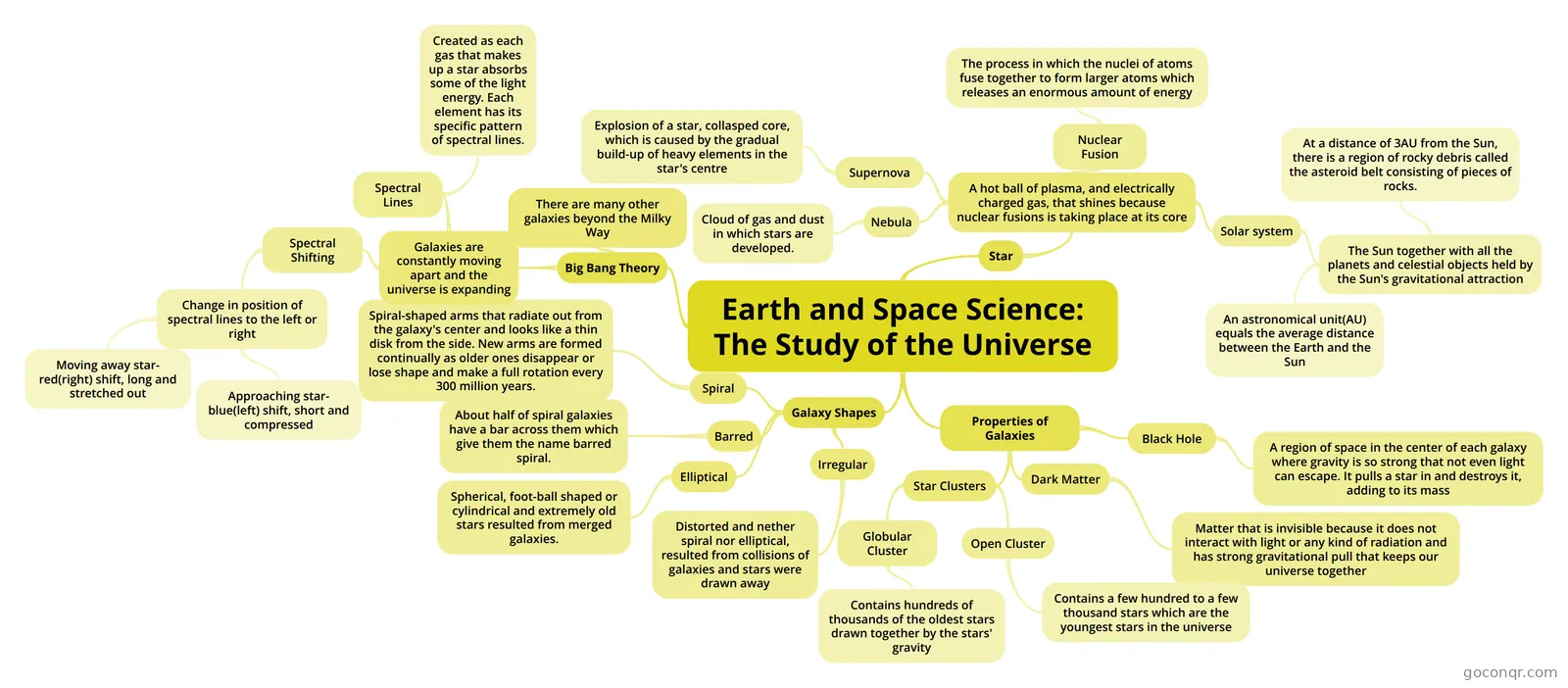 Earth and Space Science: The Study of the Universe
-
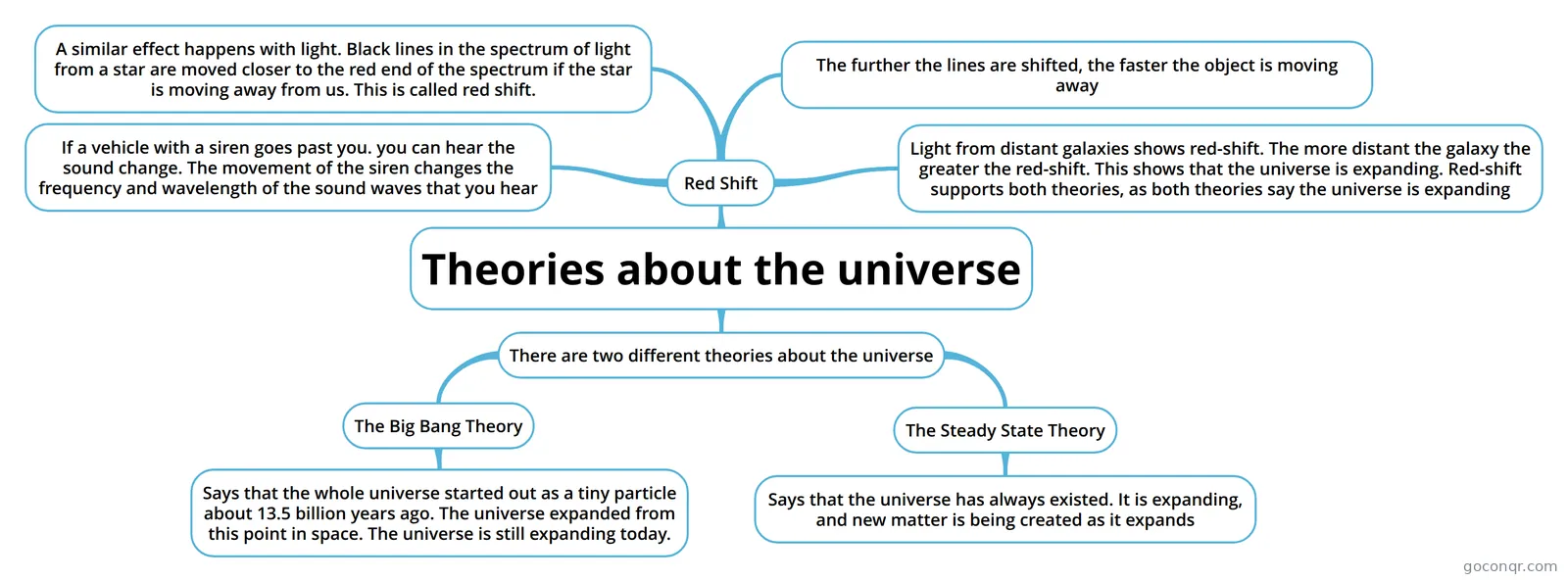 Theories about the universe
-
Parts of the Universe good
-
THE universe daniel rey picon
-
4 Phases of the big bang The big bang
Flashcards
See all 24 flashcards-
21 cardsunit 2.1.1 - OUR PLACE IN THE UNIVERSE List the planets of the solar, in their order going away from the sun.
-
9 cardsStars in the Universe Stars have many characteristics to differentiate them.
-
55 cardsThe Universe
-
105 cardsP7: Studying the universe What is a waxing moon?
-
78 cardsP.7.1-4 - Studying the Universe What does the word 'phases' mean in astronomy?
-
96 cardsSpace Science (Grade 9 ) any object that exists in space
-
22 cardsThe Big Bang Fill the gaps: Almost all of the ........ are moving way from each other with the ....... galaxies moving f...
-
28 cardsThe Earth in the Universe The earth in the universe: planets, galaxies, etc
Notes
-
BCScience9 Ch 10 10.1 Explaining the Early UniverseAstronomers: People who study objects in spaceCelestial bodies: Objects in spaceEdwin Hubble discovered that galaxies farther from our galaxy were moving away from each other faster t...
-
rajan balige Models of the universe (revision quiz)https://revisely.com/quiz/9TPl5 The Geocentric model Aristotle The earth is the centre of the universe. The earth does not move, and it has planets orbit...
-
Science Chapter 11.1 Questions: How does a star birth? What is the evolution of stars? What are low mass stars? What are intermediate stars? What are high mass stars? Words to Know: black hole dopper effect fusion interstellar matter star...
-
Stars The stars. A star is a luminous sphere of plasma held together by its own gravity. The nearest star to Eart is the sun. Many other stars are visible to the naked eye from Earth during the nig...
-
Physical Science Module 16 Notes Stars and the Universe Sun lights our planet, is just the closest star to us Special Star sun exists by itself as an individual star Multiple Star systems - the stars orbit each other Size and Mass Essentially sp...
Slides
More Astronomy topics
About The Universe: Structure and Scale
GoConqr OriginalWhat this unit covers
The resources run from the near to the very far. Some start with the solar system: the flashcards unit 2.1.1 - OUR PLACE IN THE UNIVERSE ask you to list the planets in order from the Sun and to say what the solar system is. The notes Option D: Astrophysics also set out the order of the planets and mention dwarf planets like Pluto.
Others turn to stars. The deck Stars in the Universe looks at star colour and surface temperature, and at the life cycle of a star. The Universe flashcards collect key terms such as absolute magnitude, apparent magnitude, black hole, light-year and gravitational lensing.
Origins and the future
Many mind maps deal with how the universe began. The Earth and Universe 1 follows the Big Bang theory and the idea that red-shift shows galaxies moving apart. The Earth and Universe 2 looks at the future, including the Big Freeze if gravity cannot stop the expansion. 1 The Universe and the solar system also touches on the Big Crunch, the Oscillating Universe Theory and the Big Rip. There are also flowcharts on the phases of the Big Bang.
Where to start
- Begin with a flashcard deck such as Grade 9 Space to meet the basic questions: how old the universe is, how stars and planets form.
- Read a mind map on the same idea to see how the pieces connect.
- Take a quiz, such as Origin of the Universe Quiz or Our galaxy, and note what you missed.
- Go back to the cards or notes for those gaps, then try another quiz.
Using quizzes and maps together
Use a map first to get the shape of a topic, then a quiz to test it. If a question on red-shift or star life cycles goes wrong, return to the matching map and trace the branch. Some resources mention GCSE Physics, AQA and IB Physics, so they may suit students working towards those courses. Teachers can use maps and slide sets, such as The Big Bang Theory, as starting points for a lesson.
Where it sits
This unit belongs to the strand Galaxies and the Universe in Astronomy. Choose one resource that matches what you are studying now, and build your own maps or flashcards from it.
Frequently asked questions
Which resource should I open first?
If you are new to the topic, try the flashcards unit 2.1.1 - OUR PLACE IN THE UNIVERSE or Grade 9 Space. They cover the planets, the Sun, the age of the universe and how stars form. After that, read a mind map and then test yourself with a quiz.
What do the mind maps cover?
They cover the origin of the universe, the Big Bang and red-shift, the sizes and colours of stars, planetary systems and the future of the universe. The Earth and Universe 2, for example, explains the Big Freeze. Others are simple overviews of space and the solar system.
Are there quizzes to check what I know?
Yes, there are more than 20 quizzes. Titles include Origin of the Universe Quiz, Our galaxy, evidence of big bang and Black holes and Galaxies (Medium Level). Take one after a map or deck, then revisit the topics you got wrong.
Which levels and exams do these resources suit?
Most are at secondary level, so they suit school students. Some resources mention GCSE Physics, AQA and IB Physics. A few are simpler, suitable for primary pupils. Check each resource's content to see whether it matches your course.
Are the resources free, and who made them?
Every resource listed here is free to open, study and take, with no account needed. They were made by GoConqr users, not by GoConqr. A free account also saves your quiz scores and lets you create your own quizzes, maps, flashcards and notes.
What if I can't find the topic I need?
Try a nearby title, such as Space, Astrophysics or The Big Bang Theory, as the same ideas often appear under different names. You can also make your own mind map or flashcards on the missing topic and keep them for revision.