
Flashcards
physics
Cards in this deck (166)
- 1What is a longitudinal wave?A longitudinal wave is one in which the particles vibrate parallel to the direction in which the wave is travelling
- 2Example of longitudinal wavesSound waves
- 3What are compressions?Compressions are places where the particles bunch together
- 4What are rarefactions?Places where the particles are furthest apart
- 5What are longitudinal waves made up of?All longitudinal waves are made up of compressions and rarefactions
- 6What is a transverse wave?A transverse wave is one in which the particles vibrate at 90 degrees to the direction in which the wave is travelling
- 7Examples of transverse wavesWater Waves
Waves on Strings and Ropes
Electromagnetic waves - 8What is the frequency of a longitudinal wave?The frequency is the number of vibrations made by a particle in 1 second
- 9What is the frequency of a longitudinal wave?A longitudinal wave is the distance between the centre of one compression (or rarefaction) and the next
- 10What is the amplitude of a longitudinal wave?The amplitude is the maximum distance any particle in the wave moves from the centre (quilibrium position) of its motion
- 11What is the frequency of a transverse wave?The frequency of a wave is the number of complete waves passing a fixed point in 1 second
- 12Symbol for frequencyƒ
- 13Units for frequencyHertz (Hz)
- 14What is the wavelength of a transverse wave?The wavelength of a transverse wave is the distance between two consecutive crest or troughs
- 15Symbol for wavelengthλ
- 16Units for wavelengthMetres (m)
- 17What is the amplitude of a transverse waves?The amplitude of a wave is the greatest displacement of the wave from its undisturbed position
- 18Units for amplitudeMetres (m)
- 19What is the wave equation?v = ƒ x λ
v+speed of the waves (cm/s)
ƒ = frequency (Hz)
λ = wavelength (cm) - 20What is a ripple tank used to do and how?-Used to learn about the behaviour of waves
-A motor makes a straight edge dipping into a tank of water produce straight water waves
-These plane waves can be used to study reflection and refraction
-A hand-held stroboscope can be used to 'freeze the motion' so that wavelength measurements can be made - 21What things should you note about wave reflection?-The angle of incidence is always equal to the angle of reflection
-the wavelength of the incident and reflected waves are equal
-there is continuity of the incident and reflected waves at the barrier
-the frequencies of the incident and reflected waves are equal
-the speeds of the incident and reflected waves are equal
-the angle between a wavefront and the direction of travel is always 90 degrees - 22How do you make a region of shallow water in a ripple tank?A region of shallow water in a ripple tank can be made by immersing a rectangular glass block. The water directly above the sunken glass is shallow while the surrounding water is deeper.
- 23What happens when travel from deep water into shallow water?-the wave slows down
-the wavelength of the wave decreases
-the frequency of the wave is unchanged - 24What happens if the waves enter the shallow region obliquely (at an angle)?The angle of incidence in the deep water is always greater than the angle of refraction in the shallow water
- 25When are soundwaves produced?Sound waves are produced when an object vibrates at a frequency that the ear can detect
- 26What is the range of human hearing?The range of human hearing is from around 20Hz to 20000Hz although the upper limit decreases with age. Sound of frequencies above 20000Hz cannot by heard by humans and is called ultrasound. Ultrasound can be heard by bats, dogs and some other animals.
- 27How does sound travel?Sound travels through materials as longitudinal waves as energy passes from molecule to molecule. The sound energy passes from particle to particle, which is why sound cannot travel through a vaccum where there are no particles.
- 28What happens when sound waves hit a hard surface.When sound waves hit a hard surface, they reflect. A reflection of sound, ultrasound, microwaves or radio waves is called an echo.
- 29Sonar-Sound navigation and ranging
-Uses echoes to locate a target + measure how far away it is
-Uses ultrasound which travels at about 340m/s in air and at about 1500m/s in water
-Limited to fairly slow-moving objects
-Examples; distances, from the size of a baby's head in the womb to the depth of a submarine below the surface - 30Radar-Radio detection and ranging
-Uses echoes to locate a target and measure how far away it is
-Uses electromagnetic waves of wavelengths ranging from about 3cm to a few metres
-Because radar waves travel so quickly and are not absorbed significantly by the air, they are used to locate very distant objects that may be moving very rapidly, such as tracking a spacecraft as it leaves the Earth's atmosphere - 31What are the applications of ultrasound in industry?-Scanning metal casings for faults or cracks
-Mapping the ocean floor in oceanography
-Fish location by sea-going trawlers
-Cleaning sensitive electronic equipment - 32What are the applications of ultrasound in medicine?-Removing harmful tartar from teeth
-Scanning soft tissues to diagnose cancers
-Scanning a womb to check the development of the unborn child
-Breaking up kidney stones - 33What features apply to all of the waves in the electromagnetic spectrum?Can travel in a vacuum - this property is unique to electromagnetic waves
Travel at exactly the same speed in a vacuum
Are transverse waves - 34Gamma wavesWavelength: 0.01nm
Uses: can destroy viruses, fungi, bacteria and living cells, used to kill cancel cells, sterilise medical equipment and kill bacteria and fungi on food
Dangers: can disrupt DNA and cause cancers - 35X-raysWavelength: 0.1nm
Uses: Used in medicine for diagnosis (detecting broken bones or body scanning to detect tumors) and to kill cancer cells
Dangers: can disrupt DNA and cause cancers - 36Ultraviolet lightWavelength: 10nm
Uses: to give a sun tan, to detect bank-note forgeries, kills bacteria in water chillers
Dangers: can cause skin cancer - 37Visible LightWavelength: 0.5μm
Uses: Used for human vision, photography and photosynthesis
Dangers: Can cause snow-blindness - 38Infrared lightWavelength: 0.01mm
Uses: in toasters, ovens, grills and stoves, night-vision goggles and by scientists to photograph nocturnal animanls, in guided weapons and tv remote controls
Dangers: damage cells by burning - 39MicrowavesWavelength: 3cm
Uses: Used in mobile phones and for fast food preparation
Dangers: Can cause eye cataracs - 40RadiowavesWavelength: 1000m
Uses: Used extensively for communication, for entertainment and by the emergency services
Dangers: No known dangers - 41Electromagnetic WavesGamma waves
X-rays
Ultraviolet light
Visible light
Infrared light
Microwaves
Radio waves - 42Health risks associated with mobile phones and communication masts-Mobile phones work by dividing a country into areas (called cells)
-Each cell has its own microwave transmitter and receiver
-When a call is made, rapid computer switching passes the call from one cell to another until it reaches the cell where the phone being called is found
-The presence of so many microwave masts for mobile phones throughout the country has caused some people to link mobile phones with cancer
-Others claim that because mobile phones use microwaves holding the phone close to your ear can cause the brain to be damaged - 43The Stewart ReportTo investigate the claims that mobile phones are linked to cancer, a committee known as the Independent Expert Group on Mobile Phones was asked to investigate and make recommendations. They reported that there is no proven case of damage being done to people either by communication masts or mobile phones.
- 44The Precautionary PrinciplesThe stewart report was published in April 2000. Since then other expert groups in other European countries and in the USA have recommended the precautionary principle. Even if the chances of negative health effects are low it makes sense to avoid unnecessary risk.
Children under the age of 9 should use mobile phones very sparingly.
Use mobile phones with headsets or speaker-phones whenever possible to keep their heads as far as possible from the radio-emitting headset.
Mobile phone masts should not be erected close to schools or hospitals. - 45LightObjects that produce light are luminous. We see such objects because light travels from then directly to our eyes. We see non-luminous objects only when they scatter (reflect) light from luminous objects into our eyes. The sun, stars and candle flames are examples of non-luminous objects.
Materials such as air, glass and water through which light travels readily are transparent. If light cannot travel through a material we call it opaque. - 46Reflection of LightThe light ray striking the mirror is called the incident ray. The normal is the imaginary line that meets the mirror at right angles at the point of incidence. The light ray travelling away from the mirror is called the reflected ray.
The angle of incidence (i) is always equal to the angle of reflection (r). This is known as the Law of Reflection. - 47Proving the law of reflection1. With a sharp pencil and a ruler, draw a straight line AOB on a sheet of white paper using a ruler.
2. Use a protractor to draw a normal, N at point O
3. With the protractor, draw straight lines at varying angles to the normal
4. Place a plane mirror on the paper so that its back rests on the line AOB
5. Using a ray box, shine a ray of light along the line marked 15 degress
6. Mark two crosses on the reflected ray on the paper
7. Remove the mirror, use a ruler to join the crosses on the paper with a pencil and extend the line backwards to point O - this line shows the reflected ray
8. Measure the angle of reflection with a protractor
9. Record in a table the angles of incidence and reflection - 48The Image in a Plane Mirror Experiment1. Support a plane mirror vertically on a sheet of white paper and with a pencil draw a straight line at the back to mark the position of the reflecting surface
2. Use a ray box to direct two rays of light from point O towards points A and B on the mirror
3. Mark the position of point O with a cross using a pencil
4. Mark two crosses on each of the real reflected rays
5. Remove both the ray box and the mirror
6. Using a ruler, join the crosses with a pencil line so as to obtain the paths of the real rays from A and B
7. Extend these lines behind the mirror (these are called virtual rays - they meet at I, the point where the image was formed
8. Measure the distance from the image I to the mirror line (IN) and the distance from the object O to the mirror line (ON) - they should be the same
9. Repeat the experiment for different positions of the object O
10. In each case, the object O and its image I should be the same perpendicular distance from the mirror - 49Features of the image in a plane mirrorVirtual
The same size as the object
Laterally inverted
The same distance behind the mirror as the object is in front - 50What is refraction?Refraction is the change in the direction of a beam of light as it travels from one material into another. It occurs because light travels at different speeds in different materials.
- 51Speed of light in different materialAir - 300,000,000 m/s
Water - 225,000,000 m/s
Glass - 200,000,000 m/s - 52What way does light move when its speed changes?When light slows down, it bends towards the normal
When light speeds up, it bends away from the normal - 53Measuring the Angles of Incidence and Refraction-Place the glass block on a sheet of white paper and draw around its outline with a sharp pencil
-Remove the block and draw a normal near the middle of one of the longer sides of the block
-Use a protractor to draw a line representing and incident ray at an angle of incidence i of 40 degrees
-Replace the block on its outline on the paper
-Place the ray box to direct a ray of light along the line drawn
-Marks the path of the emergent ray
-Remove the block and join the points of incidence and emergence with a straight line to construct the path of the ray through the block
-Repeat this procedure for angles of incidence i of 50 degrees, 60 degrees and 70 degrees using the same normal line
-Use diagram to make measurement of the angles of refraction in a table - 54DispersionDispersion is the breaking up of white light into its component colours. Each colour in white light travels at the same speed in air, but at a slightly different speed in glass. This means that each colour bends by a slightly different amount when it refracts:
-Red light is fastest in glass, so it refracts (bends) the least
-Violet light is slowest in glass and refracts the most
The separated colours are called the visible spectrum - 55Water waves + light waves when they reflect-Angle of incidence = angle of reflection
-Reflected wavelength = incident wavelength
-Reflected frequency = incident frequency
-Reflected speed = incident speed - 56Water waves when they pass from deep into shallow water and light when it passes from air into glass and refracts-Bend towards the normal
-Refracted wavelength is less than incident wavelength
-Refracted frequency = incident frequency
-Refracted speed is less than incident speed - 57ConductorsHave many free electrons e.g silver, copper, aluminium and steel
- 58SemiconductorsHave very few free electrons at room temperature but considerably more at high temperatures e.g. silicon, germanium
- 59InsulatorsHave almost no free electrons e.g plastic, rubber, wood, cork
- 60Static electricityWhen two insulators are rubbed together they both become electrically charged. This is because negatively charged electrons rub off one material on to the other. The material that gains electrons becomes negatively charged. The material that loses electrons becomes positively charged. Notice, however, that in every case only electrons move. Positive charges do not move.
- 61Polythene RodWhen a polythene rod is rubbed with a cloth, electrons are taken off the cloth (which now has a shortage of electrons and is therefore positively charged) and transferred to the polythene rod (which now has a surplus of electrons and is therefore negatively charged.)
- 62Cellulose Acetate RodWhen a cellulose acetate rod is rubbed with a cloth, electrons are taken off the rod (which now has a shortage of electrons and is therefore positively charged) and transferred to cloth (which now has a surplus of electrons and is therefore negatively charged).
- 63How can a charged conductor to be discharged?A charged conductor can be discharged by connecting it to earth with a metal (conducting) wire or chain. The surplus electrons move down the chain to earth if the conductor is negatively charged. If the conductor is positively charged, electrons flow up from the earth.
- 64The Law of Static ElectricityThe law of static electricity states that opposite charges attract each other, while objects with the same charge repel each other
- 65PolarisationCharged objects can attract uncharged objects. When a positively charged rod is brought near a tiny piece of aluminium foil, the free electrons in the foil are pulled towards the rod, creating a surplus of electrons at the top of the foil and a deficiency of electrons at the bottom of the foil. This is called polarisation. Consequently, the top of the foil is attracted to the rod, because unlike charges attract. But like charges repel, so the positive charge at the bottom of the foil is repelled. The attraction forces are stronger than the repulsion forces because the attracting charge is closer to the rod than the repelling charge. As a result there is a net upward attraction force between the rod and the foil.
- 66Dangers of Static ElectricityStatic electricity is a nuisance and can pose a hazard:
-In an electric storm (lightning)
-In grain chutes
-When refuelling aircraft and road vehicles with flammable liquids
-When loading and unloading oil tankers
-In integrated circuits inside computers (computer engineers wear earthed wrist straps to reduce the possibility of destroying computer chips) - 67LightningLightning is an electrical discharge between a charged cloud and the Earth. Buildings can be protected against lightning by a lightning conductor. This is a long strip of copper metal with a spike at the top, running the length of the building and terminating in the ground.
- 68Grain ChutesIn grain chutes there can be an accumulation of dust and electric charge. An electrical discharge can result in a spark, leading to a fire. There is a similar danger with flammable fuels. In both cases the solution is to earth all metal parts to prevent charge accumulation.
- 69Current in a simple circuitInside an electrical cell, chemical reactions occur that push electrons out from the negative terminal and pull electrons in at the positive terminal. In the 19th century scientists thought that an electric current was a flow of positive charge from the positive terminal of the battery to the negative terminal. This idea was wrong, but the picture that a current us from positive to negative remained. Today we say that:
-Conventional current flows from positive to negative
-Electrons flow from negative to positive - 70Charge and current equationThe quantity of charge, Q, is measured in units called coulombs, C. Electric current, I, is the rate at which charge flows in a circuit. The charge equation is therefore:
Q=It or I=Q/t
where Q= charge in C, passing a fixed point
I= current in amperes (A)
t=time taken in seconds (s) - 71The Law of Static ElectricityThe law of static electricity states that opposite charges attract each other, while objects with the same charge repel each other
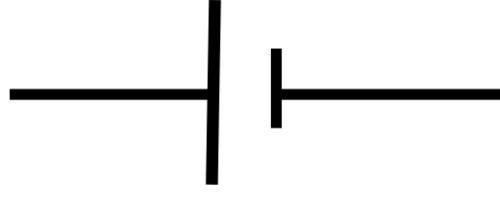
- 72—Cell
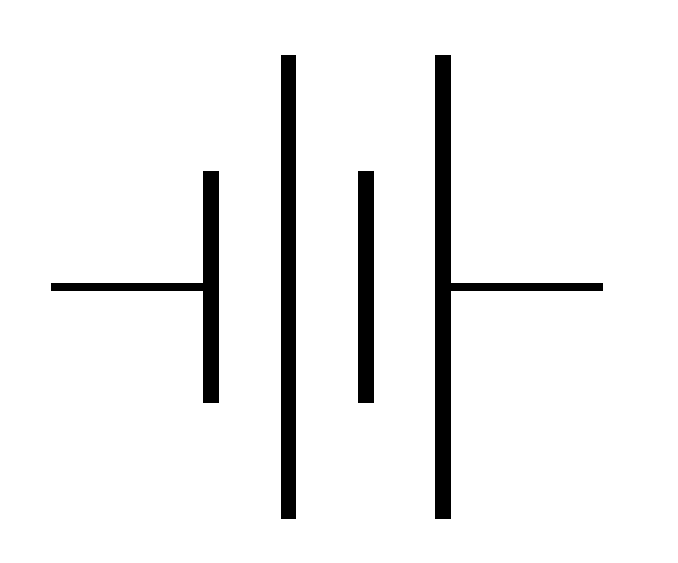
- 73—Battery
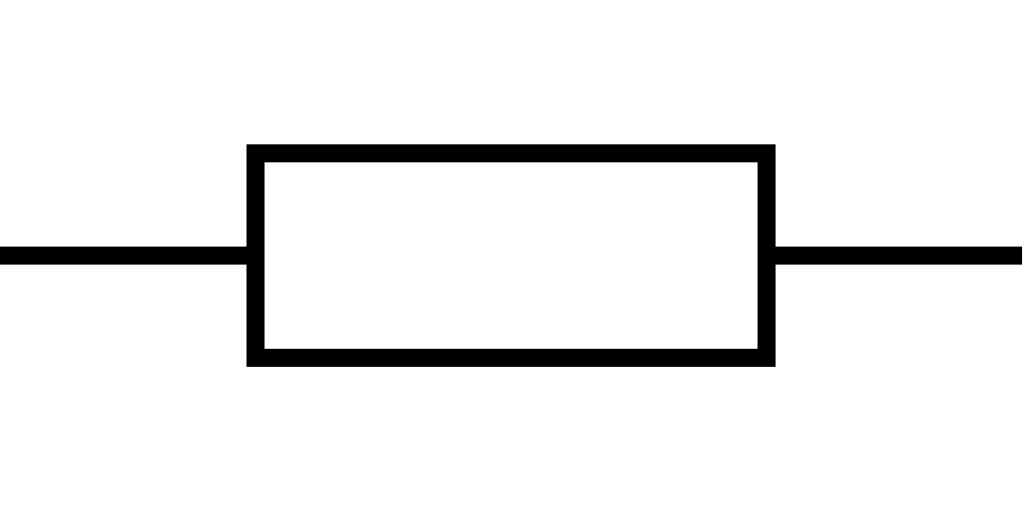
- 74—Resistor
- 75—Switch

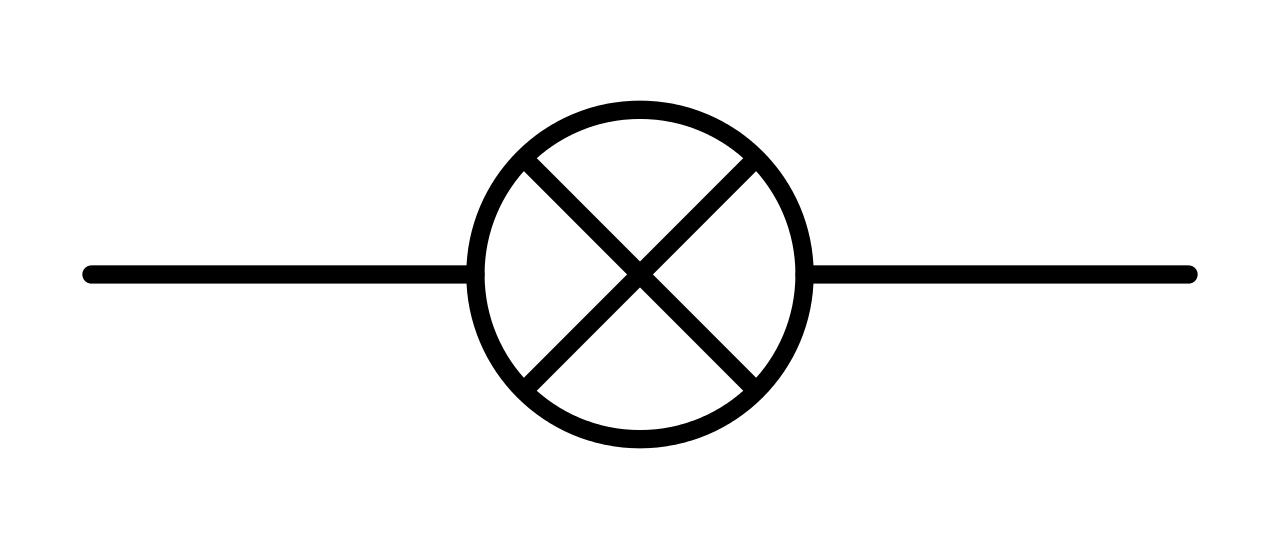
- 76—Lamp
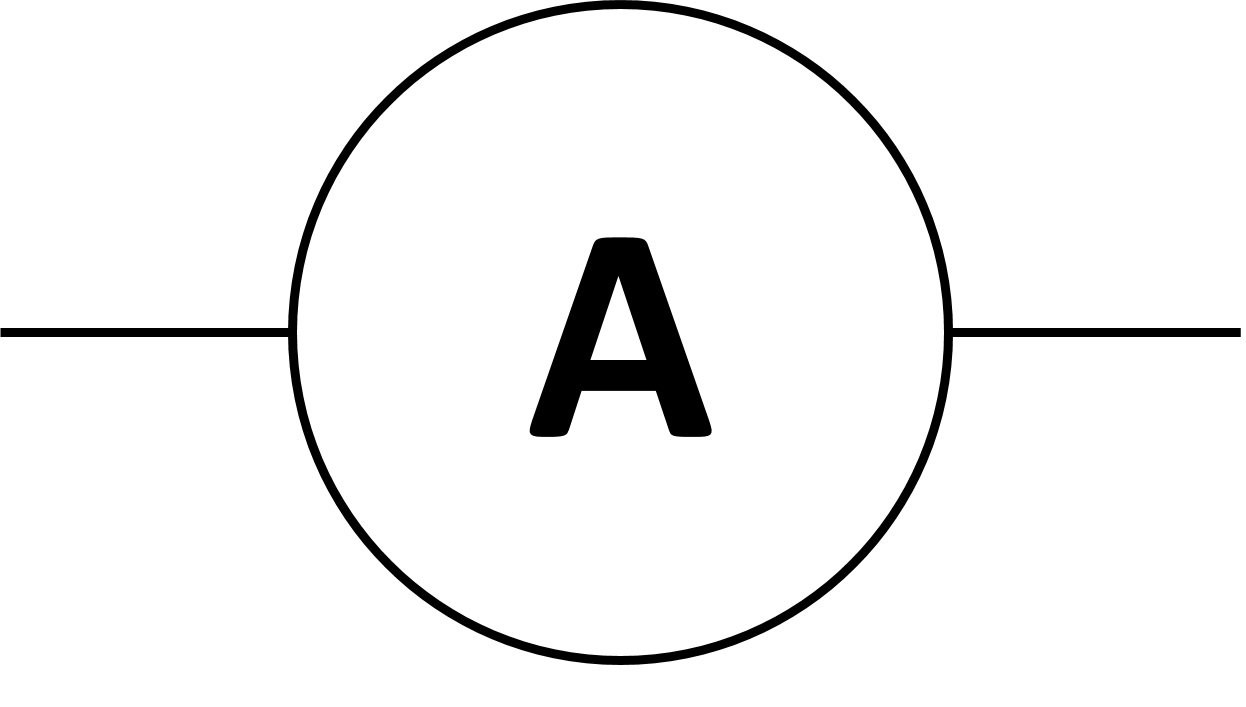
- 77—Ammeter
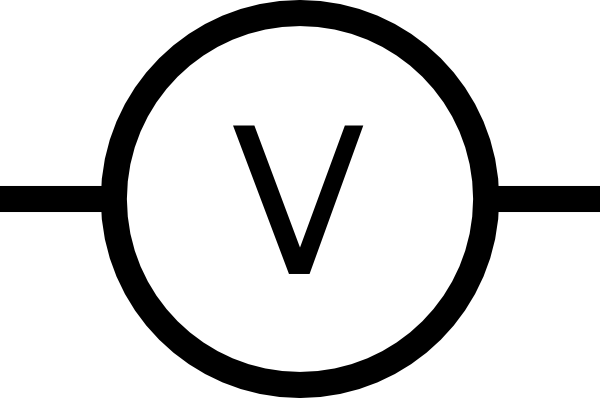
- 78—Voltmeter
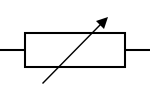
- 79—Variable resistor
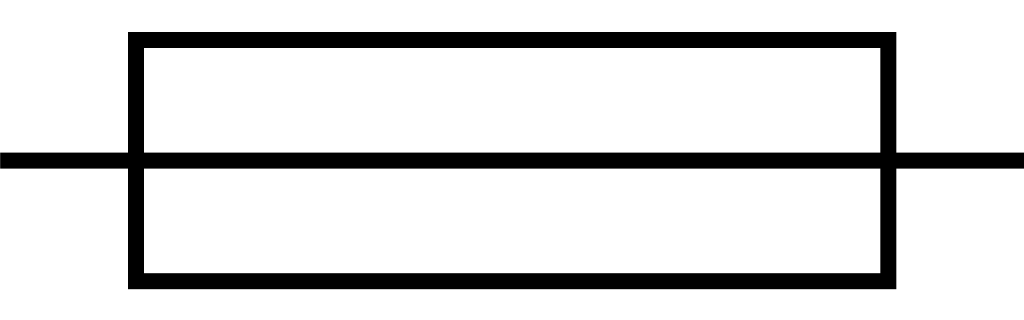
- 80—Fuse
- 81Measuring current and voltageThe long, thin line in the symbol for a cell is the positive terminal. The short, fat line is the negative terminal. Current through a component is measured using an ammeter placed in series with it. Voltage is measured across a component using a voltmeter in parallel with it. The words potential difference mean exactly the same as voltage. The arrows on the diagram opposite show the direction in which conventional current flows.
- 82Joining cells in seriesWhen we join cells in series, plus to minus, the cell voltages add up. For example, when two 1.5 volt cells are joined together they supply a total voltage of 3 V. If the cells are connected the wrong way round they cancel each other out and we get no voltage at all! When joining cells in series we must pay attention to cell polarity. We always join a plus (long, thin line) to a minus (short, fat line).
If two identical lamps are connected in series across a 1.5 V cell, they are generally equally dim and much dimmer than when there is only a single lamp. Why should this be? The reason is that the voltage across each lamp is now only half of the cell's voltage. This in turn means that the current through each lamp is less than before, so it burns less brightly. - 83Ohm's lawThis law states that the current through many conductors is directly proportional to the voltage across it, provided the temperature remains constant.
V = I x R
V = voltage across component in volts (V)
I = current through component in amperes (A)
R = Resistance of the component in ohms (Ω) - 84Current-voltage graphs for non-ohmic materialsMost materials do not obey Ohm's law. For such materials it is customary to show behaviour in the form of a current-voltage graph. Two devices are of particular interest.
The resistance of filament lamps increases as the current increases. This is because the increasing current in the lamp increases the temperature of the filament's resistance. - 85Resistors in seriesThe total resistance of two or more resistors in series is the sum of the individual resistances.
Rtotal=R1+R2+R3 - 86Resistors in parallelWhen two equal resistors are placed in parallel, their combined resistance is half the resistance of one of them.
If there are more than 2 resistance, then total/sum - 87Series circuits-all components are connected in a line
-the current in every component in series is the same
-disconnecting any component means: there is no longer a complete circuit, all currrent stops flowing
-the voltages across the components add up to to the same battery voltage
-voltages across identical components are the same - 88Parallel Circuits-all components are connected across the battery independently
-the voltage across each component is equal to that of the battery
-the current in different components is different
-disconnecting any component has no effect on the current in the other components
-the sum of the currents through the components is equal to that taken from the battery - 89Short circuitsA switch in parallel with any component can cause a short circuit. When the switch is closed, current flows through the switch and not through the component. This generally decreases the resistance of the circuit and increases the current drawn from the power supply.
- 90The factors affecting resistanceThe resistance of a conductor at constant temperature depends on three factors:
Length
Cross-sectional area
Material - 91How does length affect the resistance of a conductor?Resistance is directly proportional to the length of the conductor. A graph of resistance against length is a straight line through the origin.
- 92How does cross-sectional area affect resistance?Resistance is inversely proportional to the area of the conductor. A graph of resistance against 1/area is a straight line through the origin.
- 93How does material affect the resistance of a conductor?Metals have low resistance, non-metals have high resistance.
- 94Investigating how these factors affect resistance?-Measure and cut off 1 metre of nichrome resistance wire
-Attach it with sticky tape to a metre ruler - make sure there are no kinks in the wire
-Measure and record the current through and the voltage across 40cm of the nichrome wire. Use Ohm's law to calculate its resistance.
-Repeat this process for increasing lengths of the wire up to 1.0m
-Be careful to switch off the current between measurements to ensure that the temperature of the wire does not increase
-Record your results in a table - 95The resistance of a metallic conductor at constant temperature depends on the cross-sectional area-Use a micrometer screw gauge to measure the diameter, D, in mm and then calculate the cross-sectional area
-Repeat this process for five further thickness of the same length of wire and same type of material
-For each thickness, measure and record the current through it and the voltage across it
-Use ohm's law to determine the resistance for that thickness
-Record results in a table - 96Energy in electrical circuitsWhen an electric current flows, free electrons move through the conductor from the negative terminal of the battery to the positive terminal. As they do so they collide with vibrating atoms in the metal. In these collisions kinetic energy is passed from the electrons to the atoms, causing them to vibrate with greater amplitude. The result is that heat causing them to vibrate with greater amplitude. The result is that heat energy is generated and the temperature of the conductor increases.
- 97Energy equationE=Q x V
E=energy in joules
Q=charge in coulombs
V=voltage in volts - 98Joule's lawP=IV or P=I2R or P=V2/R
P=energy converted per second in watts (or joules per second)
I=current in resistor in amperes
V=voltage across resistor in volts
R=resistance of resistor in ohms - 99Blue wireNeutral
Goes left
The neutral wire is 0 volts at all times. - 100Brown wirelive
Goes right - 101Green and yellow stripes wireearth
Goes to the top - 102Fuse-There is a fuse between the live terminal and the live pin
-The fuse heats up, melts and breaks the circuit if too much current flows
-Fuses in plugs come in 1A, 3A, 5A, 13A - 103How is the cable secured?By a cable grip
- 104What side must the fuse always go to and why?The fuse must always be on the live side of the plug. If the fuse was on the neutral side then the appliance would still be at a dangerously high voltage even when the fuse blows
- 105How does the earth wire protect the user?The earth wire protects the user by providing a safe route for the current to flow through if the live wire touches the casing
- 106How does the earth terminal work?The earth terminal is connected to the metal casing, so the current goes through the earth wire instead of causing an electric shock if the live wire come loose and touches the metal casing.
- 107Double insulationAppliances such as radios and computer printers have plastic casings and therefore they do not have an earth wire. The casing cannot give an electric shock, even if the wires inside touch it. These appliances have all their metal parts in a separate plastic box, so that the user can never touch a conductor at a high voltage. These appliances are double insulated.
- 108Always switch and fuse on the live sideFuses and switches are always wired into the live side. If they were in the neutral side then the appliance would be 'live' even when the fuse had blown or the appliance was switched off. It would then be possible to get an electrical shock even when the appliance was switched off.
- 109Paying for electricityElectricity companies bill customers in units known as kilowatt-hours (kWh).
1kWh is the amount of energy used by an electrical appliance rated 1000W in 1 hour.
number of kWh = number of kilowatts x number of hours - 110Direct currentA direct current (d.c.) always flows in the same direction, from a fixed positive terminal to the fixed negative terminal of a supply.
Batteries provide d.c. - 111Alternating currentThe electricity supply to your home is an alternating current (a.c.) supply. In an a.c supply, the voltage (and hence the current) changes size and direction in a regular and repetitive way. The current changes direction 100 times ever second and makes 50 complete cycles per second - hence the frequency of the mains is 50 Hz. An a.c. supply is said to be bidirectional.
Generators and some laboratory power supply units provide a.c. - 112Electromagnetic inductionIn an electric motor the user supplies an electric current and a magnetic field to produce motion.
In electromagnetic induction the user supplies a magnetic field and motion to produce an electric current. - 113How can the size of the induced current be increased?-moving the wire faster
-using a stronger magnet
-looping the wire so that several turns pass through the poles - 114Current induction in stationary wireA current can also be induced in a stationary wire, usually a coil, by moving a magnetic field.
As the magnet is being moved into the coil, a current is observed on the ammeter. Once the magnet stops moving there is no longer an induced current - so the deflection on the needle on the meter is only momentary. Reversing the direction of its motion or the polarity of the magnet reserves the direction of the induced current. - 115The two major applications of electromagnetic induction-a.c. generator
-transformer - 116Current induction using two coilsTwo coils are wrapped on an iron ring.
One coil is connected to a switch and battery, while the other is connected to a cente-zero ammeter to detect electric current and show its direction - 117Current induction using two coils when the switch is closedWhen the switch is closed there is an increase in the current in the primary coil, which includes a momentary current in the secondary current
- 118Current induction using two coils when there is a steady currentWhen a steady current flows in the primary coil, there is no current in the secondary coil
- 119Current induction using two coils as the switch is openedAs the switch is opened, there is a momentary current in the primary coil, but this time in the opposite direction
- 120TransformersA transformer changes an alternating voltage from one value to another. It consists of two coils of insulated wire wrapped around an iron core. The input voltage is connected to the primary coil and the output voltage is taken from the secondary coil.
- 121Step-up transformersStep-up transformers increase the voltage - they have more turns on the secondary coil than the primary coil
- 122Step-down transformersStep-down transformers decrease the voltage - they have more turns on the primary coil than the secondary coil
- 123Turns ratio transformer equationNs/Np = Vs/Vp
Ns = number of turns on the secondary coil
Np = number of turns on the primary coil
Vs = voltage at the secondary coil
Vp = voltage at the primary coil - 124Transformers are very efficient, how can we write the power?power in = VpIp = VsIs = power out
- 125Electricity transmission-A typical generator at a power station might produce a current of 22000A at a voltage of 25000V
-Before transfer to the overhead power lines, the generator's output is passed to a large step-up transformer to raise the voltage to about 275000V and reduce the current to about 2000A
-The overhead power cables transmit this electrical energy all over the county in a network known as the National Grid. Power from the Grid is then distributed to customers after the voltage is reduced in stages in step-down transformers at electricity substations to much safer levels
-High voltage transmission means that a smaller current can be used to transmit a given amount of power
-A low current means that there is less energy lost in the cables as heat and the cables need not be so thick
-Less heat loss saves energy and conserves fossil fuels at the power stations - 126Order of the starsMercury
Venus
Earth
Mars
Jupiter
Saturn
Uranus
Neptune - 127How do the planets orbit the sun?The planets orbit a star we call the sun we call ellipitical paths
- 128MoonsMoons are natural satellites of planets. This means that moons orbit planets, just as the planets orbit the sun
- 129PlanetA body which spins around a star
- 130StarsA star is a large body which produces its own energy. Our sun is a star.
- 131CometsComets are balls of ice and dust in orbit around the Sun.
- 132AsteroidsAsteroids are rocky objects, smaller than planets. Most of them are found in an 'asteroid belt', in orbit around the Sun between Mars and Jupiter. Asteroids can crash into each other. When they do, they may break apart and their orbit may change.
- 133MercuryDistance from sun=58
Orbital period=88 days
Rotation period=59 days
Size=4878km
Mass=0.055
Density=5.42
Surface temp = 430 max, -170 min
Surface gravity=0.39
No. of known moons= 0 - 134VenusDistance from sun=108.2
Orbital period=224.7 days
Rotation period=243 days
Size=12100km
Mass=0.815
Density=5.25
Surface temp = 480 max
Surface gravity=0.88
No. of known moons= 0 - 135EarthDistance from sun=149.6
Orbital period=365.25 days
Rotation period=23h 56mins days
Size=12756km
Mass=1
Density=5.52
Surface temp = 22
Surface gravity=1
No. of known moons= 1 - 136MarsDistance from sun=227.9
Orbital period=687 days
Rotation period=24h 47mins days
Size=6794km
Mass=0.108
Density=3.94
Surface temp = -23
Surface gravity=0.38
No. of known moons= 2 - 137JupiterDistance from sun=778.3
Orbital period=11.86 years
Rotation period=9h 50mins Size=142796km
Mass=317.9
Density=1.31
Surface temp = -150
Surface gravity=2.64
No. of known moons= 17 - 138SaturnDistance from sun=1472
Orbital period=29.64years
Rotation period=10h 14mins
Size=120000km
Mass=95.1
Density=0.69
Surface temp =-180
Surface gravity=1.15
No. of known moons= 18 - 139UranusDistance from sun=2869.6
Orbital period=84.01years
Rotation period=17h
Size=52290km
Mass=14.5
Density=1.19
Surface temp =-210
Surface gravity=1.17
No. of known moons= 15 - 140NeptuneDistance from sun=4496.6
Orbital period=164.79 years
Rotation period=19.2h
Size=48600km
Mass=17.2
Density=1.71
Surface temp = -220
Surface gravity=1.18
No. of known moons= 8 - 141SatellitesA satellite is anything that orbits a celestial body
- 142Natural satellitesThe moon is the Earth's natural satellite. Scientists believe that it was formed when a Mars-sized planet collided with the early Earth, throwing some of the crush into orbit. Howver the Moon was formed, it locked into the Earth's gravitation field and circles our planet once every 27.5 days.
- 143Artificial satellitesPlaced in orbit by man.
Used for; -telecommunications
-satellite navigation
-spying on other countries
-weather forecasts - 144Geostationary orbitCommunications satellites occupy a geostationary orbit. They are in orbit above the equator at just the right distance so that it takes them one day to complete an orbit. As a result, they always appear in the same position when seen from the ground. This is why satellite television dishes can be bolted into position and do not need to move.
- 145Polar orbitsEarth observation and monitoring satellites occupy polar orbits, passing over the North and South poles, and crossing the equator twice during each orbit. The Earth spins beneath the satellite as it moves, so the satellite can scan the whole surface of the earth.
- 146Gas GiantsJupiter
Saturn
Uranus
Neptune - 147Inner rocky planetsMercury
Venus
Earth
Mars - 148How old is the universe?About 14,000 million years old
- 149Big bang theory-Observation of red shift is a key piece of evidence for the big bang theory
-The theory states that the universe 'began' with a colossal explosion 13,7000 million years ago and has been expanding ever since
-The other key piece of evidence for the big bang theory is cmbr
-Cmbr is radiation remaining from the big bang explosion and fills the whole of the universe
-This radiation has cooled as the universe has expanded and is now slightly less than 3 degrees above absolute zero
-Scientists call this point that exploded a singularity - 150Steady state theory-The universe now appears much the same as it has always done
-It does recognise that the universe is expanding but more matter is being created in the spaces as the universe expands
-Scientists don't believe that this theory is the correct theory because they do not believe that energy can be created like this
-This theory doesnt explain cmbr - 151Steady state v big bang-The steady state theory is not popular, scientists believe the big bang theory explains how the universe was made
-big bang explains the microwave energy found in the universe, steady state doesnt
-All galaxies appear to be moving appart
-Expansion is slowing down - 152Formation of a star-Huge cloud of Hydrogen and dust (called a Nebulae)
-Dust and hydrogen pulled together by gravity
-This gas, hydrogen, starts to contract under gravity and as it does so it begins to rotate
-Temperature rises + pressure increases
-When the temperature gets to about 15 million degrees c nuclear fusion starts
-Small hydrogen nuclei combine to produce large helium nuclei, huge amounts of energy is released and a star is born
-When a nebulae becomes a star, the nebulae is called a stellar nebulae - 153GeocentricThe geocentric model of the solar system said that the Earth was in the middle of the solar system and that everything else; planets, moons, stars, the sun all orbit the earth. This theory was first out forward by Aristotle who was a Greek philosopher. Aristotle's geocentric model was changed slightly by a scientist called Ptolemy.
- 154HeliocentricA scientist called Copernicus first proposed the idea of a heliocentric model of the solar system. His model was that the Sun was in the middle of the solar system and everything else orbited the sun. Copernicus was locked up and not allowed to teach because people did not agree with his model. Another scientist called Galileo also supported this theory, he was able to use a telescope to show that this theory was correct.
- 155What does the earth consist of?The earth consists of four concentric layers: inner core, outer core, mantle and crust. The crust is made up of tectonic plates, which are in constant motion. Earthquakes and volcanoes are most likely to occur at plate boundaries.
- 156Inner coreThe inner core is in the centre and is the hottest part of the Earth. It is solid and made up of iron and nickel with temperatures of up to 5,500. The presence of iron and nickel give the earth its magnetic field.
- 157The outer coreThe layer surrounding the inner core. It is a liquid layer, also made up of iron and nickel. It is still extremely hot, with temperatures similar to the inner core.
- 158The mantleThe widest section of the Earth. It has a thickness of approximately 2,900km. The mantle is made up of semi-molten rock called magma. In the upper parts of the mantle the rock is hard, but lower down the rock is soft and beginning to melt.
- 159The crustThe outer layer of the earth. It is a thin layer between 0-60km thick. The crust is the solid rock layer upon which we live.
There are 2 different types of crust; continental and oceanic - 160LithosphereThe earth's lithosphere is the lower part of the crust and the solid part of the mantle.
- 161Tectonic platesThe crust is broken up into pieces called tectonic plates. Heat generated from the core moves through the mantle by convection currents. These move the plates in a movement called plate tectonics. Plate tectonics cause earthquakes and volcanoes.
- 162Stability of the sunThe outward pressure coming from the nuclear fusion in the sun is equal to the gravitational forces pulling inwards on the sun. Two forces are equal so there is no change in the size of the sun.
- 163What is a lightyear?A lightyear is the distance that light travels in one year. Light travels 300,000,000m/s.
- 164Different plate boundaries-At a tensional, constructive or divergent boundary the plates move apart
-At a compressional, destructive or convergent boundary the plates move towards each other
-At a conservative or transform boundary the plates slide past each other - 165Tensional marginsAt a tentional or constructiv boundary the plates are moving apart. The plates move apart due to convection currents. As the plates move apart magma rises from the mantle. The magma erupts to the surface of the earth.
- 166What causes an earthquake?-Tectonic plates are locked together by friction
-Pressure (strain energy) builds up due to movement in the mantle
-The rock breaks along a weak point (fault line) when the pressure is released. Where the rock breaks is the 'focus'
-The tectonic plate suddenly moves
-Energy is released as 'seismic waves' travel along the surface away from the epicentre.
-This is an earthquake
-As the surface settles back down there will be smaller earthquakes known as aftershocks
Information
- Description
- Flashcards on physics, created by Orlagh Dooris on 16/06/2017.
- Created by
- Orlagh Dooris
- Views
- 1
- Rating