
Flashcards
Occupational Stress
Cards in this deck (29)
- 1Why Occupational Stress should be addressed?1. Financial Stress - for employers and national governments
2. Health & Performance Reasons - sickness, absenteeism, workplace injuries (hidden reporting of these by citing other illness types)
3. Social Reasons - road rage, workplace violence, harassment & bullying, divorce rates. who has moral responsibility for these issues? - 2Theoretical Models of Stress1. Response-based stress theories - focus on consequences of stress
2. Stimulus based theories - focus on causes of stress (stressors)
3. Transactional stress theories - focus on both causes & consequences of stress process - 3Selye's GAS Model General Adaptation Syndrome- A Response based theory
- Stress response has three stages:
1. Alarm Stage - Body's initial response to environmental stressor
2. Adaptation Stage:
- body's ability to adapt or resist to ongoing stressor.
- Stress Resistance - ability of individuals to be unaffected by stress.
-Physical adaptation mainly occurs without our awareness.
- first two stages are common in everyday life.
3. Exhaustion Stage
- occurs only in severe stress cases.
- ongoing adaptation can no longer occur.
- need not be a permanent or fatal stage. - 4Stimulus-based Stress Theories- Emanated from fields of physics & engineering
- Vocabulary: under stress, heavy load, weighed down, etc.
- Stress: amount of force (stimuli) which produces a load or demand upon a system, resulting in impaired functioning of that system.
- rope snaps, beam breaks, ligament tears
- stressors: financial, health, relationship, study problems. - 5Transactional Stress Theories-Describe stress as a process without focussing neither on stimulus or response.
- stress is a dynamic, interactive process between an individual and his environment.
Psychological stress is a particular relationship between the person and the environment that is appraised by the person as taxing or exceeding his or her resources and endangering his or her well-being (Lazarus & Folkman, 1984) - 6Three Core Elements of Transactional Stress1. Perception of the stressor by the individual - reason why different people react to a 'stress type' event in different ways.
2. Cognitive Appraisal of the stressor:
(i) Primary Appraisal - impact of stressor - what is at stake?
(ii) Secondary Appraisal - resources available to deal with stressor.
(iii) Re-appraisal - is stressor still a serious threat?
3. Coping: attempts to resolve or reduce the stressor and return to state of well-being.
-a feedback loop exist between 'appraisal' & 'coping' - 7Occupational Stress Theories- Theories studied so far are related to stress in all walks of life.
- Four Occupational Stress Theories:
1. Person-Environment fit
2. Cooper & Marshall's 'work stress' model
3. Warr's 'Vitamin' model
4. Job Demands-Control Model - 8Person-Environment (P-E) Fit- French, Caplan & Harrison (1982)
- stress due to imbalance between a person's abilities and demands of their environment.
- P-E fit/misfit & strain shown on a u shaped curve
-left arm of the U depicting high stress levels when demand is less than ability.
- right arm depicting high stress levels when demand is more than ability.
- bottom of U (curve) depicting minimal strain when demand & ability are optimal.
-'Eustress' zone - desirable level of stress that yields motivation, learning, growth & change. - 9Cooper & Marshall's 'Work Stress' Model (contd)Five sources of Occupational Stress:
1. Intrinsic job factors - working conditions, workload, time pressure, shift work, etc
2. Individual's role in organisation - role ambiguity & conflict, perceived image of role, work role boundary conflicts
3. Career development - promotions, job insecurity, thwarted ambitions.
4. Relationships at work - superiors, colleagues, subordinates, etc
5. Organisational structure & Climate - participative decision making, office politics, constraints on behaviour, etc - 10Cooper & Marshall's 'Work Stress' Model (Contd)Sources of Org Stress > Individual Characteristics > Ill Health Symptoms > Stress Consequences
- Individual Characteristics: The individual-anxiety, neuroticism, Ambiguity; Work-family balance
- Ill Health Symptoms - Individual: BP, smoking, depression, cholesterol, etc; Org Symptoms: absenteeism, turnover, industrial relations, quality control
- Stress Consequences: Indi - coronray heart disease, mental ill health; org-prolonged strikes, accidents, chronic poor performnace - 11MediatorsThe direct reationship between two vaiables may be strongly influenced by a third (mediating) variable.For instance, job demands & strain may be exacerbated by an individual's level of neuroticism. If levels of neuroticism decrease, then the demand-strain relationship may also decrease.
- 12Warr's Vitamin Model-Relationship between job characteristics & psychological well-being is similar to a person's intake of vitamins & general health.
-Ten Job characteristics:
1. Opportunity for personal control
2. Opportunity for skill use
3. externally generated goals
4. variety
5. Environment clarity
6. Availability of money
6. physical security
8. supportive supervision
9. opportunity for interpersonal contact
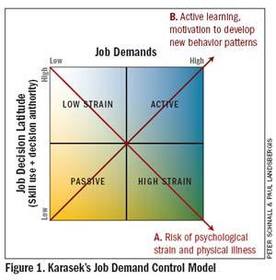
10. Valued social position - 13Job Demands-Control (JD-C)Model- Karasek (1979)
- High demands, low control = High stress = burnout, depression, anxiety, distress, etc
- High demands, high control = Low stress = feelings of mastery & confidence
- Buffering role of 'job control' for high demand jobs.
-Low demand & low control results in boredom & passivity (passive jobs)
- Control refers to autonomy - 14JD-C Model Depiction
- 15JDC-S Model- An extension of JD-C model
- Job Demand-Control-Structure (JDC-S)Model
-Johnson & Hall, 1988
- low support for job adds to the stress. - 16Consequences of Occupational StressOrganisational Consequences
1. Job performance - continual high stress levels
2. Absenteeism - [stigma attached to admitting stress]
3. Job attitudes
Individual Consequences
1. Psychological Consequences - Anxiety & Depression
2. Psychological burnout
- Emotional exhaustion
3. Physical Consequences
4. Behavioural Consequences - 17Anxiety- Feeling nervous or worried
- being irritable
- having trouble eating or sleeping or concentrating on work
- panic attacks
-compulsive behaviours
-perceive events to be more stressful than normal - 18Depression- symptoms range from mild 'withdrawal behaviours' (consistent lateness, absenteeism, avoiding social encounters)through to more serious symptoms requiring medication & counselling
- also overlaps with psychological burnout - 19Psychological Burnout- extreme consequence of occupational stress that develops over a period of time from excessive job demands, particularly those that involve interactions with other people.
- sysndrome of emotional exhaustion, depersonalisation, and reduced personal accomplishment that can occuramong individuals who work with other people in some capacity (Maslach, Jackson & Leiter) - 20Psychological burnout (contd)Three Consequences
1. Emotional exhaustion - sever depletion of an individual's emotional resources and is the central or core component of burnout.
2. Cynicism - negative or indifferent attitudes held by burnout workers and their attempts to distance themselves from their customers/clients/patients.
3. Inefficacy - perception of depleted personal accomplishment and interactions and feeling of 'unlikley to improve'. - 21Physical Consequences-relatively minor elements like fatigue, colds, flu, migraines, gastric problems, shoulder & back muscular problems
- serious diseases such as hypertension, high cholesterol, cardiovascular disease & cancer
- emerging link between occupational stress & reproductive health of both men & women - 22Behavioural Consequences- increased irritability, impatience, hostility & aggression
- smoking, alcohol & drug abuse, craving junk food
- positive behaviours such as exercise
- withdrawal behaviours: avoiding social interactions, isolation from colleagues, friends & family, changes in sleeping patterns. - 23Occupational Stress in Practice- use of Promoting Resilient Officers (PRO) program by a police department to increase their officers resilience.
- Engaged workforce copes better with burnout as rvealed by a study into Queensland teachers.
- Stressful jobs: Occupations involving regular contact with other people (patients, students, school children, clients), high workloads, tight deadlines, threat of physical attack, lack of workplace support. - 24Coping- a response to maintain a state of individual wellbeing.
-individual's ability to cope with the stressor is the most important thing in the concept of stress.
- coping consists of:
(a) a behaviour - seeking advice or going for a run
(b) a cognition - appraising the impact of the stressor, rethinking actions.
Direct response: asking for an extension, seeing a doctor.
Avoidance response: devaluing the impcat, seeking short-term pleasure with alcohol, TV, etc. - 25Coping Classifications [see figure 8.6]1. problem focussed coping: dealing with stressor directly
2. Emotion focussed coping: avoiding the stressor; not necessarily bad when problem focussed coping cannot be deployed in the immediate timeframe.
- an individual could deploy both. - 26Other Coping Classifications1. Trait based coping:
- a relatively stable response to stress, habitually presented regardless of the stressor or the situation.
- e.g: going for a run or swim, talking to your spouse, having a drink, etc
2. State-based coping: aligns with transacation definition of stress - continually evolving until stressor is eliminated.
- allows for numerous responses - some trait based, some novel. - 27Stress management Interventions (SMIs) Stress Reduction1. Stress reduction
- most proactive approach, primary intervention
-work redesign, support, reducing ambiguity, increased communication
- least adopted option due to the time, cost & effort it takes. - 28Stress management Interventions (SMIs) Stress management TrainingStress management Training
- secondary intervention
-targets individual responses to stressors, rather than actual stressors.
-known as 'worker oriented' SMIs - 29Stress management Training Employee Assistance Programs- Tertiary intervention
- 'ambulance at the bottom of the cliff'
-focus on counselling, debriefing, guidance
-treat & rehabilitate to resume jobs
- a combination of three approaches - tripartite SMI model required for effective occupational stress reduction
Information
- Description
- MBA Organisational Behaviour (Occupational Stress) Flashcards on Occupational Stress, created by pelikanbrief on 01/06/2014.
- Created by
- pelikanbrief
- Views
- 22
- Rating