
Flashcards
Evolutionary Trends In Hominids
Cards in this deck (16)
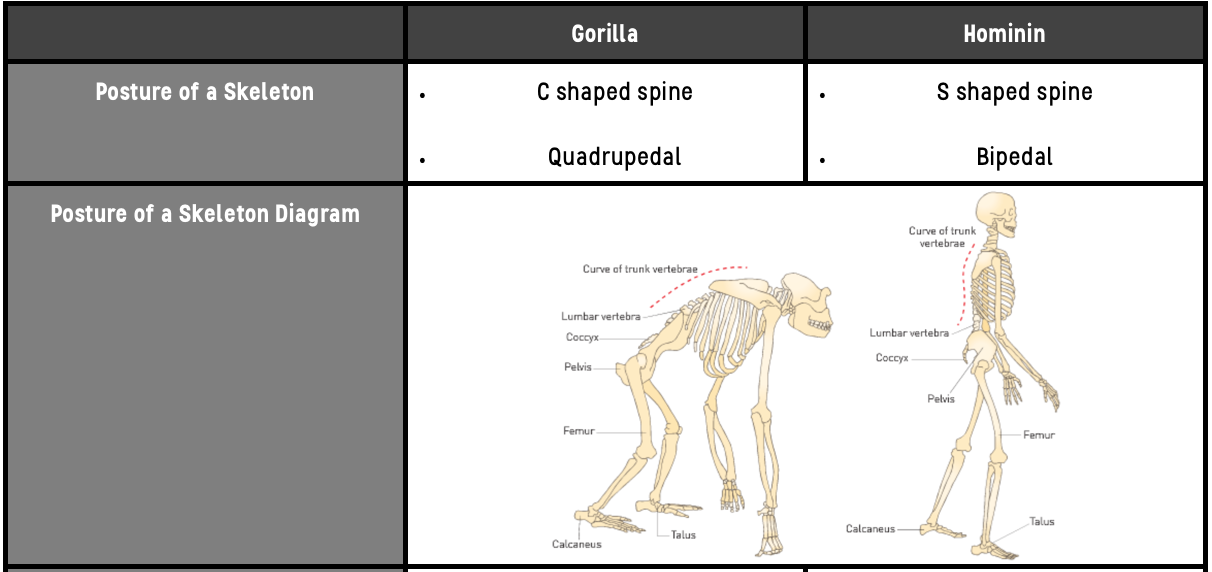
- 1Comparison of a Gorilla & Hominin Posture of the skeleton
- 2Comparison of a Gorilla & Hominin Foramen Magnum

- 3Comparison of a Gorilla & Hominin Foramen Magnum

- 4Comparison of a Gorilla & Hominin Jaw

- 5Comparison of a Gorilla & Hominin Pelvis

- 6Comparison of a Gorilla & Hominin Carrying Angle

- 7Comparison of a Gorilla & Hominin Knee

- 8Comparison of a Gorilla & Hominin Foot

- 9Comparison of a Gorilla & Hominin Centre Of Gravity

- 10Stance And Locomotion• Scientists have observed/examined fossils to work out whether ancient primates would have walked bipedally by looking at anatomical features such as skull, pelvis, knee joint and the arches in the foot.
• Scientists know that extinct hominins such as Australopithecus, Homo Erectus and Homo Neanderthalensis walked upright because of the anatomical features. Anyone who can walk upright on two legs is classified as Hominins. - 11Maintaining upright stance Muscle tone• Partial contraction of skeletal muscles.
• Having partial muscle contraction allows us to stand upright.
• The muscles which help us being upright are muscles in the spine, hip, knee, ankle and the abdominal muscles. - 12Maintaining upright stance Walking upright• Humans are the only ones in animals which have perfected Locomotion.
• When walking upright, our hip and knee are fully straightened.
• Apes have their knees bent and body bent forward. - 13Maintaining upright stance Striding Gait (walking)• Weight is transferred from the heel to the outside of the foot, to the big toe which is a lift off.
• Our foot lost opposability of the big toe because we use our feet for weight baring not grasping.
• When walking, our arms swing forward as our legs move forward. - 14Relative size of cerebral cortexHumans have a relatively large brain compared to the great apes.
Humans →1350cm3
Ape → 400cm3
• The outer portion of the brain called the cerebral cortex is larger which shows the greatest degree of development. This is because of the increase of folds called convolutions.
• The frontal lobe had the greatest enlargement in surface area (makes up 47%) of the surface area.
• Our front lobe has increased due to the front lobe having the processing sections- thinking, reasoning, planning and processing.
• A large brain requires a large cranium to fit the brain in. Our cranium is alrge to house the brain in.
• This has seen a reduction in brow ridges and a snout in humans.
• Our skull tends to be flat but our nose is more prominent.
• If you look at the skull of Afarensis and work towards a advanced hominin, then the brow ridges start to disappear, the face becomes flatter and this is because of the expanding frontal lobe. - 15Dentition• In humans the canine teeth do no project beyond the level of the teeth (stick out)
• Our canine teeth are quite small and look more like incisors.
• Modern Humans are gradually losing their wisdom teeth and an increasing number of humans not having any wisdom teeth at all.
• Our dental arcade is Parabolic not U shaped like an Ape. - 16Prognathism• Apes and early hominins had a very forward jutting jaw which was accompanied with prominent brow ridges.
• Over time this has been reduced due to the increase in cranial capacity and distinct forehead.
• Humans have a reduction in the brow ridge and have a flatter face with a chin.
Information
- Description
- Year 12 ATAR Human Biology (Chapter 18 • Evolutionary Trends In Hominids •) Flashcards on Evolutionary Trends In Hominids , created by Lewis Johnson on 17/08/2017.
- Created by
- Lewis Johnson
- Views
- 11
- Rating