
Flowchart
Flowchart Research Problem
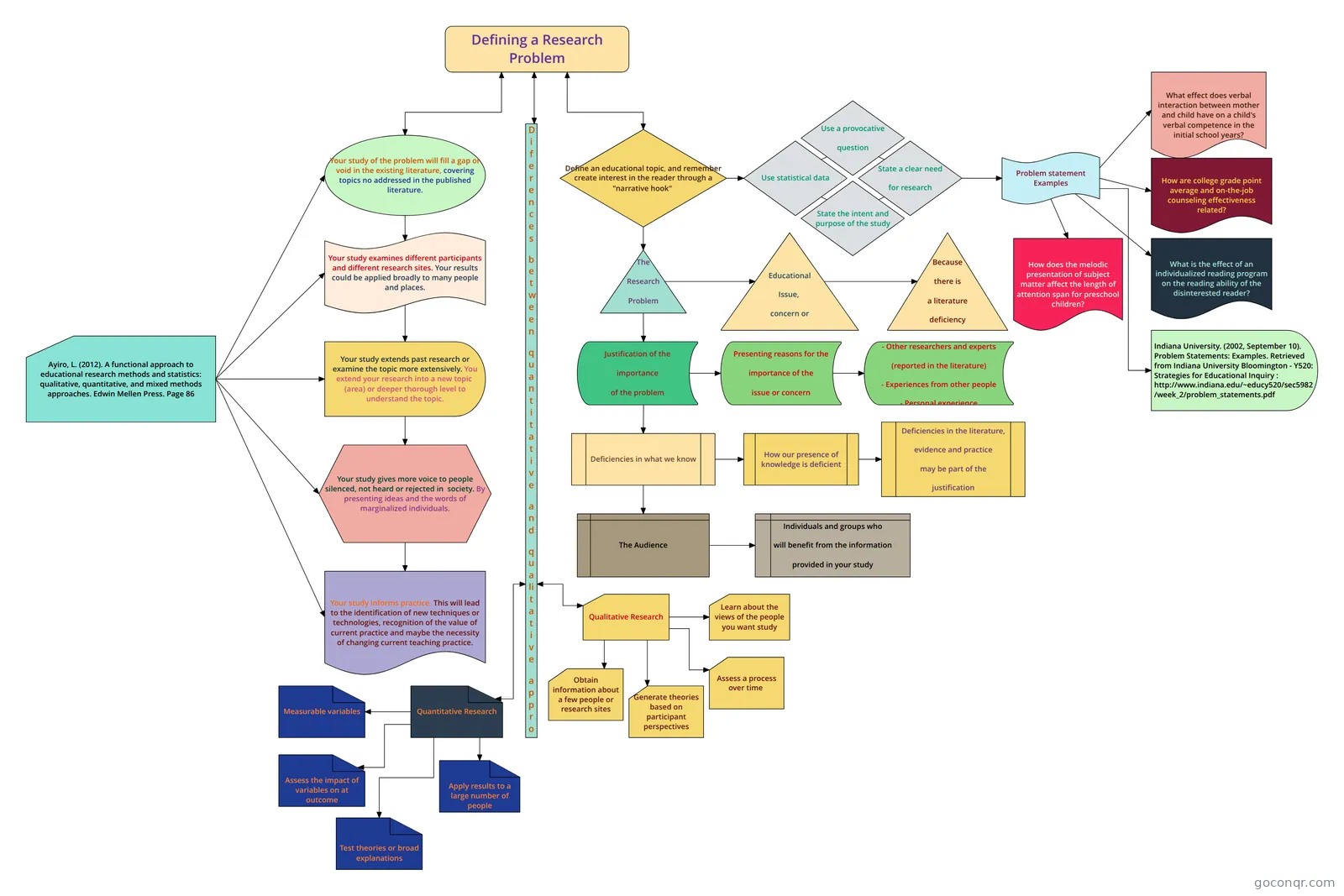
Flowchart: Research problem in educational research
Flowchart content
Defining a Research Problem
Your study of the problem will fill a gap or void in the existing literature, covering topics no addressed in the published literature.
Your study examines different participants and different research sites. Your results could be applied broadly to many people and places.
Your study extends past research or examine the topic more extensively. You extend your research into a new topic (area) or deeper thorough level to understand the topic.
Your study gives more voice to people silenced, not heard or rejected in society. By presenting ideas and the words of marginalized individuals.
Your study informs practice. This will lead to the identification of new techniques or technologies, recognition of the value of current practice and maybe the necessity of changing current teaching practice.
Ayiro, L. (2012). A functional approach to educational research methods and statistics: qualitative, quantitative, and mixed methods approaches. Edwin Mellen Press. Page 86
Define an educational topic, and remember create interest in the reader through a "narrative hook"
Use statistical data
Use a provocative
question
State a clear need
for research
State the intent and purpose of the study
The
Research
Problem
Justification of the
importance
of the problem
Deficiencies in what we know
The Audience
Educational
Issue,
concern or
controversy
Because
there is
a literature
deficiency
Presenting reasons for the
importance of the
issue or concern
- Other researchers and experts
(reported in the literature)
- Experiences from other people
- Personal experience
How our presence of knowledge is deficient
Deficiencies in the literature,
evidence and practice
may be part of the
justification
Individuals and groups who
will benefit from the information
provided in your study
Diferences
between
quantitative
and
qualitative
approach
Qualitative Research
Quantitative Research
Measurable variables
Assess the impact of variables on at outcome
Test theories or broad explanations
Apply results to a large number of people
Learn about the views of the people you want study
Assess a process over time
Generate theories based on participant perspectives
Obtain information about a few people or research sites
Problem statement Examples
What effect does verbal interaction between mother and child have on a child's verbal competence in the initial school years?
How are college grade point average and on-the-job counseling effectiveness related?
What is the effect of an individualized reading program on the reading ability of the disinterested reader?
How does the melodic presentation of subject matter affect the length of attention span for preschool children?
Indiana University. (2002, September 10). Problem Statements: Examples. Retrieved from Indiana University Bloomington - Y520: Strategies for Educational Inquiry : http://www.indiana.edu/~educy520/sec5982/week_2/problem_statements.pdf
Information
- Description
- Flowchart on Flowchart Research Problem , created by Fabiola Suárez on 30/04/2018.
- Created by
- Fabiola Suárez
- Views
- 18
- Rating