
Mind map
Alkali metals
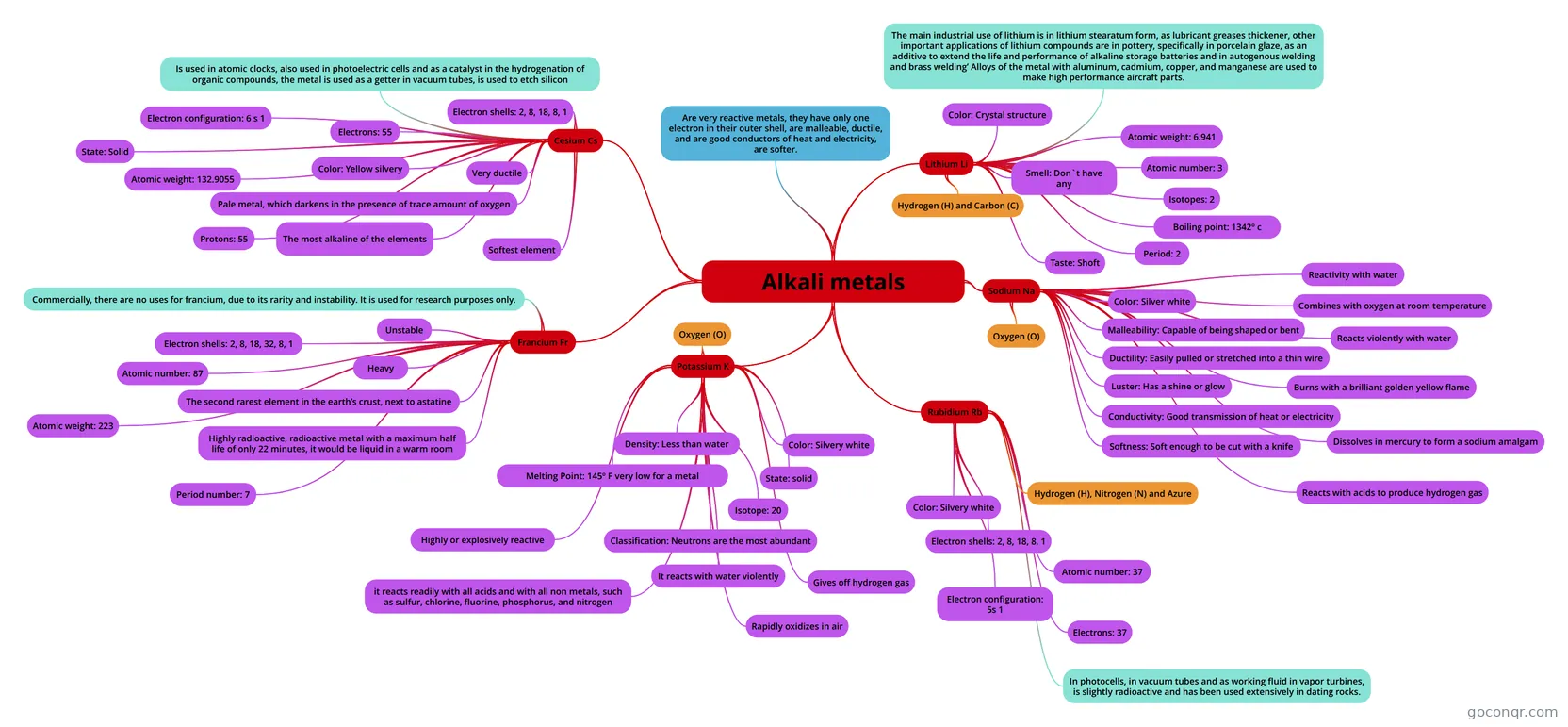
Mind map: Alkali metals
Map content
Alkali metals
Are very reactive metals, they have only one electron in their outer shell, are malleable, ductile, and are good conductors of heat and electricity, are softer.
Lithium Li
- Color: Crystal structure
- Smell: Don`t have any
- Taste: Shoft
- Atomic weight: 6.941
- Atomic number: 3
- Isotopes: 2
- Boiling point: 1342º c
- Period: 2
- Hydrogen (H) and Carbon (C)
- The main industrial use of lithium is in lithium stearatum form, as lubricant greases thickener, other important applications of lithium compounds are in pottery, specifically in porcelain glaze, as an additive to extend the life and performance of alkaline storage batteries and in autogenous welding and brass welding’ Alloys of the metal with aluminum, cadmium, copper, and manganese are used to make high performance aircraft parts.
Sodium Na
- Softness: Soft enough to be cut with a knife
- Color: Silver white
- Malleability: Capable of being shaped or bent
- Ductility: Easily pulled or stretched into a thin wire
- Luster: Has a shine or glow
- Conductivity: Good transmission of heat or electricity
- Oxygen (O)
- Reacts with acids to produce hydrogen gas
- Reactivity with water
- Combines with oxygen at room temperature
- Reacts violently with water
- Burns with a brilliant golden yellow flame
- Dissolves in mercury to form a sodium amalgam
Potassium K
- Density: Less than water
- Color: Silvery white
- State: solid
- Classification: Neutrons are the most abundant
- Isotope: 20
- Melting Point: 145º F very low for a metal
- Oxygen (O)
- Highly or explosively reactive
- It reacts with water violently
- Gives off hydrogen gas
- it reacts readily with all acids and with all non metals, such as sulfur, chlorine, fluorine, phosphorus, and nitrogen
- Rapidly oxidizes in air
Rubidium Rb
- Color: Silvery white
- Hydrogen (H), Nitrogen (N) and Azure
- Atomic number: 37
- Electron shells: 2, 8, 18, 8, 1
- Electron configuration: 5s 1
- Electrons: 37
- In photocells, in vacuum tubes and as working fluid in vapor turbines, is slightly radioactive and has been used extensively in dating rocks.
Cesium Cs
- Pale metal, which darkens in the presence of trace amount of oxygen
- Softest element
- Very ductile
- Is used in atomic clocks, also used in photoelectric cells and as a catalyst in the hydrogenation of organic compounds, the metal is used as a getter in vacuum tubes, is used to etch silicon
- Electrons: 55
- The most alkaline of the elements
- Color: Yellow silvery
- Atomic weight: 132.9055
- Protons: 55
- State: Solid
- Electron shells: 2, 8, 18, 8, 1
- Electron configuration: 6 s 1
Francium Fr
- Highly radioactive, radioactive metal with a maximum half life of only 22 minutes, it would be liquid in a warm room
- Heavy
- Unstable
- The second rarest element in the earth’s crust, next to astatine
- Commercially, there are no uses for francium, due to its rarity and instability. It is used for research purposes only.
- Electron shells: 2, 8, 18, 32, 8, 1
- Atomic number: 87
- Atomic weight: 223
- Period number: 7
Information
- Description
- Mind Map on Alkali metals, created by Stephanie Aroesti on 01/09/2017.
- Created by
- Stephanie Aroesti
- Views
- 0
- Rating