
Mind map
Using Rubrics in Students Assessment
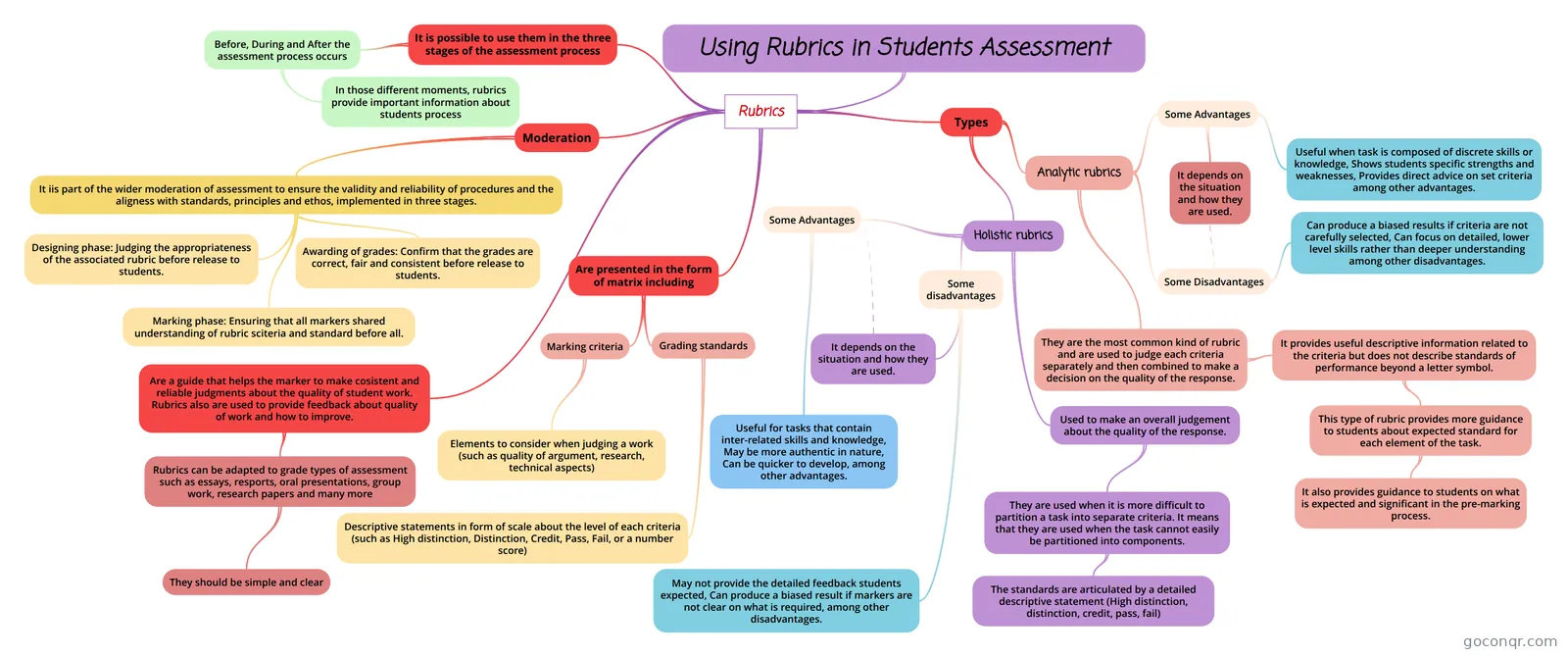
Mind map: Using rubrics in students assessment
Map content
Using Rubrics in Students Assessment
Rubrics
- Are a guide that helps the marker to make cosistent and reliable judgments about the quality of student work. Rubrics also are used to provide feedback about quality of work and how to improve.
- Rubrics can be adapted to grade types of assessment such as essays, resports, oral presentations, group work, research papers and many more
- They should be simple and clear
- Rubrics can be adapted to grade types of assessment such as essays, resports, oral presentations, group work, research papers and many more
- Are presented in the form of matrix including
- Marking criteria
- Elements to consider when judging a work (such as quality of argument, research, technical aspects)
- Grading standards
- Descriptive statements in form of scale about the level of each criteria (such as High distinction, Distinction, Credit, Pass, Fail, or a number score)
- Marking criteria
- It is possible to use them in the three stages of the assessment process
- Before, During and After the assessment process occurs
- In those different moments, rubrics provide important information about students process
- Before, During and After the assessment process occurs
- Types
- Analytic rubrics
- They are the most common kind of rubric and are used to judge each criteria separately and then combined to make a decision on the quality of the response.
- It provides useful descriptive information related to the criteria but does not describe standards of performance beyond a letter symbol.
- This type of rubric provides more guidance to students about expected standard for each element of the task.
- It also provides guidance to students on what is expected and significant in the pre-marking process.
- This type of rubric provides more guidance to students about expected standard for each element of the task.
- It provides useful descriptive information related to the criteria but does not describe standards of performance beyond a letter symbol.
- Some Advantages
- Useful when task is composed of discrete skills or knowledge, Shows students specific strengths and weaknesses, Provides direct advice on set criteria among other advantages.
- It depends on the situation and how they are used.
- Some Disadvantages
- Can produce a biased results if criteria are not carefully selected, Can focus on detailed, lower level skills rather than deeper understanding among other disadvantages.
- They are the most common kind of rubric and are used to judge each criteria separately and then combined to make a decision on the quality of the response.
- Holistic rubrics
- Used to make an overall judgement about the quality of the response.
- They are used when it is more difficult to partition a task into separate criteria. It means that they are used when the task cannot easily be partitioned into components.
- The standards are articulated by a detailed descriptive statement (High distinction, distinction, credit, pass, fail)
- They are used when it is more difficult to partition a task into separate criteria. It means that they are used when the task cannot easily be partitioned into components.
- Some Advantages
- Useful for tasks that contain inter-related skills and knowledge, May be more authentic in nature, Can be quicker to develop, among other advantages.
- Some disadvantages
- May not provide the detailed feedback students expected, Can produce a biased result if markers are not clear on what is required, among other disadvantages.
- It depends on the situation and how they are used.
- Used to make an overall judgement about the quality of the response.
- Analytic rubrics
- Moderation
- It iis part of the wider moderation of assessment to ensure the validity and reliability of procedures and the aligness with standards, principles and ethos, implemented in three stages.
- Designing phase: Judging the appropriateness of the associated rubric before release to students.
- Marking phase: Ensuring that all markers shared understanding of rubric sciteria and standard before all.
- Awarding of grades: Confirm that the grades are correct, fair and consistent before release to students.
- It iis part of the wider moderation of assessment to ensure the validity and reliability of procedures and the aligness with standards, principles and ethos, implemented in three stages.
- Are a guide that helps the marker to make cosistent and reliable judgments about the quality of student work. Rubrics also are used to provide feedback about quality of work and how to improve.
Information
- Description
- Mind Map on Using Rubrics in Students Assessment, created by Carolina Builes Quintero on 11/10/2017.
- Created by
- Carolina Builes Quintero
- Views
- 0
- Rating