
Mind map
User-centered approaches to interaction design
Map content
User-centered approaches to interaction design
involving users
- the best way to that development continues to take users' activities into account is to involve users throughout. In this way, developers can gain a better understanding of their needs and their goals, leading to a more appropriate, more product.
- expectation management
- is the process of making sure that the users views and expectations of the new product are realistic. The purpose of expectation management is to ensure that there are no surprises for users when the product arrives. If users feel they have been "cheated" by promises that have not been fulfilled, then this will cause resistance and ma be rejection.
- ownership
- Users who are involved and feel that they have contributed to a product's development, are more likely to feel a sense of "ownership" towards it and to be receptive to it when it finally emerges.
degrees of involvement
- users may be co-opted to the design team so that they are major contributors.
- If a user is co-opted full-time for the whole project, their input will be consistent and they will become very familiar with the system and its rationale.
- However, if the project takes many years they may lose touch with the rest of the user group, making their input less valuable.
user-centered approach
- Gould and Lewis
- Early focus on users and tasks.
- This means first understanding who the users will be by directly studying their cognitive, behavioral, anthropomorphic, and attitudinal characteristics. This required observing users doing their normal tasks, studying the nature of those tasks, and then involving users in the design process.
- Empirical measurement
- Early in development, the reactions and perfor- mance of intended users to printed scenarios, manuals, etc. is observed and measured. Later on, users interact with simulations and prototypes and their performance and reactions are observed, recorded, and analyzed.
- Iterative design
- When problems are found in user testing, they are fixed and then more tests and observations are carried out to see the effects of the fixes. This means that design and development is iterative, with cycles of "design, test, measure, and redesign" being repeated as often as necessary.
- Early focus on users and tasks.
- Gould and Lewis
applying ethnography in design
- Ethnography is a method that comes originally from anthropology and literally means "writing the culture"
- Ethnography for development yields ethnographic studies that can be used as a resource for development, studies of organizational work.
- Ethnography within software development is the most common form of study
- In some ways, the goals of design and the goals of ethnography are at opposite ends of a spectrum. Design is concerned with abstraction and rationalization. Ethnography, on the other hand, is about detail. An ethnographer's account will be concerned with the minutiae of observation, while a designer is looking for useful abstractions that can be used to inform design.
- The distributed co-ordination dimension focuses on the distributed nature of the tasks and activities, and the means and mechanisms by which they are co- ordinated.
- The plans and procedures dimension focuses on the organizational support for the work, such as workflow models and organizational charts, and how these are used to support the work.
- The awareness of work dimension focuses on how people keep themselves aware of others' work. No-one works in isolation, and it has been shown that being aware of others' actions and work activities can be a crucial ele- ment of doing a good job.
coherence
- The Coherence method combines experiences of using ethnography to inform design with developments in requirements engineering. Specifically, it is intended to integrate social analysis with object-oriented analysis from software engineering.
- viewpoints
- Coherence builds upon the framework introduced above and provides a set of focus questions for each of the three dimensions, here called "viewpoints".
- In addition to viewpoints, Coherence has a set of concerns and associated questions. Concerns are a kind of goal, and they represent criteria that guide the requirements activity.
- If it is relevant, then a set of elaboration questions is used to explore the concern further. The concerns, which have arisen from experience of using ethnography in systems design, are:
- Paperwork and computer work.
- These are embodiments of plans and procedures, and at the same time are a mechanism for developing and sharing an awareness of work.
- Skill and the use of local knowledge.
- This refers to the that are developed in organizations and are at the heart of how the real work gets done.
- Spatial and temporal organization.
- This concern looks at the physical layout of the workplace and areas where time is important.
- Organizational memory.
- Formal documents are not the only way in which things are remembered within an organization. Individuals may keep their own records, or there may be local gurus.
- Paperwork and computer work.
- Coherence builds upon the framework introduced above and provides a set of focus questions for each of the three dimensions, here called "viewpoints".
- viewpoints
- The Coherence method combines experiences of using ethnography to inform design with developments in requirements engineering. Specifically, it is intended to integrate social analysis with object-oriented analysis from software engineering.
contextual Design
- contextual inquiry
- is an approach to ethnographic study used for design that fol- lows an apprenticeship model: the designer works as an apprentice to the user.
- Work Modeling
- Contextual design identifies five aspects to modeling "work," each of which guides the team to take a different perspective on what they have observed:
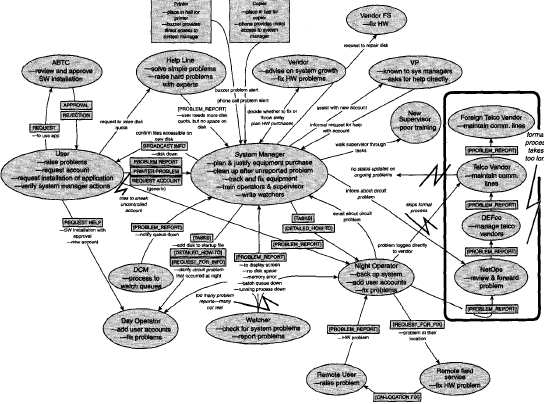
- workflowmodel
- represents the people involved in the work and the communication and coordination that takes place among them in order to achieve the work.
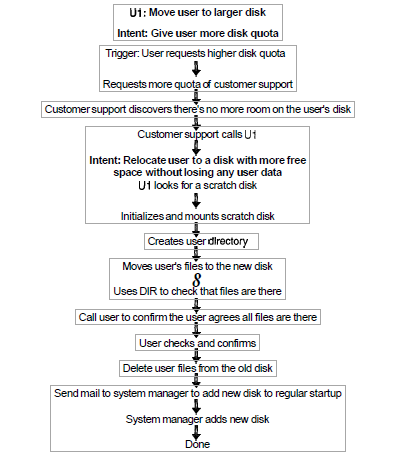
- sequence model
- shows the detailed work steps necessary to achieve a goal. Sequences are collected during the contextual interview, as the user works.
- artifact model
- represents the physical things created to do the work, such as the sticky notes at my desk, described above.
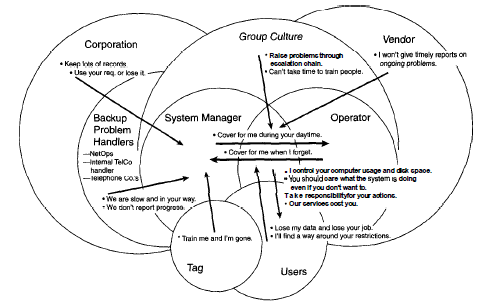
- cultural model
- represents constraints on the system caused by organizational culture.
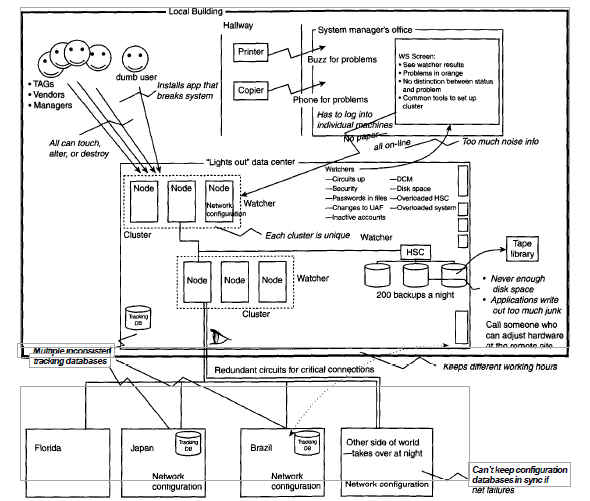
- physical model
- shows the physical structure of the work. It may be a physical plan of the users' work environment, the office, or it may be a schematic of a communications network showing how components are linked together.
- workflowmodel
- Contextual design identifies five aspects to modeling "work," each of which guides the team to take a different perspective on what they have observed:
- consolidation
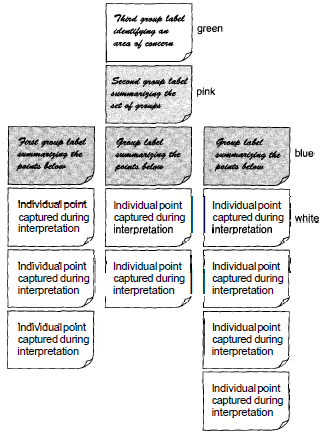
- The affinity diagram aims to organize the individual notes captured in the interpretation sessions into a hierarchy showing common structures and themes.
- Work redesign
- design room
- where all the work models are kept, pinned to the wall. The room is an environment that contains everything the team knows about the customer and their work. Design discussions held in the room can refer to data collected at the beginning of the project, and this can be used to support design ideas and decisions.
- design room
- user environment design
- mockup and test
- are one way to make effective use of the users' experience and knowledge.
- putting it into practice
- contextual inquiry
involving users in design
- participatory design
- In contrast to Contextual Design, users are actively involved in development. The intention is that they become an equal partner in the design team, and they design the product in coop- eration with the designers.
- WYSIWYG (what you see is what you get)
- In contrast to Contextual Design, users are actively involved in development. The intention is that they become an equal partner in the design team, and they design the product in coop- eration with the designers.
- participatory design
pictive
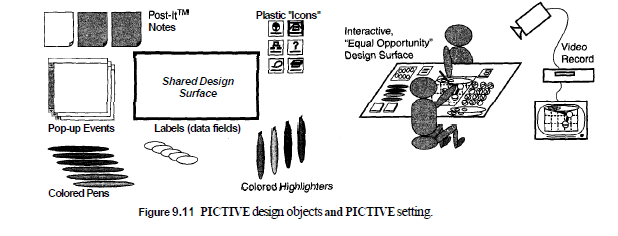
- PICTIVE (Plastic Interface for Collaborative Technology Initiatives through Video Exploration)
- The motives for developing the techniques were to:
- empower users to act as full participants in the design process
- improve knowledge acquisition for design
- The motives for developing the techniques were to:
- PICTIVE (Plastic Interface for Collaborative Technology Initiatives through Video Exploration)
Card
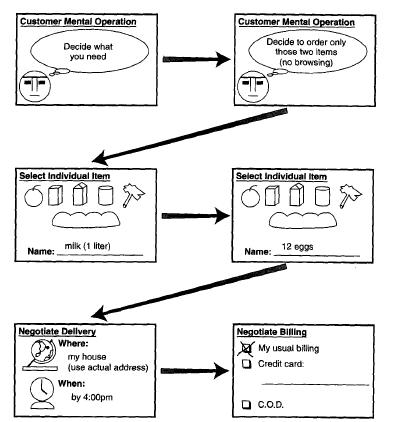
- CARD (Collaborative Analysis of Requirements and Design)
- uses playing cards with pictures of computers and screen dumps on them to explore workflow options
- CARD can be used to complement PICTIVE as it provides a different granu- larity of focus. Muller et al. (1995) characterized this as a bifocal view, CARD giv- ing a macroscopic view, and PICTIVE the microscopic.
- Whereas PICTIVE concentrates on detailed aspects of the system, CARD takes a more macroscopic view of the task flow.
- CARD (Collaborative Analysis of Requirements and Design)
Naomi Macias Honti
- A01282098
Images and files in the map
Information
- Description
- Mind Map on User-centered approaches to interaction design, created by Naomi Macias on 14/10/2017.
- Created by
- Naomi Macias
- Views
- 0
- Rating