
Mind map
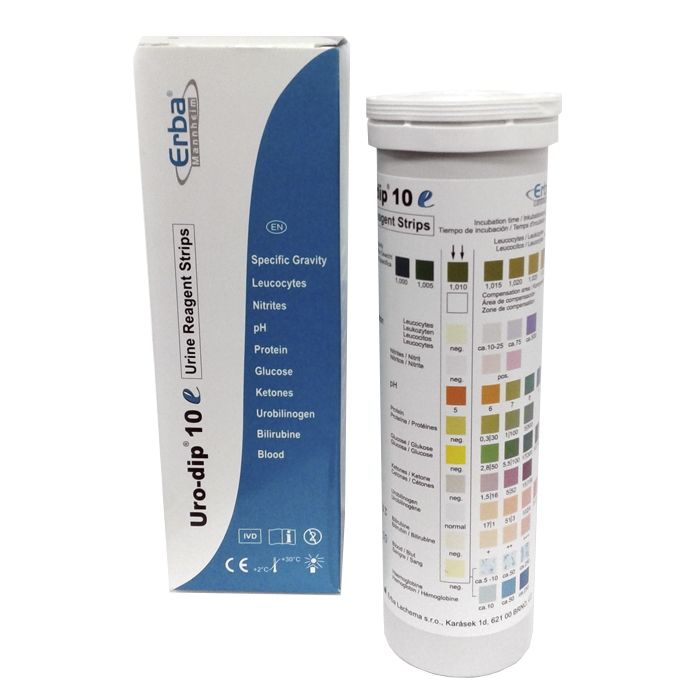
Uro-dip® 10e
Map content
Uro-dip® 10e
The test is based on the principle of ion exchange, which runs between polyelectrolyte and ions present in urine. Its result is colour change of acid-base indicator from blue-green colour in urine with low concentration of ions, through green and yellow-green in urine with increased concentration of ions, to umber yellow colour. Using this test it is possible to determine specific gravity of urine in the range of 1.000 up to 1.030. The first morning urine of healthy person should be in the range of 1.015 up to 1.025. Ingredients: poly(methylvinylether/maleic acid) 32 %; bromthymol blue 5.1 %
- PLEASE NOTE: Knowledge of the effects of drugs or their metabolites upon the individual tests is not yet complete. In doubtful cases, it is advisable to repeat the test after discontinuing a drug. The sensitivity depends upon the variability of urines. The semiquantitative analysis is not sufficient for the completing of diagnoses.
- The reaction is not affected by pH values of urine over 6.5 shift colour response towards lower values of specific gravity
- PLEASE NOTE: Knowledge of the effects of drugs or their metabolites upon the individual tests is not yet complete. In doubtful cases, it is advisable to repeat the test after discontinuing a drug. The sensitivity depends upon the variability of urines. The semiquantitative analysis is not sufficient for the completing of diagnoses.
Leucocytes . The colour intensity is proportional to leucocytes amount in a sample of tested urine. Ingredients: indoxyl ester 0.43 %; diazonium salt 0.05 % . 10 Leu/μl - intact and lysed WBCs
- In case vhen the urine sample is more markedly coloured (e.g. increased bilirubin content), the resulting colour could be affected by a sample coloration. The intensity of colour reaction is increased by alkaline pH and higher urine density.
Nitrite - Some degree of pink coloration should be interpreted as a positive nitrite test suggestive of 105 or more organisms in 1 ml of urine specimen, but coloration of pad is not quantitatively proportional to the amount of bacteria present in urine.
- Before testing the patient should intake vegetable-rich meals and discontinue antibiotic therapy and vitamin C for 3 days prior to the test. Sensitivity of this test declines with high specific gravity of urine. Increased diuresis can cause false negative results. Limited fluid intake prior testing can prevent from the excessive dilution of urine.
pH - The test is based on the double indicator principle and gives a range of colours from orange through yellow and green to blue and permits differentiation to within 0.5 pH unit in the range pH 5 to 9.
Protein - The test is based on colour change of acid-base indicator, which is caused by presence of proteins. It is particularly sensitive to albumin, but is much less sensitive to globulin, mucoprotein, haemoglobin and Bence-Jones protein.
- In strongly alkaline urines (pH >8) from patients on medication with quinine or quinoline containing drugs false positive reading may be obtained. False positive results may be found when the urine collection vessel contains traces of disinfectants with quarternary ammonium groups.
Glucose - The reagent pad does not react with other sugars, it reacts with presence of D-glucose by greeny to dark-green coloration.
- - The reaction is independent on pH and presence of ketone bodies
Ketones - The test is based on the principle of Legal‘s test and is more susceptible to acetoacetic acid than to acetone. Test does not react with ß-hydroxybutyric acid. The colour scale is calibrated for acetoacetic acid.
- Drugs and diagnostics on the basis of phenolphtalein or sulphophthalein may turn red to purple because of alkaline reaction of the pad
Urobilinogen - The test is based on the coupling of urobilinogen with stabilized reagent. The test is specific for urobilinogen and stercobilinogen and is not susceptible to the interfering factors known at Ehrlich‘s test.
- The reaction is not affected by pH of urine. The presence of bilirubin gives yellow colour. This colour which turns slowly to greenish-blue does not interfere with urobilinogen determination provided the reading is made 1 minute after wetting.
Bilirubin - The test is based on the coupling of bilirubin with stabilized reagent.
- The urine specimen should not be exposed to direct sunlight as this promotes the oxidation of bilirubin and thus leads to artificially low or false negative readings. High concentrations of urobilinogen (above 100 μmol/l) interfere with the test.
Blood - The test is based on the peroxidase activity of haemoglobin which catalyzes the oxidation of the indicator due to the presence of the organic hydroperoxide contained in the diagnostic pad. The label contains two colour scales; for detection of intact erythrocytes and free haemoglobin.
- Microbial peroxidase associated with urinary tract infection may cause a false positive reaction. The sensitivity of the test is influenced by specific gravity or by inhibitors of pharmacological origin.
Compensation field – Pad, which is not impregnated with any reagents. The compensation field is used for suppressing of the dark colour of the urine sample, because the dark colour could have the effect on the evaluation of reagent pads
Images and files in the map
Information
- Description
- Mind Map on Uro-dip® 10e, created by Karla Lissete Orozco Coello on 24/10/2017.
- Created by
- Karla Lissete Orozco Coello · Oct 2017
- Updated
- Oct 24, 2017
- Views
- 0
- Rating