
Mind map
1 What is Interaction Design?
Map content
1 What is Interaction Design?
One main aim of interaction design is to reduce the negative aspects (e.g. frustration, annoyance) of the user experience while enhancing the positive ones (e.g. enjoyment, engagement). In essence, it is about developing interactive products1 that are easy , effective, and pleasurable to use – from the users’ perspective
Good and Poor Design
- Voice Mail System
- A central concern of interaction design is to develop interactive products that are usable.
- By this is generally meant easy to learn, effective to use, and providing an enjoyable user experience.
- A good place to start thinking about how to design usable interactive products is to compare examples of well- and poorly-designed ones. Through identifying the specific weaknesses and strengths of different interactive products, we can begin to understand what it means for something to be usable or not.
- By this is generally meant easy to learn, effective to use, and providing an enjoyable user experience.
- Remote Control Device
What to Design
- Designing interactive products requires considering who is going to be using them, how they are going to be used, and where they are going to be used.
- Another key concern is to understand the kind of activities people are doing when interacting with the products
- Taking into account what people are good and bad at.
- Considering what might help people with the way they currently do things.
- Thinking through what might provide quality user experiences.
- Listening to what people want and getting them involved in the design.
- Using tried and tested user-based techniques during the design process.
- Listening to what people want and getting them involved in the design.
- Thinking through what might provide quality user experiences.
- Considering what might help people with the way they currently do things.
- understanding of the users, this involves:
What Is Interaction Design?
- Winograd describes it as “designing spaces for human communication and interaction” (1997, p. 160). Thackara views it as “the why as well as the how of our daily interactions using computers” (2001, p. 50) while Saffer emphasizes its artistic aspects: “the art of facilitating interactions between humans through products and services” (2010, p. 4).
- By interaction design, we mean designing interactive products to support the way people communicate and interact in their everyday and working lives
The Components of Interaction Design
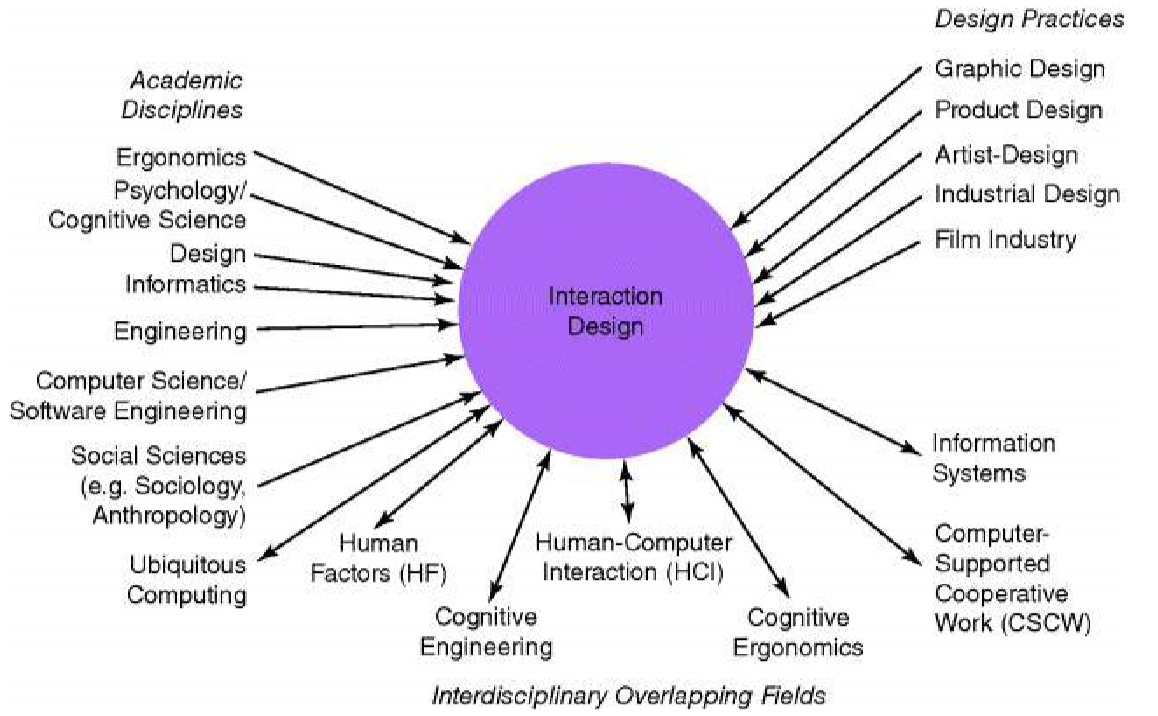
Who Is Involved in Interaction Design?
- One of the benefits of bringing together people with different backgrounds and training is the potential of many more ideas being generated, new methods developed, and more creative and original designs being produced. However, the downside is the costs involved. The more people there are with different backgrounds in a design team, the more difficult it can be to communicate and make progress forward with the designs being generated. Why? People with different backgrounds have different perspectives and ways of seeing and talking about the world. What one person values as important others may not even see (Kim, 1990). Similarly , a computer scientist's understanding of the term ‘representation’ is often very different from a graphic designer's or a psychologist's
Interaction Design Consultants
- The presence or absence of good interaction design can make or break a company . To get noticed in the highly competitive field of web products requires standing out. Being able to say that your product is easy , effective, and engaging to use is seen as central to this. Marketing departments are also realizing how branding, the number of hits, customer return rate, and customer satisfaction are greatly affected by the usability of a website.
The User Experience
- The user experience (UX) is central to interaction design. By this it is meant how a product behaves and is used by people in the real world. Nielsen and Norman (2014) define it as encompassing “all aspects of the end-user's interaction with the company , its services, and its products.” As stressed by Garrett (2010, p. 10), “every product that is used by someone has a user experience: newspapers, ketchup bottles, reclining armchairs, cardigan sweaters.” More specifically , it is about how people feel about a product and their pleasure and satisfaction when using it, looking at it, holding it, and opening or closing it.
- As Dewey (1934) points out: “Emotion is the moving and cementing force. It selects what is congruous and dyes what is selected with its color, thereby giving qualitative unity to materials externally disparate and dissimilar. It thus provides unity in and through the varied parts of experience.” McCarthy and Wright propose four core threads that make up our holistic experiences: sensual, emotional, compositional, and spatiotemporal:
- The sensual thread. This is concerned with our sensory engagement with a situation and is similar to the visceral level of Norman's model. It can be equated with the level of absorption people have with various technological devices and applications, most notable being computer games, smartphones, and chat rooms, where users can be highly absorbed in their interactions at a sensory level. These can involve thrill, fear, pain, and comfort.
- The emotional thread. Common examples of emotions that spring to mind are sorrow, anger, joy , and happiness. In addition, the framework points out how emotions are intertwined with the situation in which they arise – e.g. a person becomes angry with a computer because it does not work properly . Emotions also involve making judgments of value. For example, when purchasing a new cell phone, people may be drawn to the ones that are most cool-looking but be in an emotional turmoil because they are the most expensive. They can't really afford them but they really would like one of them.
- The compositional thread. This is concerned with the narrative part of an experience, as it unfolds, and the way a person makes sense of it. For example, when shopping online, the options laid out to people can lead them in a coherent way to making a desired purchase or they can lead to frustrating experiences resulting in no purchase being made. When in this situation, people ask themselves questions such as: What is this about? Where am I? What has happened? What is going to happen next? What would happen if . . . ? The compositional thread is the internal thinking we do during our experiences.
- The spatio-temporal thread. This refers to the space and time in which our experiences take place and their effect upon those experiences. There are many ways of thinking about space and time and their relationship with one another: for example, we talk of time speeding up, standing still, and slowing down, while we talk of space in terms of public and personal places, and needing one's own space.
- The compositional thread. This is concerned with the narrative part of an experience, as it unfolds, and the way a person makes sense of it. For example, when shopping online, the options laid out to people can lead them in a coherent way to making a desired purchase or they can lead to frustrating experiences resulting in no purchase being made. When in this situation, people ask themselves questions such as: What is this about? Where am I? What has happened? What is going to happen next? What would happen if . . . ? The compositional thread is the internal thinking we do during our experiences.
- The emotional thread. Common examples of emotions that spring to mind are sorrow, anger, joy , and happiness. In addition, the framework points out how emotions are intertwined with the situation in which they arise – e.g. a person becomes angry with a computer because it does not work properly . Emotions also involve making judgments of value. For example, when purchasing a new cell phone, people may be drawn to the ones that are most cool-looking but be in an emotional turmoil because they are the most expensive. They can't really afford them but they really would like one of them.
- The sensual thread. This is concerned with our sensory engagement with a situation and is similar to the visceral level of Norman's model. It can be equated with the level of absorption people have with various technological devices and applications, most notable being computer games, smartphones, and chat rooms, where users can be highly absorbed in their interactions at a sensory level. These can involve thrill, fear, pain, and comfort.
- As Dewey (1934) points out: “Emotion is the moving and cementing force. It selects what is congruous and dyes what is selected with its color, thereby giving qualitative unity to materials externally disparate and dissimilar. It thus provides unity in and through the varied parts of experience.” McCarthy and Wright propose four core threads that make up our holistic experiences: sensual, emotional, compositional, and spatiotemporal:
- The user experience (UX) is central to interaction design. By this it is meant how a product behaves and is used by people in the real world. Nielsen and Norman (2014) define it as encompassing “all aspects of the end-user's interaction with the company , its services, and its products.” As stressed by Garrett (2010, p. 10), “every product that is used by someone has a user experience: newspapers, ketchup bottles, reclining armchairs, cardigan sweaters.” More specifically , it is about how people feel about a product and their pleasure and satisfaction when using it, looking at it, holding it, and opening or closing it.
The Process of Interaction Design
- 1. Establishing requirements
- 2. Designing alternatives
- 3. Prototyping
- 4. Evaluating.
- 3. Prototyping
- 2. Designing alternatives
- 1. Establishing requirements
Usability Goals
- effective to use (effectiveness) efficient to use (efficiency) safe to use (safety) having good utility (utility) easy to learn (learnability) easy to remember how to use (memorability).
- Efficiency refers to the way a product supports users in carrying out their tasks
- Effectiveness is a very general goal and refers to how good a product is at doing what it is supposed to do.
- Utility refers to the extent to which the product provides the right kind of functionality so that users can do what they need or want to do.
- Learnability refers to how easy a system is to learn to use.
- Memorability refers to how easy a product is to remember how to use, once learned
Design Principles
- La Visibilidad: Consiste en los apoyos visuales que le brindan al usuario información sobre cómo actuar en determinadas circunstancias. Ejemplos: calcomanías, letreros, etc.
- La Retroalimentación: Consiste en enviar información al usuario sobre lo que éste esté haciendo. Incluye sonidos, luminosidad, animaciones y combinaciones de estas. Ejemplo: Cuando conectas auriculares a algún Smartphone, en la pantalla aparece algún símbolo, advertencia o sonido, haciendo referencia a que se han conectado unos auriculares.
- Las Limitaciones: Consiste en restringir y advertir acciones, para prevenir que el usuario selecciones opciones incorrectas. Ejemplo: Al eliminar archivos en una computadora, la máquina te pregunta si en verdad quieres eliminarlos.
- La Consistencia: Diseñar interfaces que tengan operaciones y elementos similares para realizar tareas similares. Ejemplo: En un ordenador, siempre usar Ctrl + la letra inicial de una palabra para hacer la operación (Ctrt + C = Copiar).
- El Affordance: No existe un sinónimo de esta palabra en español, pero puede interpretarse como dar una pista de algo que hay que hacer. Se refiere al atributo de un objeto que permite a las personas saber cómo usarlo. Ejemplo: El botón del mouse incita a presionarlo.
- La Consistencia: Diseñar interfaces que tengan operaciones y elementos similares para realizar tareas similares. Ejemplo: En un ordenador, siempre usar Ctrl + la letra inicial de una palabra para hacer la operación (Ctrt + C = Copiar).
- Las Limitaciones: Consiste en restringir y advertir acciones, para prevenir que el usuario selecciones opciones incorrectas. Ejemplo: Al eliminar archivos en una computadora, la máquina te pregunta si en verdad quieres eliminarlos.
- La Retroalimentación: Consiste en enviar información al usuario sobre lo que éste esté haciendo. Incluye sonidos, luminosidad, animaciones y combinaciones de estas. Ejemplo: Cuando conectas auriculares a algún Smartphone, en la pantalla aparece algún símbolo, advertencia o sonido, haciendo referencia a que se han conectado unos auriculares.
- La Visibilidad: Consiste en los apoyos visuales que le brindan al usuario información sobre cómo actuar en determinadas circunstancias. Ejemplos: calcomanías, letreros, etc.
Images and files in the map
Information
- Description
- dise_ño Mind Map on 1 What is Interaction Design?, created by Alfonso AO on 02/12/2017.
- Created by
- Alfonso AO
- Views
- 0
- Rating