
Mind map
Probability 1.1-1.4
Map content
Probability 1.1-1.4
Basic concepts
- Outcomes: possible results of the experiment
- Sample space: set of all possible outcomes
- Event: any subset of the sample space
- Experiments: observation or measurment of a random phenomena
- Odds: -in favor (1 to 5) -against (5 to 1)
- Enter text here
- Probability formulas
- Theoretical
- P(E)=n(E)/n(S)= 1/4
- Empirical
- P(E)=numer of times event E ocurred/ number of times the experiment was performed
- Theoretical
- Odds: -in favor (1 to 5) -Against (5 to 1)
- Probability Formulas
- Theoretical
- P(E)=n(E)/n(S)=1/4
- Empirical
- P(E)= number of times event E occurred/ number of times the experiment was performed
- Theoretical
Events involving "not" and "or"
- Properties of probability
- Impossible event: P(E)=0
- Certain event: P(E)=1 something always happens
- Probability value: 0<P(E)<1 percentage of a thing to happen
- Probability of the complement
- Probability that on event E will not occur is equal to 1 minus the probability that it will occur P(not E)= 1- P(E)
- Addition rule of probability
- A&B --> 2 events then P(A/B)=P(A)+P(B)-P(A and B) A & B --> mutually exclusive then P(A/B)=P(A)+P(B)
- Mutually exclusive events: no outcomes in common, can't occur simultaneously
- A&B --> 2 events then P(A/B)=P(A)+P(B)-P(A and B) A & B --> mutually exclusive then P(A/B)=P(A)+P(B)
- Properties of probability
Events involving "and"
- Multiplication rule of probability
- For any 2 events: P(A and B)= P(A). P(B/A)
- For independent events: if knowledge about the occurrence of one of them has no effect on the probability of the other
- P(B/A)=P(B) or P(A/B)=P(A) P(A and B)=P(A).P(B)
- Conditional probability formula
- P(B/A)=P(AnB)/P(A)=P(A and B)/P(A)
- Probability of event B computed on the assumption that event A has happened
- P(B/A)=P(AnB)/P(A)=P(A and B)/P(A)
- Multiplication rule of probability
Set Operations
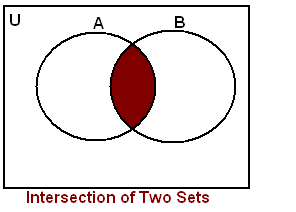
- Intesection
- AnB={x|xE A and x E B}
- AnB={x|xE A and x E B}
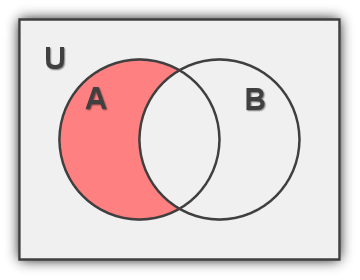
- Difference
- A-B={x|xE A and x not E B}
- A-B={x|xE A and x not E B}
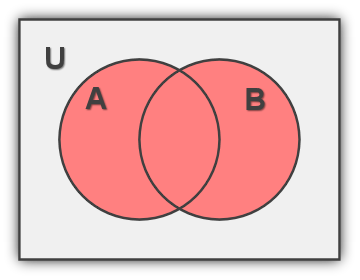
- Union
- AuB={x|x E A or x E B}
- AuB={x|x E A or x E B}
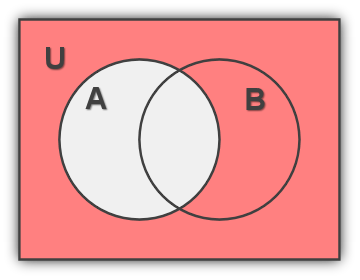
- Complement
- A'={x|x E U and x not E A}
- A'={x|x E U and x not E A}
- Intesection
Events involving "not" and "or"
- Properties of probabilities
- P(E)=1 something always happens
- Impossible event: P(E)=0
- Probability value: 0<P(E)<1 percentage of a thing to happen
- Probability of the complement
- Probability that on event E will not occur is equal to 1 minus the probability that it will occur P(not E)=1-P(E)
- Addition rule of probability
- A,B--> 2 events then P(A/B)=P(A)+P(B)-P(Aand B) A,B--> mutually exclusive then P(A/B)=P(A)+P(B)
- Mutually exclusive events: no outcomes in common, can´t occur simustaneoulsy
- A,B--> 2 events then P(A/B)=P(A)+P(B)-P(Aand B) A,B--> mutually exclusive then P(A/B)=P(A)+P(B)
- Properties of probabilities
Events involving "and"
- For any 2 events P(A and B)=P(A).P(B/A)
- For independent events if knowledge about the occurrance of one of them has no effect on the probability of the other
- P(B/A)=P(B) or P(A/B)=P(A) P(A and B)=P(A).P(B)
- Conditional probability formula
- Probability of event B computed on the assumption that event A has happened
- P(B/A)=P(AnB)/P(A)=P(A and B)/P(A)
- Probability of event B computed on the assumption that event A has happened
Set Operations
- Intersection
- AnB={x|x E A and x E B}
- Difference
- A-B={x|x E A and x not E B}
- Union
- AuB={x|x E A or x E B}
- Complement
- A'={x|x E U and x not E A}
- Intersection
Images and files in the map
Information
- Description
- Mind Map on Probability 1.1-1.4, created by Cinthya Virelas on 22/08/2014.
- Created by
- Cinthya Virelas
- Views
- 10
- Rating