
Mind map
10. PROJECT COMMUNICATIONS MANAGEMENT
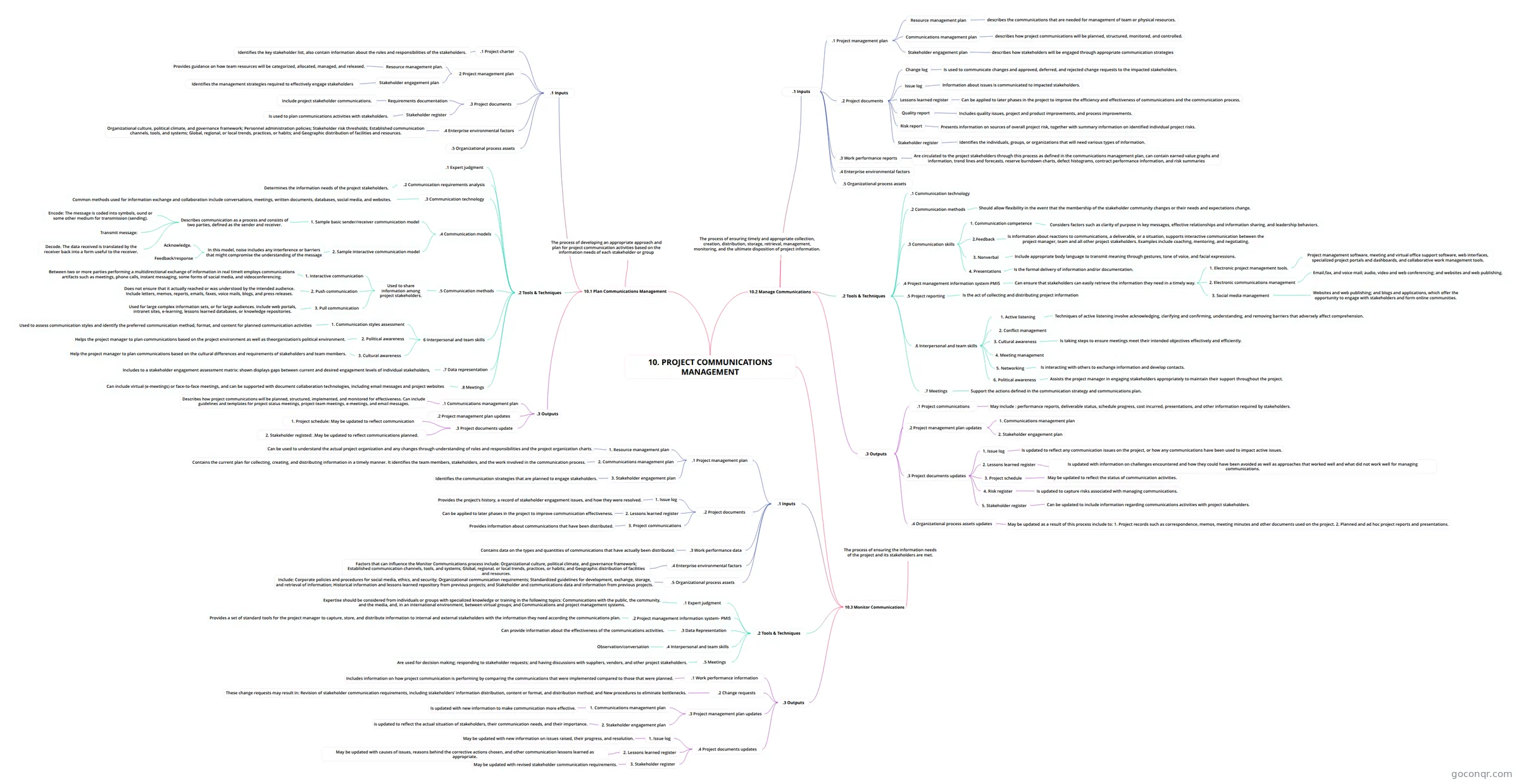
Mind map: Project communications management
Map content
10. PROJECT COMMUNICATIONS MANAGEMENT
10.1 Plan Communications Management
- The process of developing an appropriate approach and plan for project communication activities based on the information needs of each stakeholder or group
- .1 Inputs
- .1 Project charter
- Identifies the key stakeholder list, also contain information about the roles and responsibilities of the stakeholders.
- 2 Project management plan
- Resource management plan.
- Provides guidance on how team resources will be categorized, allocated, managed, and released.
- Stakeholder engagement plan
- Identifies the management strategies required to effectively engage stakeholders
- Resource management plan.
- .3 Project documents
- Requirements documentation
- Include project stakeholder communications.
- Stakeholder register
- Is used to plan communications activities with stakeholders.
- Requirements documentation
- .4 Enterprise environmental factors
- Organizational culture, political climate, and governance framework; Personnel administration policies; Stakeholder risk thresholds; Established communication channels, tools, and systems; Global, regional, or local trends, practices, or habits; and Geographic distribution of facilities and resources.
- .5 Organizational process assets
- .1 Project charter
- .2 Tools & Techniques
- .1 Expert judgment
- .2 Communication requirements analysis
- Determines the information needs of the project stakeholders.
- .3 Communication technology
- Common methods used for information exchange and collaboration include conversations, meetings, written documents, databases, social media, and websites.
- .4 Communication models
- 1. Sample basic sender/receiver communication model
- Describes communication as a process and consists of two parties, defined as the sender and receiver.
- Encode: The message is coded into symbols, ound or some other medium for transmission (sending).
- Transmit message:
- Decode. The data received is translated by the receiver back into a form useful to the receiver.
- Describes communication as a process and consists of two parties, defined as the sender and receiver.
- 2. Sample interactive communication model
- In this model, noise includes any interference or barriers that might compromise the understanding of the message
- Acknowledge.
- Feedback/response
- In this model, noise includes any interference or barriers that might compromise the understanding of the message
- 1. Sample basic sender/receiver communication model
- .5 Communication methods
- Used to share information among project stakeholders.
- 1. Interactive communication
- Between two or more parties performing a multidirectional exchange of information in real timeIt employs communications artifacts such as meetings, phone calls, instant messaging, some forms of social media, and videoconferencing.
- 2. Push communication
- Does not ensure that it actually reached or was understood by the intended audience. Include letters, memos, reports, emails, faxes, voice mails, blogs, and press releases.
- 3. Pull communication
- Used for large complex information sets, or for large audiences. include web portals, intranet sites, e-learning, lessons learned databases, or knowledge repositories.
- 1. Interactive communication
- Used to share information among project stakeholders.
- 6 Interpersonal and team skills
- 1. Communication styles assessment
- Used to assess communication styles and identify the preferred communication method, format, and content for planned communication activities
- 2. Political awareness
- Helps the project manager to plan communications based on the project environment as well as theorganization’s political environment.
- 3. Cultural awareness
- Help the project manager to plan communications based on the cultural differences and requirements of stakeholders and team members.
- 1. Communication styles assessment
- .7 Data representation
- Includes to a stakeholder engagement assessment matrix: shown displays gaps between current and desired engagement levels of individual stakeholders,
- .8 Meetings
- Can include virtual (e-meetings) or face-to-face meetings, and can be supported with document collaboration technologies, including email messages and project websites
- .3 Outputs
- .1 Communications management plan
- Describes how project communications will be planned, structured, implemented, and monitored for effectiveness. Can include guidelines and templates for project status meetings, project team meetings, e-meetings, and email messages.
- .2 Project management plan updates
- .3 Project documents update
- 1. Project schedule: May be updated to reflect communication
- 2. Stakeholder registed: .May be updated to reflect communications planned.
- .1 Communications management plan
10.2 Manage Communications
- The process of ensuring timely and appropriate collection, creation, distribution, storage, retrieval, management, monitoring, and the ultimate disposition of project information.
- .1 Inputs
- .1 Project management plan
- Resource management plan
- describes the communications that are needed for management of team or physical resources.
- Communications management plan
- describes how project communications will be planned, structured, monitored, and controlled.
- Stakeholder engagement plan
- describes how stakeholders will be engaged through appropriate communication strategies
- Resource management plan
- .2 Project documents
- Change log
- Is used to communicate changes and approved, deferred, and rejected change requests to the impacted stakeholders.
- Issue log
- Information about issues is communicated to impacted stakeholders.
- Lessons learned register
- Can be applied to later phases in the project to improve the efficiency and effectiveness of communications and the communication process.
- Quality report
- Includes quality issues, project and product improvements, and process improvements.
- Risk report
- Presents information on sources of overall project risk, together with summary information on identified individual project risks.
- Stakeholder register
- Identifies the individuals, groups, or organizations that will need various types of information.
- Change log
- .3 Work performance reports
- Are circulated to the project stakeholders through this process as defined in the communications management plan, can contain earned value graphs and information, trend lines and forecasts, reserve burndown charts, defect histograms, contract performance information, and risk summaries
- .4 Enterprise environmental factors
- .5 Organizational process assets
- .1 Project management plan
- .2 Tools & Techniques
- .1 Communication technology
- .2 Communication methods
- Should allow flexibility in the event that the membership of the stakeholder community changes or their needs and expectations change.
- .3 Communication skills
- 1. Communication competence
- Considers factors such as clarity of purpose in key messages, effective relationships and information sharing, and leadership behaviors.
- 2.Feedback
- Is information about reactions to communications, a deliverable, or a situation, supports interactive communication between the project manager, team and all other project stakeholders. Examples include coaching, mentoring, and negotiating.
- 3. Nonverbal
- Include appropriate body language to transmit meaning through gestures, tone of voice, and facial expressions.
- 4. Presentations
- Is the formal delivery of information and/or documentation.
- 1. Communication competence
- .4 Project management information system PMIS
- Can ensure that stakeholders can easily retrieve the information they need in a timely way.
- 1. Electronic project management tools.
- Project management software, meeting and virtual office support software, web interfaces, specialized project portals and dashboards, and collaborative work management tools.
- 2. Electronic communications management
- Email,fax, and voice mail; audio, video and web conferencing; and websites and web publishing.
- 3. Social media management
- Websites and web publishing; and blogs and applications, which offer the opportunity to engage with stakeholders and form online communities.
- 1. Electronic project management tools.
- Can ensure that stakeholders can easily retrieve the information they need in a timely way.
- .5 Project reporting
- Is the act of collecting and distributing project information
- .6 Interpersonal and team skills
- 1. Active listening
- Techniques of active listening involve acknowledging, clarifying and confirming, understanding, and removing barriers that adversely affect comprehension.
- 2. Conflict management
- 3. Cultural awareness
- Is taking steps to ensure meetings meet their intended objectives effectively and efficiently.
- 4. Meeting management
- 5. Networking
- Is interacting with others to exchange information and develop contacts.
- 6. Political awareness
- Assists the project manager in engaging stakeholders appropriately to maintain their support throughout the project.
- 1. Active listening
- .7 Meetings
- Support the actions defined in the communication strategy and communications plan.
- .3 Outputs
- .1 Project communications
- May include : performance reports, deliverable status, schedule progress, cost incurred, presentations, and other information required by stakeholders.
- .2 Project management plan updates
- 1. Communications management plan
- 2. Stakeholder engagement plan
- .3 Project documents updates
- 1. Issue log
- Is updated to reflect any communication issues on the project, or how any communications have been used to impact active issues.
- 2. Lessons learned register
- Is updated with information on challenges encountered and how they could have been avoided as well as approaches that worked well and what did not work well for managing communications.
- 3. Project schedule
- May be updated to reflect the status of communication activities.
- 4. Risk register
- Is updated to capture risks associated with managing communications.
- 5. Stakeholder register
- Can be updated to include information regarding communications activities with project stakeholders.
- 1. Issue log
- .4 Organizational process assets updates
- May be updated as a result of this process include to: 1. Project records such as correspondence, memos, meeting minutes and other documents used on the project. 2. Planned and ad hoc project reports and presentations.
- .1 Project communications
10.3 Monitor Communications
- The process of ensuring the information needs of the project and its stakeholders are met.
- .1 Inputs
- .1 Project management plan
- 1. Resource management plan
- Can be used to understand the actual project organization and any changes through understanding of roles and responsibilities and the project organization charts.
- 2. Communications management plan
- Contains the current plan for collecting, creating, and distributing information in a timely manner. It identifies the team members, stakeholders, and the work involved in the communication process.
- 3. Stakeholder engagement plan
- Identifies the communication strategies that are planned to engage stakeholders.
- 1. Resource management plan
- .2 Project documents
- 1. Issue log
- Provides the project’s history, a record of stakeholder engagement issues, and how they were resolved.
- 2. Lessons learned register
- Can be applied to later phases in the project to improve communication effectiveness.
- 3. Project communications
- Provides information about communications that have been distributed.
- 1. Issue log
- .3 Work performance data
- Contains data on the types and quantities of communications that have actually been distributed.
- .4 Enterprise environmental factors
- Factors that can influence the Monitor Communications process include: Organizational culture, political climate, and governance framework; Established communication channels, tools, and systems; Global, regional, or local trends, practices, or habits; and Geographic distribution of facilities and resources.
- .5 Organizational process assets
- Include: Corporate policies and procedures for social media, ethics, and security; Organizational communication requirements; Standardized guidelines for development, exchange, storage, and retrieval of information; Historical information and lessons learned repository from previous projects; and Stakeholder and communications data and information from previous projects.
- .1 Project management plan
- .2 Tools & Techniques
- .1 Expert judgment
- Expertise should be considered from individuals or groups with specialized knowledge or training in the following topics: Communications with the public, the community, and the media, and, in an international environment, between virtual groups; and Communications and project management systems.
- .2 Project management information system- PMIS
- Provides a set of standard tools for the project manager to capture, store, and distribute information to internal and external stakeholders with the information they need according the communications plan.
- .3 Data Representation
- Can provide information about the effectiveness of the communications activities.
- .4 Interpersonal and team skills
- Observation/conversation
- .5 Meetings
- Are used for decision making; responding to stakeholder requests; and having discussions with suppliers, vendors, and other project stakeholders.
- .1 Expert judgment
- .3 Outputs
- .1 Work performance information
- Includes information on how project communication is performing by comparing the communications that were implemented compared to those that were planned.
- .2 Change requests
- These change requests may result in: Revision of stakeholder communication requirements, including stakeholders’ information distribution, content or format, and distribution method; and New procedures to eliminate bottlenecks.
- .3 Project management plan updates
- 1. Communications management plan
- Is updated with new information to make communication more effective.
- 2. Stakeholder engagement plan
- is updated to reflect the actual situation of stakeholders, their communication needs, and their importance.
- 1. Communications management plan
- .4 Project documents updates
- 1. Issue log
- May be updated with new information on issues raised, their progress, and resolution.
- 2. Lessons learned register
- May be updated with causes of issues, reasons behind the corrective actions chosen, and other communication lessons learned as appropriate.
- 3. Stakeholder register
- May be updated with revised stakeholder communication requirements.
- 1. Issue log
- .1 Work performance information
Information
- Description
- Mind Map on 10. PROJECT COMMUNICATIONS MANAGEMENT, created by MARILUZ TAYPE ALMONACID on 03/06/2018.
- Created by
- MARILUZ TAYPE ALMONACID
- Views
- 3
- Rating