
Mind map
TEACHER MOTIVATION
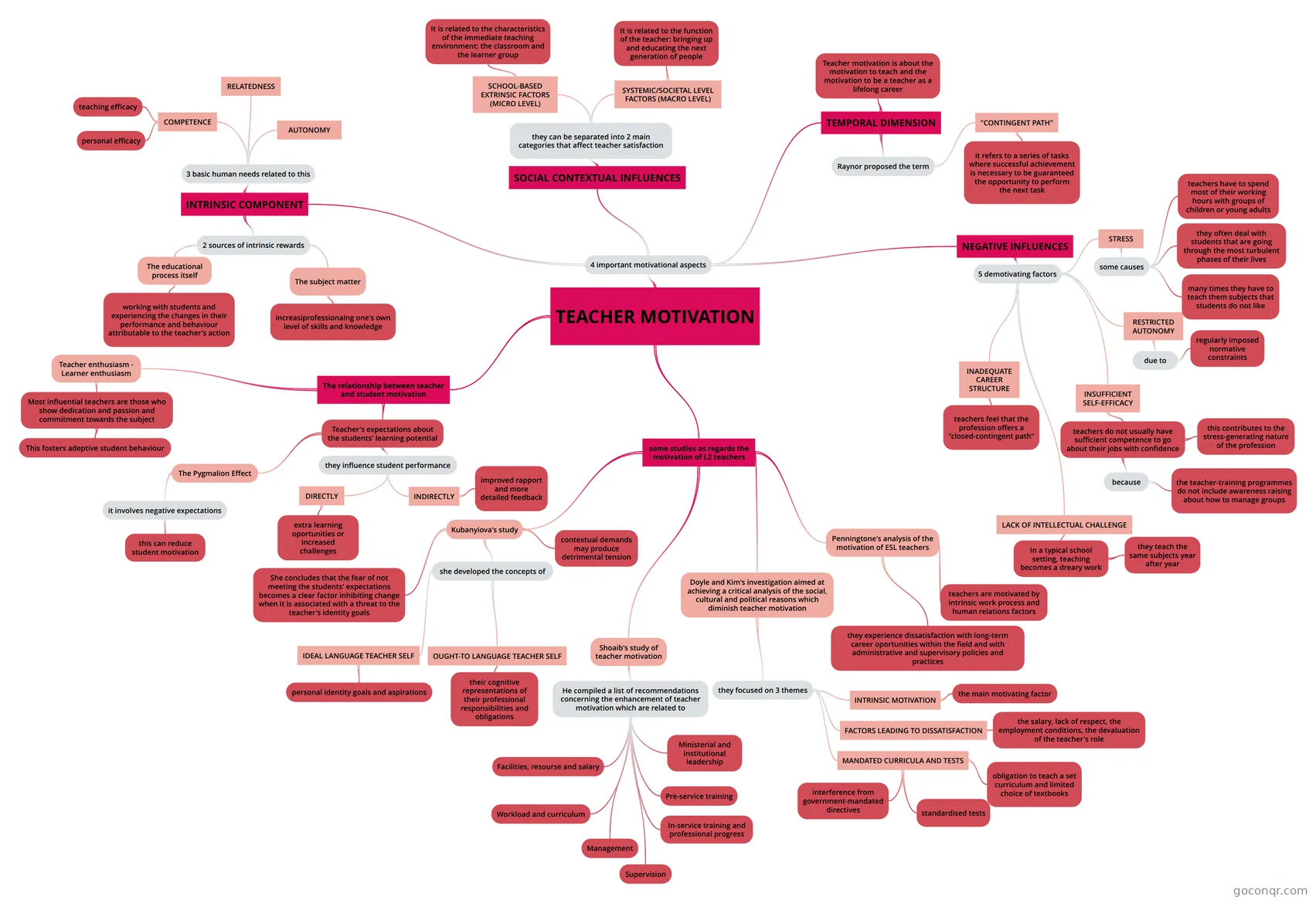
Mind map: Teacher motivation
Map content
TEACHER MOTIVATION
4 important motivational aspects
- INTRINSIC COMPONENT
- 2 sources of intrinsic rewards
- The educational process itself
- working with students and experiencing the changes in their performance and behaviour attributable to the teacher's action
- The subject matter
- increasiprofessionalng one's own level of skills and knowledge
- The educational process itself
- 3 basic human needs related to this
- AUTONOMY
- RELATEDNESS
- COMPETENCE
- teaching efficacy
- personal efficacy
- 2 sources of intrinsic rewards
- SOCIAL CONTEXTUAL INFLUENCES
- they can be separated into 2 main categories that affect teacher satisfaction
- SCHOOL-BASED EXTRINSIC FACTORS (MICRO LEVEL)
- It is related to the characteristics of the immediate teaching environment: the classroom and the learner group
- SYSTEMIC/SOCIETAL LEVEL FACTORS (MACRO LEVEL)
- It is related to the function of the teacher: bringing up and educating the next generation of people
- SCHOOL-BASED EXTRINSIC FACTORS (MICRO LEVEL)
- they can be separated into 2 main categories that affect teacher satisfaction
- TEMPORAL DIMENSION
- Teacher motivation is about the motivation to teach and the motivation to be a teacher as a lifelong career
- Raynor proposed the term
- "CONTINGENT PATH"
- it refers to a series of tasks where successful achievement is necessary to be guaranteed the opportunity to perform the next task
- "CONTINGENT PATH"
- NEGATIVE INFLUENCES
- 5 demotivating factors
- STRESS
- some causes
- teachers have to spend most of their working hours with groups of children or young adults
- they often deal with students that are going through the most turbulent phases of their lives
- many times they have to teach them subjects that students do not like
- some causes
- RESTRICTED AUTONOMY
- due to
- regularly imposed normative constraints
- due to
- INSUFFICIENT SELF-EFFICACY
- teachers do not usually have sufficient competence to go about their jobs with confidence
- because
- the teacher-training programmes do not include awareness raising about how to manage groups
- this contributes to the stress-generating nature of the profession
- because
- teachers do not usually have sufficient competence to go about their jobs with confidence
- LACK OF INTELLECTUAL CHALLENGE
- In a typical school setting, teaching becomes a dreary work
- they teach the same subjects year after year
- In a typical school setting, teaching becomes a dreary work
- INADEQUATE CAREER STRUCTURE
- teachers feel that the profession offers a "closed-contingent path"
- STRESS
- 5 demotivating factors
- INTRINSIC COMPONENT
some studies as regards the motivation of L2 teachers
- Penningtone's analysis of the motivation of ESL teachers
- teachers are motivated by intrinsic work process and human relations factors
- they experience dissatisfaction with long-term career oportunities within the field and with administrative and supervisory policies and practices
- Doyle and Kim's investigation aimed at achieving a critical analysis of the social, cultural and political reasons which diminish teacher motivation
- they focused on 3 themes
- INTRINSIC MOTIVATION
- the main motivating factor
- FACTORS LEADING TO DISSATISFACTION
- the salary, lack of respect, the employment conditions, the devaluation of the teacher's role
- MANDATED CURRICULA AND TESTS
- obligation to teach a set curriculum and limited choice of textbooks
- standardised tests
- interference from government-mandated directives
- INTRINSIC MOTIVATION
- they focused on 3 themes
- Shoaib's study of teacher motivation
- He compiled a list of recommendations concerning the enhancement of teacher motivation which are related to
- Ministerial and institutional leadership
- Pre-service training
- In-service training and professional progress
- Supervision
- Management
- Workload and curriculum
- Facilities, resourse and salary
- He compiled a list of recommendations concerning the enhancement of teacher motivation which are related to
- Kubanyiova's study
- she developed the concepts of
- OUGHT-TO LANGUAGE TEACHER SELF
- their cognitive representations of their professional responsibilities and obligations
- IDEAL LANGUAGE TEACHER SELF
- personal identity goals and aspirations
- OUGHT-TO LANGUAGE TEACHER SELF
- She concludes that the fear of not meeting the students' expectations becomes a clear factor inhibiting change when it is associated with a threat to the teacher's identity goals
- contextual demands may produce detrimental tension
- she developed the concepts of
- Penningtone's analysis of the motivation of ESL teachers
The relationship between teacher and student motivation
- Teacher's expectations about the students' learning potential
- they influence student performance
- DIRECTLY
- extra learning oportunities or increased challenges
- INDIRECTLY
- improved rapport and more detailed feedback
- DIRECTLY
- The Pygmalion Effect
- it involves negative expectations
- this can reduce student motivation
- it involves negative expectations
- they influence student performance
- Teacher enthusiasm - Learner enthusiasm
- Most influential teachers are those who show dedication and passion and commitment towards the subject
- This fosters adeptive student behaviour
- Most influential teachers are those who show dedication and passion and commitment towards the subject
- Teacher's expectations about the students' learning potential
Information
- Description
- Mind Map on TEACHER MOTIVATION, created by Mercedes Cresta on 13/07/2018.
- Created by
- Mercedes Cresta
- Views
- 0
- Rating