
Mind map
Routh's stability criterion
Map content
Routh's stability criterion
This method allows us to know if there are or not unstable roots in a polynomial equation
By: Abigail RomeroTrejo
- 1112567
It applies to polynomials with only a finite number of terms
Information about absolute stability can be obtained directly from the coefficients of the characteristic equation
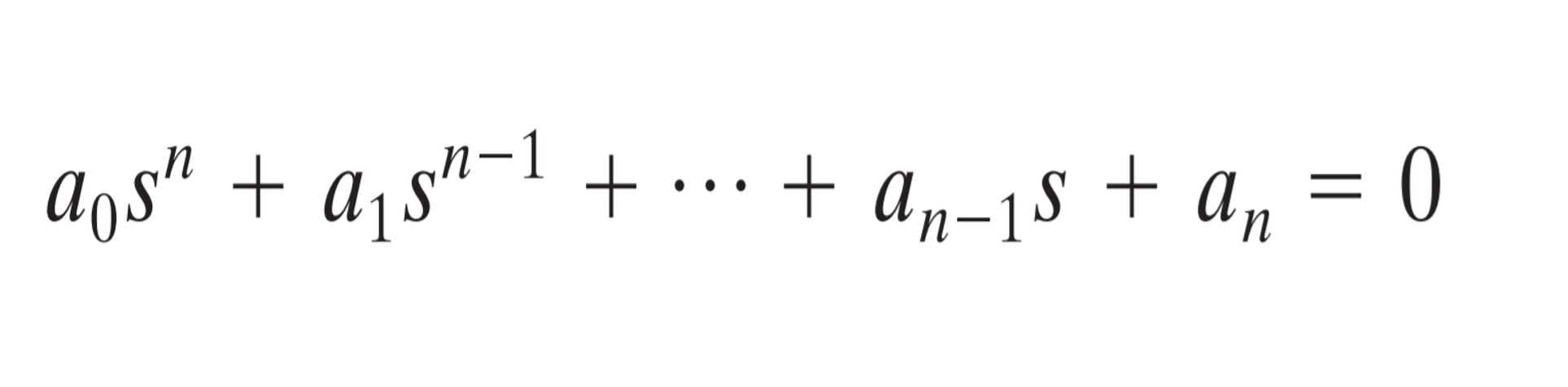
1. Order the polynomial as shown:
- All the coefficients must be positive
- If any of the coefficients are zero or negative in the presence of at least one positive coefficient
- A root or roots exist that are imaginary
- Or that have positive real parts
- Conclusion: The system is not stable!!!
- The product of any number of linear and quadratic factors containing only positive coefficients always yields a polynomial with positive coefficients
- If all a's are negative, they can be made positive by multiplying both sides of the equation by -1
- If any of the coefficients are zero or negative in the presence of at least one positive coefficient
- All the coefficients must be positive
Although this condition is not sufficient to assure stability!
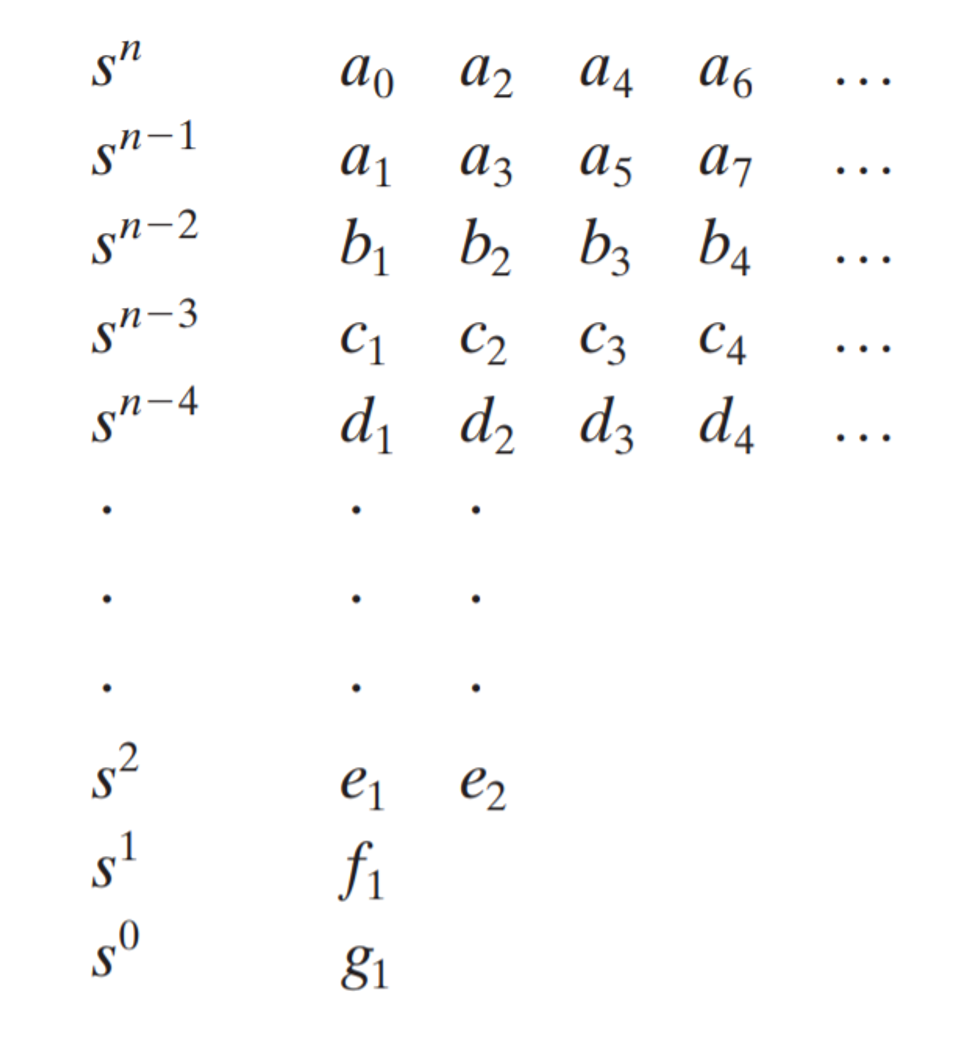
2. Arrange the coefficients of the polynomial in rows and columns as it is shown:
- The total number of rows is n + 1
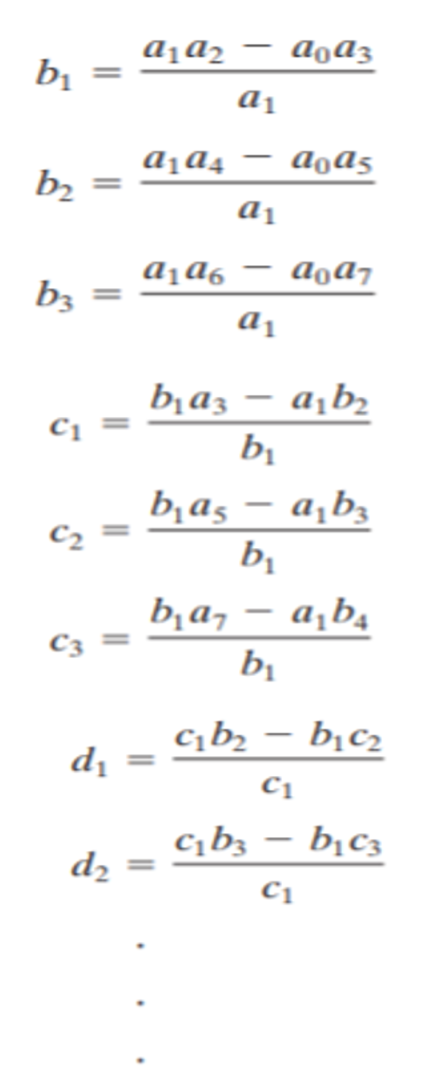
- Where:
- The evaluation of the b's is continued until the remaining ones are all zero
- The same pattern of cross-multiplying the coefficients of the two previous rows is followed in evaluating the c's, d's, e's and so on
- This process is continued until the nth row has been completed
This criterion states that the number of roots of the polynomial with positive real parts is equal to the number of changes in sign of the coefficients of the first column of the array
Images and files in the map
Information
- Description
- Mind Map on Routh's stability criterion, created by Abby Romero on 24/08/2018.
- Created by
- Abby Romero
- Views
- 0
- Rating