
Mind map
Modules
Map content
Modules
Collection of related functions, types or typeclasses
- An application is a main module that loads up other modules an use there functions
- You can import a module partially so you don't need to load all the functions inside a module
- To import module: import <module>
- Data.List
- This module provides functions for deal with Lists and it doesn't have to be import via qualified
- Offers functions as: intersperse, intercalte, transpose, concat, concatMap, and, or, any, all, iterate, splitAt, takeWhile. dropWhile, span sort, inits, tails, isInfixOf, isPrefixOf, isSuffixOf, elem, notElem, partition, findIndex, lines, unlines, words, unwords, nub, delete, union, intersect, insert.
- If want to review the functionality of each of this functions please visit the link : http://learnyouahaskell.com/modules#data-list
- Offers functions as: intersperse, intercalte, transpose, concat, concatMap, and, or, any, all, iterate, splitAt, takeWhile. dropWhile, span sort, inits, tails, isInfixOf, isPrefixOf, isSuffixOf, elem, notElem, partition, findIndex, lines, unlines, words, unwords, nub, delete, union, intersect, insert.
- This module provides functions for deal with Lists and it doesn't have to be import via qualified
- Data.Char
- This module exports functions that deal with characters. This module is helpful to "filter" and "map" over strings because the naturality of strings as lists of characters
- This module offers some functions that act like predicates that tell us if an assumption is True or False about a character
- Predicates or functions: isControl, isSpace, isLower, isUpperm isAlpha, isAlphaNum, isPrint, isDigit, isOctDigit, isHexDigit, isLetter, isMark, isNumber, isPunctuation, isSymbol, isSeparator, isAscii, isLatin1, isAasciiUpper, isAsciiLower
- Other functions: toUpper, toLower, toTitle, digitToInt, intToDigit
- If want to review the functionality of each of this functions please visit the link: http://learnyouahaskell.com/modules#data-char
- Other functions: toUpper, toLower, toTitle, digitToInt, intToDigit
- Predicates or functions: isControl, isSpace, isLower, isUpperm isAlpha, isAlphaNum, isPrint, isDigit, isOctDigit, isHexDigit, isLetter, isMark, isNumber, isPunctuation, isSymbol, isSeparator, isAscii, isLatin1, isAasciiUpper, isAsciiLower
- This module offers some functions that act like predicates that tell us if an assumption is True or False about a character
- This module exports functions that deal with characters. This module is helpful to "filter" and "map" over strings because the naturality of strings as lists of characters
- Data.Map
- Association lists, or called "dictionaries" designed to store key-value pairs where ordering doesn't matter.
- As we have a list of pairs the first component of the pair is the "key" and the second component is the "value"
- This module offers functions to deal with this structure called Map as: fromList, empty, insert, null, size, singleton, lookup, member, map, filter, keys, elems, fromListWith, insertWith
- If want to review the functionality of each of this functions please visit the link: http://learnyouahaskell.com/modules#data-map
- This module offers functions to deal with this structure called Map as: fromList, empty, insert, null, size, singleton, lookup, member, map, filter, keys, elems, fromListWith, insertWith
- As we have a list of pairs the first component of the pair is the "key" and the second component is the "value"
- Association lists, or called "dictionaries" designed to store key-value pairs where ordering doesn't matter.
- Data.Set
- Sets are like a cross between lists and maps where all the elements are unique and ordered because they are internally implemented with Trees.
- Some actions as check the membership, inserting and deleting are much faster than in lists and this module has to be imported as "qualified"
- Some of the functions offered to work with sets are: fromList, difference, intersection, union, null, size, member, empty, singleton, insert, delete, map, filter, toList,
- Some actions as check the membership, inserting and deleting are much faster than in lists and this module has to be imported as "qualified"
- Sets are like a cross between lists and maps where all the elements are unique and ordered because they are internally implemented with Trees.
- Data.List
- To import module: import <module>
- Making our own modules
- Example: "import Geometry"
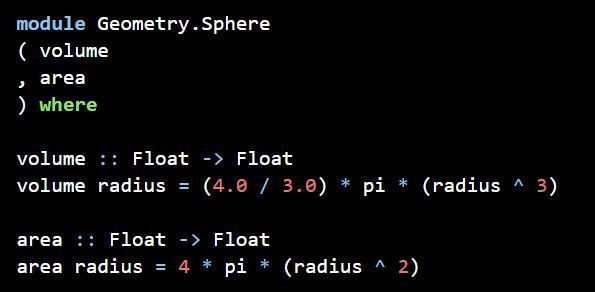
- Example we write the module Sphere derived from Geometry:
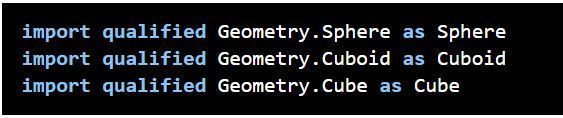
- We can import some other modules:
- Example we write the module Sphere derived from Geometry:
- Example: "import Geometry"
- You can import a module partially so you don't need to load all the functions inside a module
- An application is a main module that loads up other modules an use there functions
Images and files in the map
Information
- Description
- Mind Map on Modules, created by Nicolas G.Bazzani on 13/09/2018.
- Created by
- Nicolas G.Bazzani
- Views
- 1
- Rating