
Mind map
2.4 Motivation
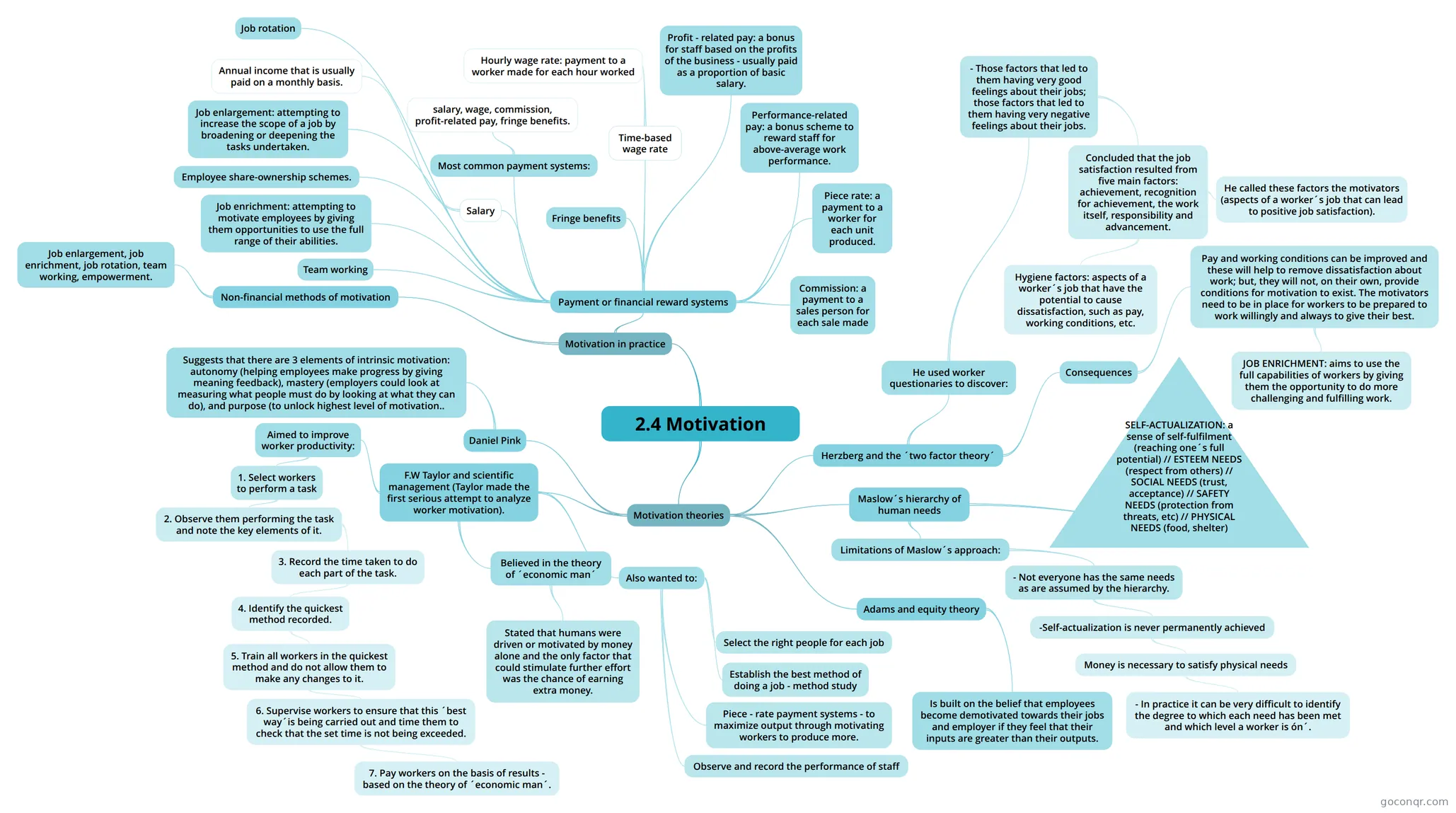
Mind map: Motivation
Map content
2.4 Motivation
Motivation theories
- F.W Taylor and scientific management (Taylor made the first serious attempt to analyze worker motivation).
- Aimed to improve worker productivity:
- 1. Select workers to perform a task
- 2. Observe them performing the task and note the key elements of it.
- 3. Record the time taken to do each part of the task.
- 4. Identify the quickest method recorded.
- 5. Train all workers in the quickest method and do not allow them to make any changes to it.
- 6. Supervise workers to ensure that this ´best way´is being carried out and time them to check that the set time is not being exceeded.
- 7. Pay workers on the basis of results - based on the theory of ´economic man´.
- 6. Supervise workers to ensure that this ´best way´is being carried out and time them to check that the set time is not being exceeded.
- 5. Train all workers in the quickest method and do not allow them to make any changes to it.
- 4. Identify the quickest method recorded.
- 3. Record the time taken to do each part of the task.
- 2. Observe them performing the task and note the key elements of it.
- 1. Select workers to perform a task
- Believed in the theory of ´economic man´
- Stated that humans were driven or motivated by money alone and the only factor that could stimulate further effort was the chance of earning extra money.
- Also wanted to:
- Select the right people for each job
- Observe and record the performance of staff
- Establish the best method of doing a job - method study
- Piece - rate payment systems - to maximize output through motivating workers to produce more.
- Aimed to improve worker productivity:
- Maslow´s hierarchy of human needs
- SELF-ACTUALIZATION: a sense of self-fulfilment (reaching one´s full potential) // ESTEEM NEEDS (respect from others) // SOCIAL NEEDS (trust, acceptance) // SAFETY NEEDS (protection from threats, etc) // PHYSICAL NEEDS (food, shelter)
- Limitations of Maslow´s approach:
- - Not everyone has the same needs as are assumed by the hierarchy.
- -Self-actualization is never permanently achieved
- Money is necessary to satisfy physical needs
- - In practice it can be very difficult to identify the degree to which each need has been met and which level a worker is ón´.
- Money is necessary to satisfy physical needs
- -Self-actualization is never permanently achieved
- - Not everyone has the same needs as are assumed by the hierarchy.
- Herzberg and the ´two factor theory´
- He used worker questionaries to discover:
- - Those factors that led to them having very good feelings about their jobs; those factors that led to them having very negative feelings about their jobs.
- Concluded that the job satisfaction resulted from five main factors: achievement, recognition for achievement, the work itself, responsibility and advancement.
- He called these factors the motivators (aspects of a worker´s job that can lead to positive job satisfaction).
- Hygiene factors: aspects of a worker´s job that have the potential to cause dissatisfaction, such as pay, working conditions, etc.
- Concluded that the job satisfaction resulted from five main factors: achievement, recognition for achievement, the work itself, responsibility and advancement.
- - Those factors that led to them having very good feelings about their jobs; those factors that led to them having very negative feelings about their jobs.
- Consequences
- Pay and working conditions can be improved and these will help to remove dissatisfaction about work; but, they will not, on their own, provide conditions for motivation to exist. The motivators need to be in place for workers to be prepared to work willingly and always to give their best.
- JOB ENRICHMENT: aims to use the full capabilities of workers by giving them the opportunity to do more challenging and fulfilling work.
- Pay and working conditions can be improved and these will help to remove dissatisfaction about work; but, they will not, on their own, provide conditions for motivation to exist. The motivators need to be in place for workers to be prepared to work willingly and always to give their best.
- He used worker questionaries to discover:
- Adams and equity theory
- Is built on the belief that employees become demotivated towards their jobs and employer if they feel that their inputs are greater than their outputs.
- Daniel Pink
- Suggests that there are 3 elements of intrinsic motivation: autonomy (helping employees make progress by giving meaning feedback), mastery (employers could look at measuring what people must do by looking at what they can do), and purpose (to unlock highest level of motivation..
- F.W Taylor and scientific management (Taylor made the first serious attempt to analyze worker motivation).
Motivation in practice
- Payment or financial reward systems
- Most common payment systems:
- salary, wage, commission, profit-related pay, fringe benefits.
- Salary
- Annual income that is usually paid on a monthly basis.
- Time-based wage rate
- Hourly wage rate: payment to a worker made for each hour worked
- Piece rate: a payment to a worker for each unit produced.
- Commission: a payment to a sales person for each sale made
- Performance-related pay: a bonus scheme to reward staff for above-average work performance.
- Profit - related pay: a bonus for staff based on the profits of the business - usually paid as a proportion of basic salary.
- Employee share-ownership schemes.
- Fringe benefits
- Job enlargement: attempting to increase the scope of a job by broadening or deepening the tasks undertaken.
- Job enrichment: attempting to motivate employees by giving them opportunities to use the full range of their abilities.
- Job rotation
- Team working
- Most common payment systems:
- Non-financial methods of motivation
- Job enlargement, job enrichment, job rotation, team working, empowerment.
- Payment or financial reward systems
Information
- Description
- Mind Map on 2.4 Motivation, created by Andrea Michell García Briones on 06/11/2018.
- Created by
- Andrea Michell García Briones
- Views
- 0
- Rating