
Mind map
t. 2 General theories of 2nd language learning
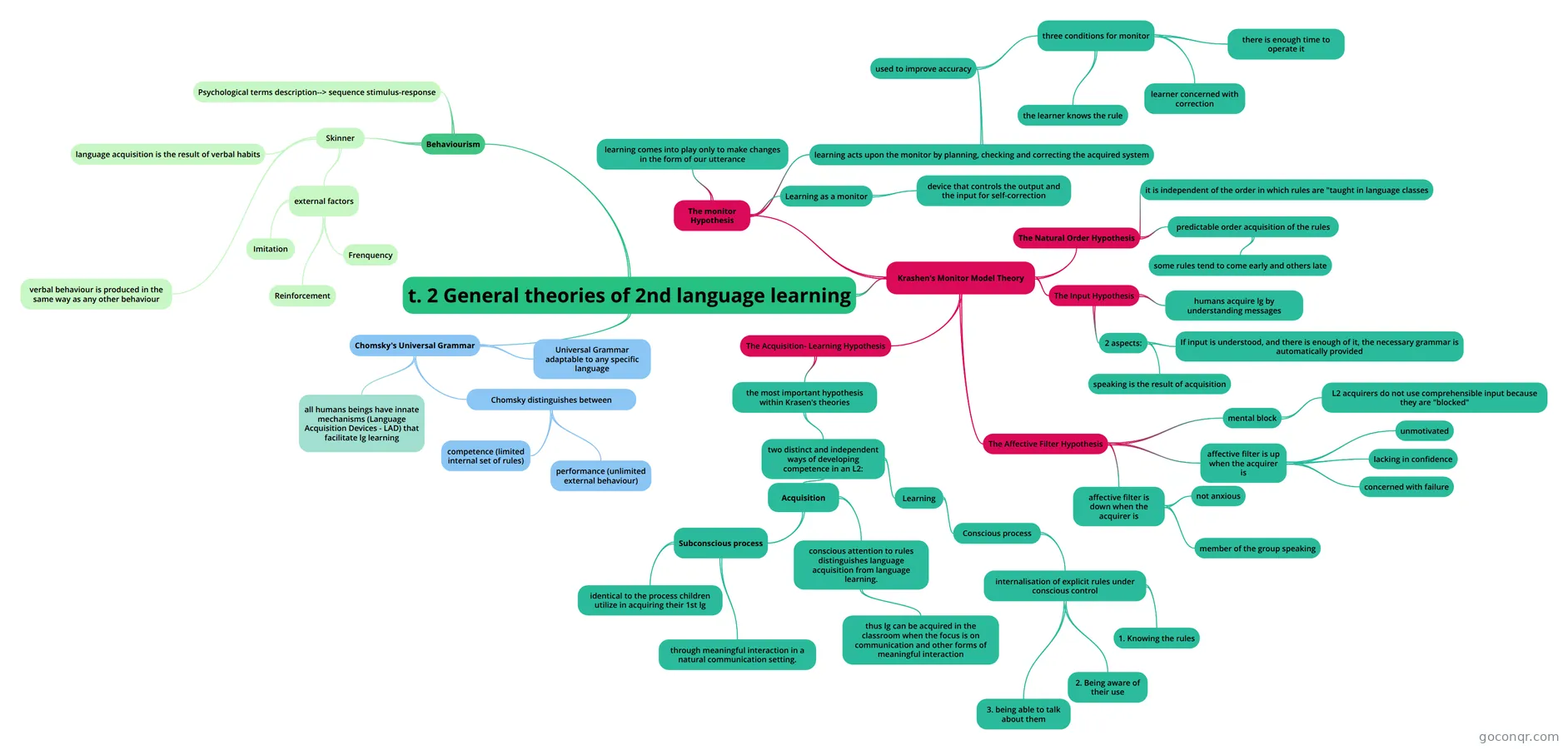
Mind map: General theories of 2nd language learning
Map content
t. 2 General theories of 2nd language learning
Behaviourism
- Psychological terms description--> sequence stimulus-response
- Skinner
- language acquisition is the result of verbal habits
- external factors
- Frenquency
- Reinforcement
- Imitation
- verbal behaviour is produced in the same way as any other behaviour
Chomsky's Universal Grammar
- all humans beings have innate mechanisms (Language Acquisition Devices - LAD) that facilitate lg learning
- Universal Grammar adaptable to any specific language
- Chomsky distinguishes between
- competence (limited internal set of rules)
- performance (unlimited external behaviour)
Krashen's Monitor Model Theory
- The Acquisition- Learning Hypothesis
- the most important hypothesis within Krasen's theories
- two distinct and independent ways of developing competence in an L2:
- Acquisition
- Subconscious process
- through meaningful interaction in a natural communication setting.
- identical to the process children utilize in acquiring their 1st lg
- conscious attention to rules distinguishes language acquisition from language learning.
- thus lg can be acquired in the classroom when the focus is on communication and other forms of meaningful interaction
- Subconscious process
- Learning
- Conscious process
- internalisation of explicit rules under conscious control
- 1. Knowing the rules
- 2. Being aware of their use
- 3. being able to talk about them
- internalisation of explicit rules under conscious control
- Conscious process
- Acquisition
- two distinct and independent ways of developing competence in an L2:
- the most important hypothesis within Krasen's theories
- The monitor Hypothesis
- Learning as a monitor
- device that controls the output and the input for self-correction
- learning comes into play only to make changes in the form of our utterance
- learning acts upon the monitor by planning, checking and correcting the acquired system
- used to improve accuracy
- three conditions for monitor
- the learner knows the rule
- learner concerned with correction
- there is enough time to operate it
- three conditions for monitor
- used to improve accuracy
- Learning as a monitor
- The Natural Order Hypothesis
- predictable order acquisition of the rules
- some rules tend to come early and others late
- it is independent of the order in which rules are "taught in language classes
- predictable order acquisition of the rules
- The Input Hypothesis
- humans acquire lg by understanding messages
- 2 aspects:
- speaking is the result of acquisition
- If input is understood, and there is enough of it, the necessary grammar is automatically provided
- The Affective Filter Hypothesis
- mental block
- L2 acquirers do not use comprehensible input because they are "blocked"
- affective filter is up when the acquirer is
- unmotivated
- lacking in confidence
- concerned with failure
- affective filter is down when the acquirer is
- not anxious
- member of the group speaking
- mental block
- The Acquisition- Learning Hypothesis
Information
- Description
- Oposicions Anglès Mind Map on t. 2 General theories of 2nd language learning, created by Míriam Figueras Bello on 09/11/2018.
- Created by
- Míriam Figueras Bello
- Views
- 0
- Rating
More on Theories of Language Acquisition