
Mind map
REFLECTIVE TEACHING AND ITS IMPACT ON FOREIGN LANGUAGE TEACHING
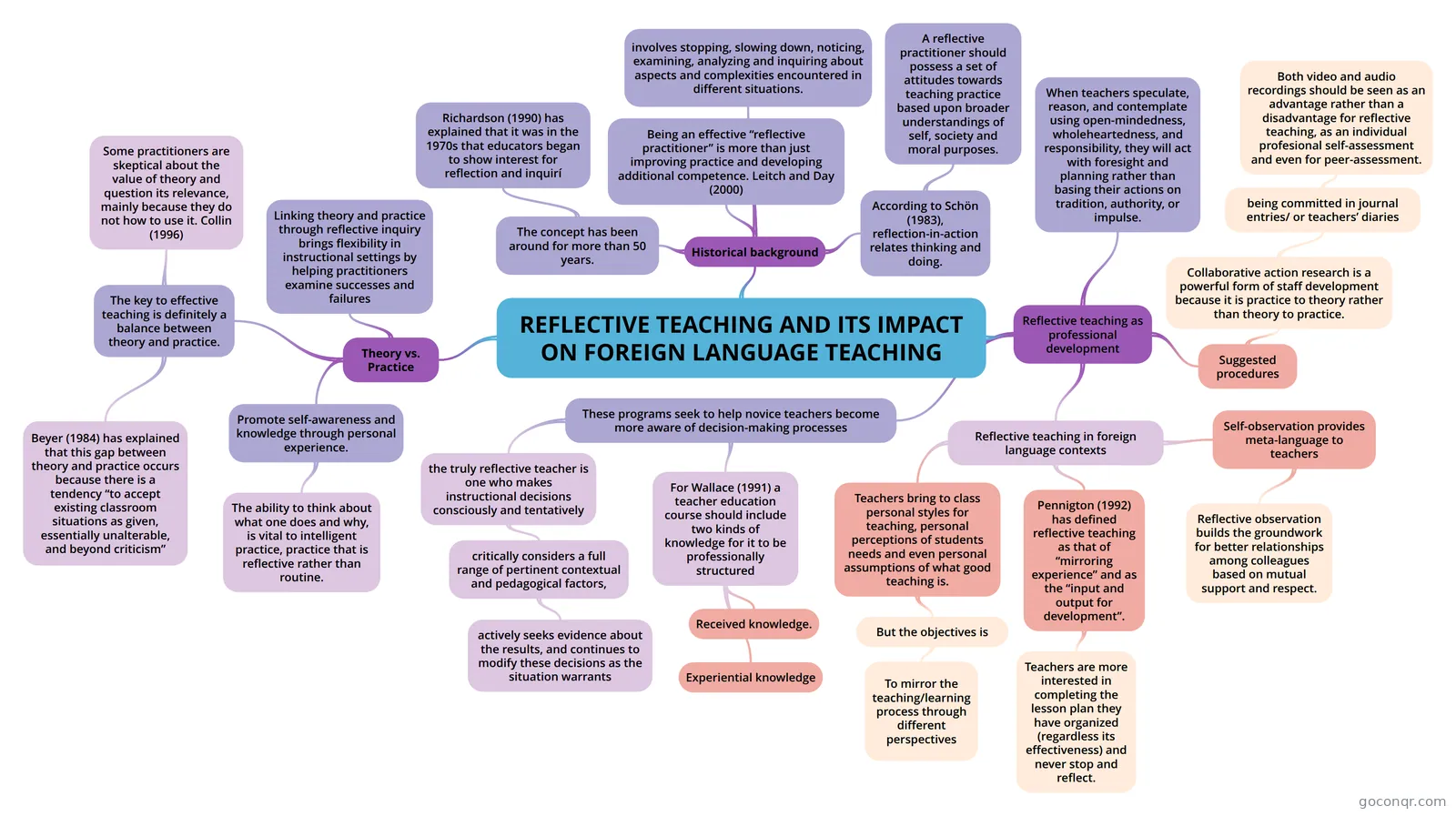
Mind map: Reflective teaching in foreign language teaching
Map content
REFLECTIVE TEACHING AND ITS IMPACT ON FOREIGN LANGUAGE TEACHING
Historical background
- The concept has been around for more than 50 years.
- Richardson (1990) has explained that it was in the 1970s that educators began to show interest for reflection and inquirí
- Being an effective “reflective practitioner” is more than just improving practice and developing additional competence. Leitch and Day (2000)
- According to Schön (1983), reflection-in-action relates thinking and doing.
- A reflective practitioner should possess a set of attitudes towards teaching practice based upon broader understandings of self, society and moral purposes.
- involves stopping, slowing down, noticing, examining, analyzing and inquiring about aspects and complexities encountered in different situations.
- The concept has been around for more than 50 years.
Theory vs. Practice
- The key to effective teaching is definitely a balance between theory and practice.
- Some practitioners are skeptical about the value of theory and question its relevance, mainly because they do not how to use it. Collin (1996)
- Beyer (1984) has explained that this gap between theory and practice occurs because there is a tendency “to accept existing classroom situations as given, essentially unalterable, and beyond criticism”
- Linking theory and practice through reflective inquiry brings flexibility in instructional settings by helping practitioners examine successes and failures
- Promote self-awareness and knowledge through personal experience.
- The ability to think about what one does and why, is vital to intelligent practice, practice that is reflective rather than routine.
- The key to effective teaching is definitely a balance between theory and practice.
Reflective teaching as professional development
- These programs seek to help novice teachers become more aware of decision-making processes
- the truly reflective teacher is one who makes instructional decisions consciously and tentatively
- critically considers a full range of pertinent contextual and pedagogical factors,
- actively seeks evidence about the results, and continues to modify these decisions as the situation warrants
- critically considers a full range of pertinent contextual and pedagogical factors,
- For Wallace (1991) a teacher education course should include two kinds of knowledge for it to be professionally structured
- Received knowledge.
- Experiential knowledge
- the truly reflective teacher is one who makes instructional decisions consciously and tentatively
- When teachers speculate, reason, and contemplate using open-mindedness, wholeheartedness, and responsibility, they will act with foresight and planning rather than basing their actions on tradition, authority, or impulse.
- Reflective teaching in foreign language contexts
- Teachers bring to class personal styles for teaching, personal perceptions of students needs and even personal assumptions of what good teaching is.
- But the objectives is
- To mirror the teaching/learning process through different perspectives
- But the objectives is
- Pennigton (1992) has defined reflective teaching as that of “mirroring experience” and as the “input and output for development”.
- Teachers are more interested in completing the lesson plan they have organized (regardless its effectiveness) and never stop and reflect.
- Self-observation provides meta-language to teachers
- Reflective observation builds the groundwork for better relationships among colleagues based on mutual support and respect.
- Teachers bring to class personal styles for teaching, personal perceptions of students needs and even personal assumptions of what good teaching is.
- Suggested procedures
- Collaborative action research is a powerful form of staff development because it is practice to theory rather than theory to practice.
- being committed in journal entries/ or teachers’ diaries
- Both video and audio recordings should be seen as an advantage rather than a disadvantage for reflective teaching, as an individual profesional self-assessment and even for peer-assessment.
- being committed in journal entries/ or teachers’ diaries
- Collaborative action research is a powerful form of staff development because it is practice to theory rather than theory to practice.
- These programs seek to help novice teachers become more aware of decision-making processes
Information
- Description
- Mind Map on REFLECTIVE TEACHING AND ITS IMPACT ON FOREIGN LANGUAGE TEACHING, created by Jose Becerra on 12/02/2019.
- Created by
- Jose Becerra
- Views
- 5
- Rating
More on Postmethod and Eclectic Language Teaching