
Mind map
HYPOTHYROIDISM
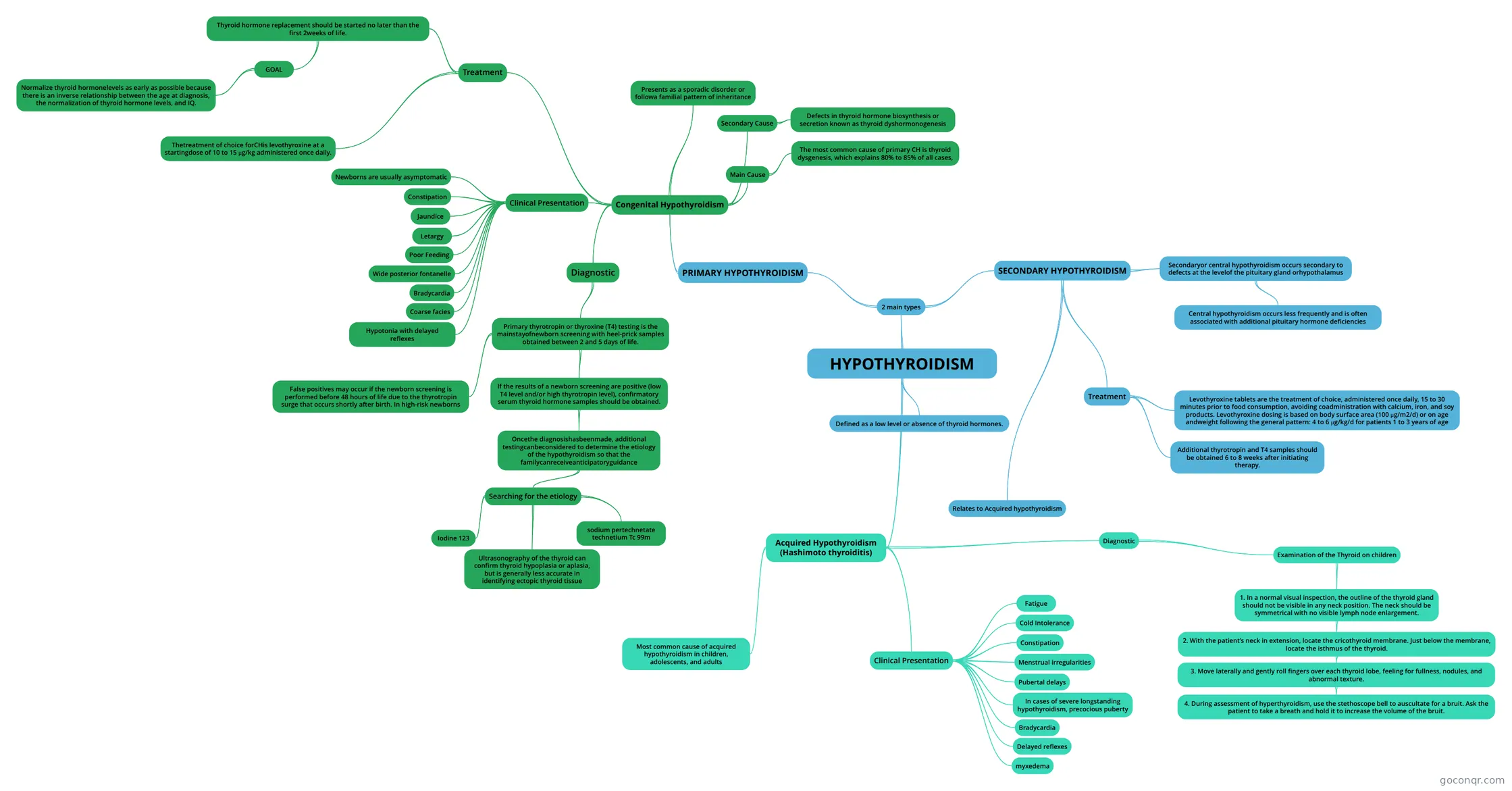
Mind map: Hypothyroidism
Map content
HYPOTHYROIDISM
Defined as a low level or absence of thyroid hormones.
2 main types
- PRIMARY HYPOTHYROIDISM
- Congenital Hypothyroidism
- Main Cause
- The most common cause of primary CH is thyroid dysgenesis, which explains 80% to 85% of all cases,
- Secondary Cause
- Defects in thyroid hormone biosynthesis or secretion known as thyroid dyshormonogenesis
- Presents as a sporadic disorder or followa familial pattern of inheritance
- Clinical Presentation
- Newborns are usually asymptomatic
- Jaundice
- Letargy
- Poor Feeding
- Constipation
- Wide posterior fontanelle
- Bradycardia
- Coarse facies
- Hypotonia with delayed reflexes
- Diagnostic
- Primary thyrotropin or thyroxine (T4) testing is the mainstayofnewborn screening with heel-prick samples obtained between 2 and 5 days of life.
- False positives may occur if the newborn screening is performed before 48 hours of life due to the thyrotropin surge that occurs shortly after birth. In high-risk newborns
- If the results of a newborn screening are positive (low T4 level and/or high thyrotropin level), confirmatory serum thyroid hormone samples should be obtained.
- Oncethe diagnosishasbeenmade, additional testingcanbeconsidered to determine the etiology of the hypothyroidism so that the familycanreceiveanticipatoryguidance
- Searching for the etiology
- Iodine 123
- sodium pertechnetate technetium Tc 99m
- Ultrasonography of the thyroid can confirm thyroid hypoplasia or aplasia, but is generally less accurate in identifying ectopic thyroid tissue
- Searching for the etiology
- Oncethe diagnosishasbeenmade, additional testingcanbeconsidered to determine the etiology of the hypothyroidism so that the familycanreceiveanticipatoryguidance
- Primary thyrotropin or thyroxine (T4) testing is the mainstayofnewborn screening with heel-prick samples obtained between 2 and 5 days of life.
- Treatment
- Thyroid hormone replacement should be started no later than the first 2weeks of life.
- GOAL
- Normalize thyroid hormonelevels as early as possible because there is an inverse relationship between the age at diagnosis, the normalization of thyroid hormone levels, and IQ.
- GOAL
- Thetreatment of choice forCHis levothyroxine at a startingdose of 10 to 15 μg/kg administered once daily.
- Thyroid hormone replacement should be started no later than the first 2weeks of life.
- Main Cause
- Congenital Hypothyroidism
- SECONDARY HYPOTHYROIDISM
- Secondaryor central hypothyroidism occurs secondary to defects at the levelof the pituitary gland orhypothalamus
- Central hypothyroidism occurs less frequently and is often associated with additional pituitary hormone deficiencies
- Treatment
- Levothyroxine tablets are the treatment of choice, administered once daily, 15 to 30 minutes prior to food consumption, avoiding coadministration with calcium, iron, and soy products. Levothyroxine dosing is based on body surface area (100 μg/m2/d) or on age andweight following the general pattern: 4 to 6 μg/kg/d for patients 1 to 3 years of age
- Additional thyrotropin and T4 samples should be obtained 6 to 8 weeks after initiating therapy.
- Relates to Acquired hypothyroidism
- Secondaryor central hypothyroidism occurs secondary to defects at the levelof the pituitary gland orhypothalamus
- PRIMARY HYPOTHYROIDISM
Acquired Hypothyroidism (Hashimoto thyroiditis)
- Most common cause of acquired hypothyroidism in children, adolescents, and adults
- Clinical Presentation
- Fatigue
- Cold Intolerance
- Constipation
- Menstrual irregularities
- Pubertal delays
- In cases of severe longstanding hypothyroidism, precocious puberty
- Bradycardia
- Delayed reflexes
- myxedema
- Diagnostic
- Examination of the Thyroid on children
- 1. In a normal visual inspection, the outline of the thyroid gland should not be visible in any neck position. The neck should be symmetrical with no visible lymph node enlargement.
- 2. With the patient’s neck in extension, locate the cricothyroid membrane. Just below the membrane, locate the isthmus of the thyroid.
- 3. Move laterally and gently roll fingers over each thyroid lobe, feeling for fullness, nodules, and abnormal texture.
- 4. During assessment of hyperthyroidism, use the stethoscope bell to auscultate for a bruit. Ask the patient to take a breath and hold it to increase the volume of the bruit.
- 3. Move laterally and gently roll fingers over each thyroid lobe, feeling for fullness, nodules, and abnormal texture.
- 2. With the patient’s neck in extension, locate the cricothyroid membrane. Just below the membrane, locate the isthmus of the thyroid.
- 1. In a normal visual inspection, the outline of the thyroid gland should not be visible in any neck position. The neck should be symmetrical with no visible lymph node enlargement.
- Examination of the Thyroid on children
Information
- Description
- segundo mapa Mind Map on HYPOTHYROIDISM, created by david g on 16/02/2019.
- Created by
- david g
- Views
- 0
- Rating