
Mind map
The Future and How to survive it
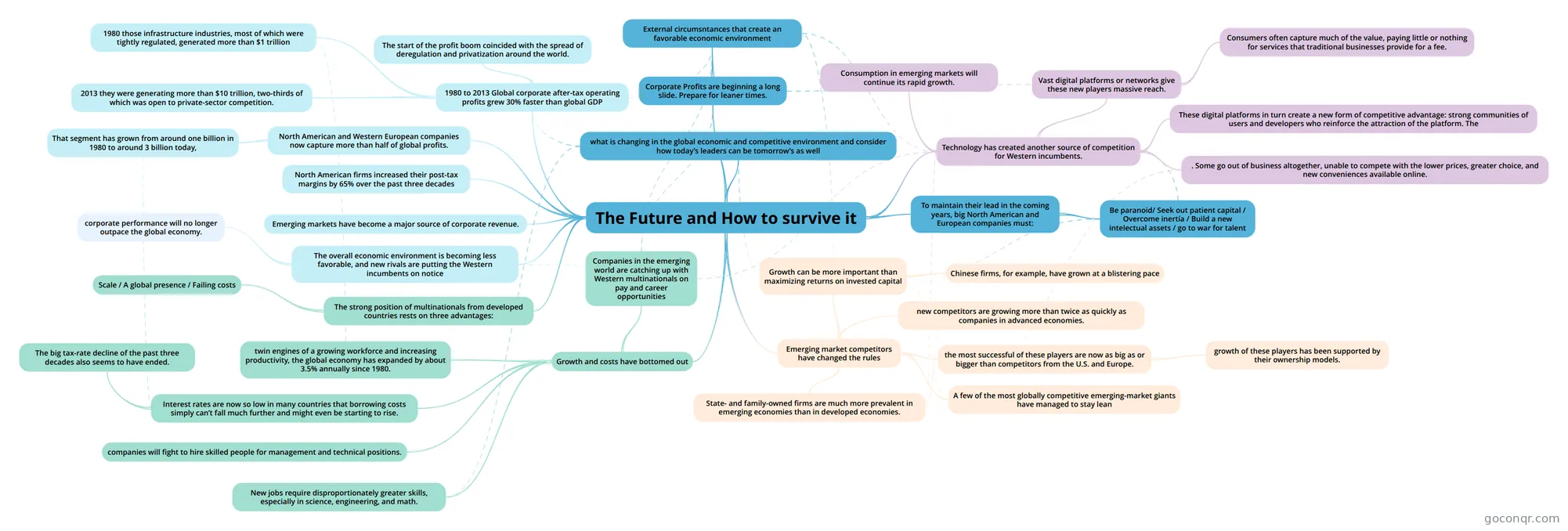
Mind map: The Future and How to Survive It
Map content
The Future and How to survive it
Corporate Profits are beginning a long slide. Prepare for leaner times.
- External circumsntances that create an favorable economic environment
1980 to 2013 Global corporate after-tax operating profits grew 30% faster than global GDP
- The start of the profit boom coincided with the spread of deregulation and privatization around the world.
- 1980 those infrastructure industries, most of which were tightly regulated, generated more than $1 trillion
- 2013 they were generating more than $10 trillion, two-thirds of which was open to private-sector competition.
North American and Western European companies now capture more than half of global profits.
- That segment has grown from around one billion in 1980 to around 3 billion today,
North American firms increased their post-tax margins by 65% over the past three decades
The overall economic environment is becoming less favorable, and new rivals are putting the Western incumbents on notice
- corporate performance will no longer outpace the global economy.
what is changing in the global economic and competitive environment and consider how today’s leaders can be tomorrow’s as well
To maintain their lead in the coming years, big North American and European companies must:
- Be paranoid/ Seek out patient capital / Overcome inertía / Build a new intelectual assets / go to war for talent
The strong position of multinationals from developed countries rests on three advantages:
- Scale / A global presence / Failing costs
Emerging markets have become a major source of corporate revenue.
Growth and costs have bottomed out
- twin engines of a growing workforce and increasing productivity, the global economy has expanded by about 3.5% annually since 1980.
- Interest rates are now so low in many countries that borrowing costs simply can’t fall much further and might even be starting to rise.
- The big tax-rate decline of the past three decades also seems to have ended.
- companies will fight to hire skilled people for management and technical positions.
- New jobs require disproportionately greater skills, especially in science, engineering, and math.
- Companies in the emerging world are catching up with Western multinationals on pay and career opportunities
Emerging market competitors have changed the rules
- new competitors are growing more than twice as quickly as companies in advanced economies.
- the most successful of these players are now as big as or bigger than competitors from the U.S. and Europe.
- growth of these players has been supported by their ownership models.
- Growth can be more important than maximizing returns on invested capital
- Chinese firms, for example, have grown at a blistering pace
- A few of the most globally competitive emerging-market giants have managed to stay lean
- State- and family-owned firms are much more prevalent in emerging economies than in developed economies.
Technology has created another source of competition for Western incumbents.
- Vast digital platforms or networks give these new players massive reach.
- Consumers often capture much of the value, paying little or nothing for services that traditional businesses provide for a fee.
- . Some go out of business altogether, unable to compete with the lower prices, greater choice, and new conveniences available online.
- These digital platforms in turn create a new form of competitive advantage: strong communities of users and developers who reinforce the attraction of the platform. The
- Consumption in emerging markets will continue its rapid growth.
- Vast digital platforms or networks give these new players massive reach.
Information
- Description
- Mind Map on The Future and How to survive it, created by Luis Rdz on 24/02/2019.
- Created by
- Luis Rdz
- Views
- 0
- Rating