
Mind map
FORMS OF INTELLECTUAL PROPERTY
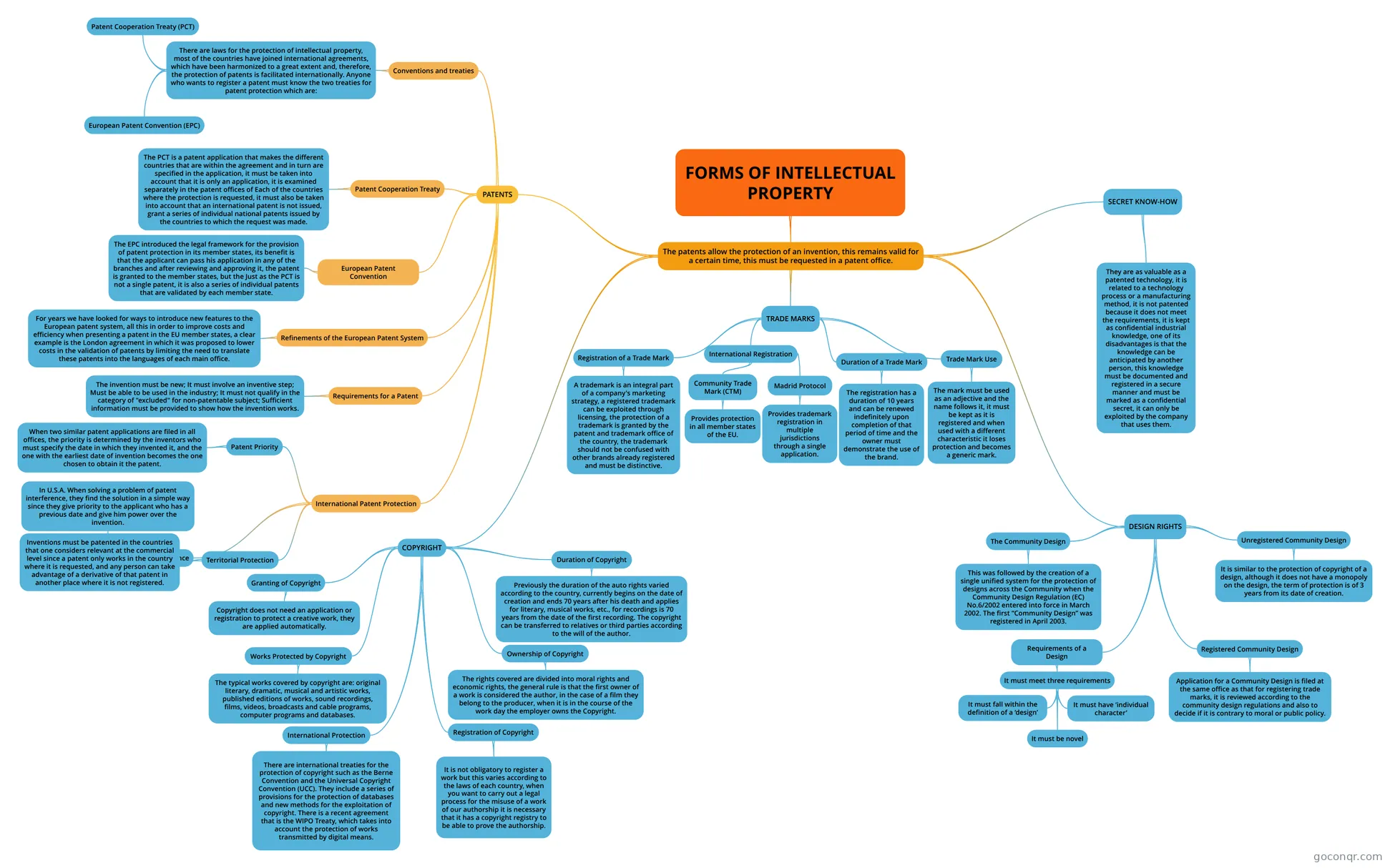
Mind map: Forms of intellectual property
Map content
FORMS OF INTELLECTUAL PROPERTY
The patents allow the protection of an invention, this remains valid for a certain time, this must be requested in a patent office.
- PATENTS
- Conventions and treaties
- There are laws for the protection of intellectual property, most of the countries have joined international agreements, which have been harmonized to a great extent and, therefore, the protection of patents is facilitated internationally. Anyone who wants to register a patent must know the two treaties for patent protection which are:
- Patent Cooperation Treaty (PCT)
- European Patent Convention (EPC)
- There are laws for the protection of intellectual property, most of the countries have joined international agreements, which have been harmonized to a great extent and, therefore, the protection of patents is facilitated internationally. Anyone who wants to register a patent must know the two treaties for patent protection which are:
- Patent Cooperation Treaty
- The PCT is a patent application that makes the different countries that are within the agreement and in turn are specified in the application, it must be taken into account that it is only an application, it is examined separately in the patent offices of Each of the countries where the protection is requested, it must also be taken into account that an international patent is not issued, grant a series of individual national patents issued by the countries to which the request was made.
- European Patent Convention
- The EPC introduced the legal framework for the provision of patent protection in its member states, its benefit is that the applicant can pass his application in any of the branches and after reviewing and approving it, the patent is granted to the member states, but the Just as the PCT is not a single patent, it is also a series of individual patents that are validated by each member state.
- Refinements of the European Patent System
- For years we have looked for ways to introduce new features to the European patent system, all this in order to improve costs and efficiency when presenting a patent in the EU member states, a clear example is the London agreement in which it was proposed to lower costs in the validation of patents by limiting the need to translate these patents into the languages of each main office.
- Requirements for a Patent
- The invention must be new; It must involve an inventive step; Must be able to be used in the industry; It must not qualify in the category of "excluded" for non-patentable subject; Sufficient information must be provided to show how the invention works.
- International Patent Protection
- Patent Priority
- When two similar patent applications are filed in all offices, the priority is determined by the inventors who must specify the date in which they invented it, and the one with the earliest date of invention becomes the one chosen to obtain it the patent.
- Interference
- In U.S.A. When solving a problem of patent interference, they find the solution in a simple way since they give priority to the applicant who has a previous date and give him power over the invention.
- Territorial Protection
- Inventions must be patented in the countries that one considers relevant at the commercial level since a patent only works in the country where it is requested, and any person can take advantage of a derivative of that patent in another place where it is not registered.
- Patent Priority
- Conventions and treaties
- COPYRIGHT
- Granting of Copyright
- Copyright does not need an application or registration to protect a creative work, they are applied automatically.
- International Protection
- There are international treaties for the protection of copyright such as the Berne Convention and the Universal Copyright Convention (UCC). They include a series of provisions for the protection of databases and new methods for the exploitation of copyright. There is a recent agreement that is the WIPO Treaty, which takes into account the protection of works transmitted by digital means.
- Ownership of Copyright
- The rights covered are divided into moral rights and economic rights, the general rule is that the first owner of a work is considered the author, in the case of a film they belong to the producer, when it is in the course of the work day the employer owns the Copyright.
- Duration of Copyright
- Previously the duration of the auto rights varied according to the country, currently begins on the date of creation and ends 70 years after his death and applies for literary, musical works, etc., for recordings is 70 years from the date of the first recording. The copyright can be transferred to relatives or third parties according to the will of the author.
- Works Protected by Copyright
- The typical works covered by copyright are: original literary, dramatic, musical and artistic works, published editions of works, sound recordings, films, videos, broadcasts and cable programs, computer programs and databases.
- Registration of Copyright
- It is not obligatory to register a work but this varies according to the laws of each country, when you want to carry out a legal process for the misuse of a work of our authorship it is necessary that it has a copyright registry to be able to prove the authorship.
- Granting of Copyright
- TRADE MARKS
- Registration of a Trade Mark
- A trademark is an integral part of a company's marketing strategy, a registered trademark can be exploited through licensing, the protection of a trademark is granted by the patent and trademark office of the country, the trademark should not be confused with other brands already registered and must be distinctive.
- International Registration
- Community Trade Mark (CTM)
- Provides protection in all member states of the EU.
- Madrid Protocol
- Provides trademark registration in multiple jurisdictions through a single application.
- Community Trade Mark (CTM)
- Duration of a Trade Mark
- The registration has a duration of 10 years and can be renewed indefinitely upon completion of that period of time and the owner must demonstrate the use of the brand.
- Trade Mark Use
- The mark must be used as an adjective and the name follows it, it must be kept as it is registered and when used with a different characteristic it loses protection and becomes a generic mark.
- Registration of a Trade Mark
- DESIGN RIGHTS
- The Community Design
- This was followed by the creation of a single unified system for the protection of designs across the Community when the Community Design Regulation (EC) No.6/2002 entered into force in March 2002. The first “Community Design” was registered in April 2003.
- Requirements of a Design
- It must meet three requirements
- It must fall within the definition of a ‘design’
- It must be novel
- It must have ‘individual character’
- It must meet three requirements
- Registered Community Design
- Application for a Community Design is filed at the same office as that for registering trade marks, it is reviewed according to the community design regulations and also to decide if it is contrary to moral or public policy.
- Unregistered Community Design
- It is similar to the protection of copyright of a design, although it does not have a monopoly on the design, the term of protection is of 3 years from its date of creation.
- The Community Design
- SECRET KNOW-HOW
- They are as valuable as a patented technology, it is related to a technology process or a manufacturing method, it is not patented because it does not meet the requirements, it is kept as confidential industrial knowledge, one of its disadvantages is that the knowledge can be anticipated by another person, this knowledge must be documented and registered in a secure manner and must be marked as a confidential secret, it can only be exploited by the company that uses them.
- PATENTS
Information
- Description
- Mind Map on FORMS OF INTELLECTUAL PROPERTY, created by Yeison Camargo on 29/04/2019.
- Created by
- Yeison Camargo
- Views
- 1
- Rating
More on Types of Intellectual Property