
Mind map
An Introduction to Design Thinking - Process Guide
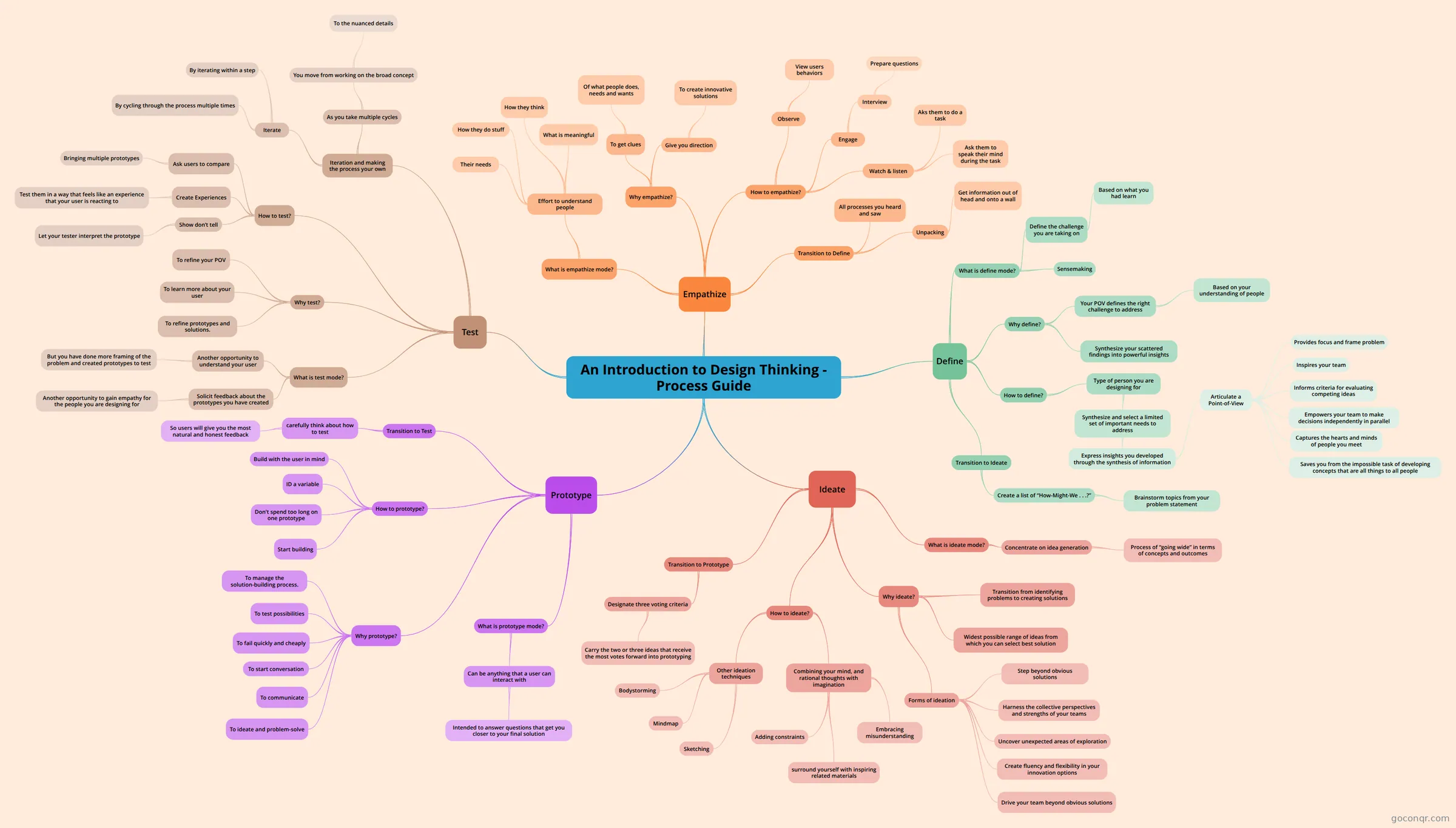
Mind map: Design thinking process guide
Map content
An Introduction to Design Thinking - Process Guide
Empathize
- What is empathize mode?
- Effort to understand people
- Their needs
- How they do stuff
- How they think
- What is meaningful
- Effort to understand people
- Why empathize?
- To get clues
- Of what people does, needs and wants
- Give you direction
- To create innovative solutions
- To get clues
- How to empathize?
- Observe
- View users behaviors
- Engage
- Interview
- Prepare questions
- Interview
- Watch & listen
- Aks them to do a task
- Ask them to speak their mind during the task
- Observe
- Transition to Define
- All processes you heard and saw
- Unpacking
- Get information out of head and onto a wall
- What is empathize mode?
Define
- What is define mode?
- Define the challenge you are taking on
- Based on what you had learn
- Sensemaking
- Define the challenge you are taking on
- Why define?
- Your POV defines the right challenge to address
- Based on your understanding of people
- Synthesize your scattered findings into powerful insights
- Your POV defines the right challenge to address
- How to define?
- Type of person you are designing for
- Synthesize and select a limited set of important needs to address
- Express insights you developed through the synthesis of information
- Articulate a Point-of-View
- Provides focus and frame problem
- Inspires your team
- Informs criteria for evaluating competing ideas
- Empowers your team to make decisions independently in parallel
- Captures the hearts and minds of people you meet
- Saves you from the impossible task of developing concepts that are all things to all people
- Articulate a Point-of-View
- Express insights you developed through the synthesis of information
- Synthesize and select a limited set of important needs to address
- Type of person you are designing for
- Transition to Ideate
- Create a list of “How-Might-We . . .?”
- Brainstorm topics from your problem statement
- Create a list of “How-Might-We . . .?”
- What is define mode?
Ideate
- What is ideate mode?
- Concentrate on idea generation
- Process of “going wide” in terms of concepts and outcomes
- Concentrate on idea generation
- Why ideate?
- Transition from identifying problems to creating solutions
- Widest possible range of ideas from which you can select best solution
- Forms of ideation
- Step beyond obvious solutions
- Harness the collective perspectives and strengths of your teams
- Uncover unexpected areas of exploration
- Create fluency and flexibility in your innovation options
- Drive your team beyond obvious solutions
- How to ideate?
- Combining your mind, and rational thoughts with imagination
- Adding constraints
- surround yourself with inspiring related materials
- Embracing misunderstanding
- Other ideation techniques
- Bodystorming
- Mindmap
- Sketching
- Combining your mind, and rational thoughts with imagination
- Transition to Prototype
- Designate three voting criteria
- Carry the two or three ideas that receive the most votes forward into prototyping
- Designate three voting criteria
- What is ideate mode?
Prototype
- What is prototype mode?
- Can be anything that a user can interact with
- Intended to answer questions that get you closer to your final solution
- Can be anything that a user can interact with
- Why prototype?
- To ideate and problem-solve
- To communicate
- To start conversation
- To fail quickly and cheaply
- To test possibilities
- To manage the solution-building process.
- How to prototype?
- Start building
- Don't spend too long on one prototype
- ID a variable
- Build with the user in mind
- Transition to Test
- carefully think about how to test
- So users will give you the most natural and honest feedback
- carefully think about how to test
- What is prototype mode?
Test
- What is test mode?
- Solicit feedback about the prototypes you have created
- Another opportunity to gain empathy for the people you are designing for
- Another opportunity to understand your user
- But you have done more framing of the problem and created prototypes to test
- Solicit feedback about the prototypes you have created
- Why test?
- To refine prototypes and solutions.
- To learn more about your user
- To refine your POV
- How to test?
- Show don’t tell
- Let your tester interpret the prototype
- Create Experiences
- Test them in a way that feels like an experience that your user is reacting to
- Ask users to compare
- Bringing multiple prototypes
- Show don’t tell
- Iteration and making the process your own
- Iterate
- By cycling through the process multiple times
- By iterating within a step
- As you take multiple cycles
- You move from working on the broad concept
- To the nuanced details
- You move from working on the broad concept
- Iterate
- What is test mode?
Information
- Description
- Mind Map on An Introduction to Design Thinking - Process Guide, created by gianfranco mello loayza on 25/05/2019.
- Created by
- gianfranco mello loayza
- Views
- 4
- Rating