
Mind map
Ethernet
Map content
Ethernet
Ethernet Encapsulation
- Ethernet supports data bandwidths of
- 10 Mb/s
- 100 Mb/s
- 1000 Mb/s (1 Gb/s)
- 10 000 Mb/s (10 Gb/s)
- 40 000 Mb/s (40 Gb/s
- 100 000 Mb/s (100 Gb/s)
- LLC sublayer
- The Ethernet LLC sublayer handles the communication between the upper layers and the lower layers.
- MAC sublayer
- MAC constitutes the lower sublayer of the data link layer.
- Ethernet supports data bandwidths of
MAC Sublayer
- Data encapsulation
- Frame delimiting
- Adressing
- Error detection
- Media Access Control
- Control of frame placement on and off the media
- Media Recovery
- Data encapsulation
Ethernet Evolution
- Since the creation of Ethernet in 1973, standards have evolved for specifying faster and more flexible versions of the technology.
Ethernet Frame Fields
- Preamble
- Destination MAC address
- Source MAC address
- EtherType
- Data
- FCS
MAC Address and Hexadecimal
- An Ethernet MAC address is a 48-bit binary value expressed as 12 hexadecimal digits (4 bits per hexadecimal digit).
Unicast MAC Address
- In Ethernet, different MAC addresses are used for Layer 2 unicast, broadcast, and multicast communications.
- Unicast
- A unicast MAC address is the unique address used when a frame is sent from a single transmitting device to a single destination device.
- Unicast
- In Ethernet, different MAC addresses are used for Layer 2 unicast, broadcast, and multicast communications.
Broadcast MAC Address
- A broadcast packet contains a destination IPv4 address that has all ones (1s) in the host portion.
- Broadcast
- This numbering in the address means that all hosts on that local network (broadcast domain) will receive and process the packet.
- Broadcast
- A broadcast packet contains a destination IPv4 address that has all ones (1s) in the host portion.
Multicast MAC Address
- Multicast addresses allow a source device to send a packet to a group of devices.
Filtering Frames
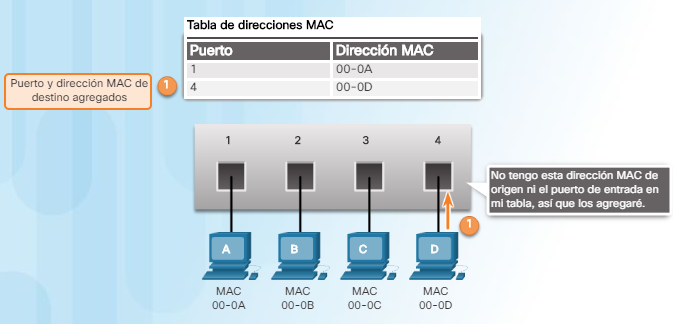
- As a switch receives frames from different devices, it is able to populate its MAC address table by examining the source MAC address of every frame.
- When the switch’s MAC address table contains the destination MAC address, it is able to filter the frame and forward out a single port.
- When the switch’s MAC address table contains the destination MAC address, it is able to filter the frame and forward out a single port.
- As a switch receives frames from different devices, it is able to populate its MAC address table by examining the source MAC address of every frame.
Frame Forwarding Methods on Cisco Switches
- Store-and-forward switching
- A store-and-forward switch receives the entire frame, and computes the CRC.
- Cut-through switching
- A cut-through switch forwards the frame before it is entirely received.
- Store-and-forward switching
Cut-Through Switching
- A cut-through switch forwards the frame before it is entirely received.
Memory Buffering on Switches
- Port-based Memory Buffering
- In port-based memory buffering, frames are stored in queues that are linked to specific incoming and outgoing ports.
- Shared Memory Buffering
- Shared memory buffering deposits all frames into a common memory buffer that all the ports on the switch share.
- Port-based Memory Buffering
Duplex and Speed Settings
- Full-duplex
- Both ends of the connection can send and receive simultaneously.
- Half-duplex
- Only one end of the connection can send at a time.
- Full-duplex
Auto-MDIX
- MDIX auto detects the type of connection required and configures the interface accordingly.
Destination on Same Network
- Physical address (the MAC address)
- Used for Ethernet NIC to Ethernet NIC communications on the same network.
- Logical address (the IP address)
- Used to send the packet from the original source to the final destination.
- Physical address (the MAC address)
Introduction to ARP
- Destination MAC address
- The MAC address of the Ethernet NIC, which will be either the MAC address of the final destination device or the router.
- Source MAC address
- The MAC address of the sender’s Ethernet NIC.
- Destination MAC address
ARP Functions
- When a packet is sent to the data link layer to be encapsulated into an Ethernet frame, the device refers to a table in its memory to find the MAC address that is mapped to the IPv4 address.
Images and files in the map
Information
- Description
- Mind Map on Ethernet, created by Johan Sebastian Lasso Rivas on 14/09/2019.
- Created by
- Johan Sebastian Lasso Rivas
- Views
- 1
- Rating