
Mind map
Control, Change, and Entrepreneurship
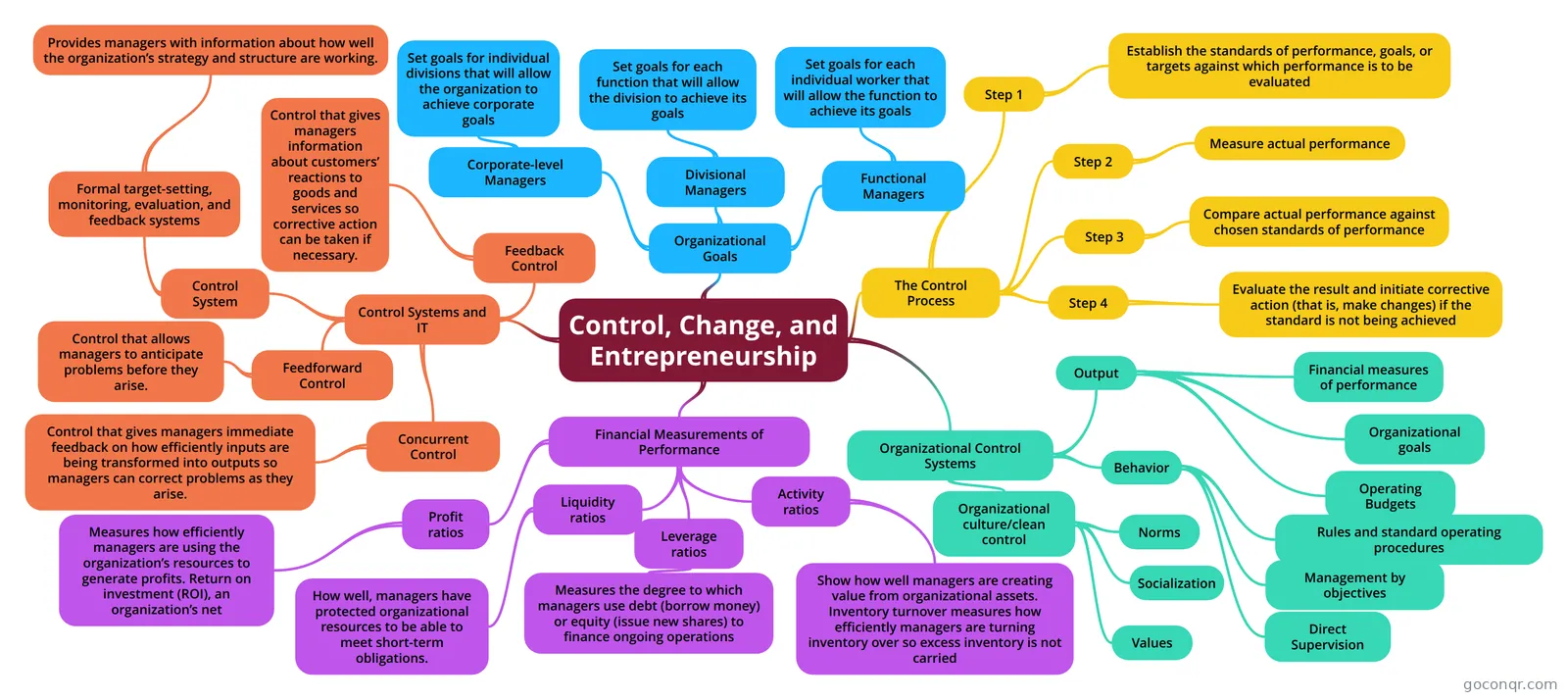
Mind map: Control, change, and entrepreneurship
Map content
Control, Change, and Entrepreneurship
Control Systems and IT
- Control System
- Formal target-setting, monitoring, evaluation, and feedback systems
- Provides managers with information about how well the organization’s strategy and structure are working.
- Formal target-setting, monitoring, evaluation, and feedback systems
- Feedforward Control
- Control that allows managers to anticipate problems before they arise.
- Concurrent Control
- Control that gives managers immediate feedback on how efficiently inputs are being transformed into outputs so managers can correct problems as they arise.
- Feedback Control
- Control that gives managers information about customers’ reactions to goods and services so corrective action can be taken if necessary.
- Control System
The Control Process
- Step 1
- Establish the standards of performance, goals, or targets against which performance is to be evaluated
- Step 2
- Measure actual performance
- Step 3
- Compare actual performance against chosen standards of performance
- Step 4
- Evaluate the result and initiate corrective action (that is, make changes) if the standard is not being achieved
- Step 1
Organizational Control Systems
- Output
- Financial measures of performance
- Organizational goals
- Operating Budgets
- Behavior
- Rules and standard operating procedures
- Management by objectives
- Direct Supervision
- Organizational culture/clean control
- Values
- Norms
- Socialization
- Output
Financial Measurements of Performance
- Profit ratios
- Measures how efficiently managers are using the organization’s resources to generate profits. Return on investment (ROI), an organization’s net
- Liquidity ratios
- How well, managers have protected organizational resources to be able to meet short-term obligations.
- Leverage ratios
- Measures the degree to which managers use debt (borrow money) or equity (issue new shares) to finance ongoing operations
- Activity ratios
- Show how well managers are creating value from organizational assets. Inventory turnover measures how efficiently managers are turning inventory over so excess inventory is not carried
- Profit ratios
Organizational Goals
- Corporate-level Managers
- Set goals for individual divisions that will allow the organization to achieve corporate goals
- Divisional Managers
- Set goals for each function that will allow the division to achieve its goals
- Functional Managers
- Set goals for each individual worker that will allow the function to achieve its goals
- Corporate-level Managers
Information
- Description
- Mind Map on Control, Change, and Entrepreneurship, created by Angela Andrea Maass Alvarado on 18/10/2019.
- Created by
- Angela Andrea Maass Alvarado
- Views
- 0
- Rating
More on Strategic Management Control Systems