
Mind map
What is Design Thinking?
Map content
What is Design Thinking?
It is a method to generate innovative ideas that focuses its effectiveness on understanding and solving the real needs of users. It comes from the way in which product designers work. Hence its name, which in Spanish is translated literally as "Design Thought," although we prefer to do so as "The way designers think."
- Theoretically developed at Stanford University in California (USA) from the 70s, and its first applicability for profit as "Design Thinking" was carried out by the IDEO design consultancy, being today Its main precursor.
Who use it?
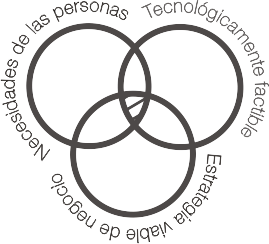
- According to Tim Brown, current CEO of IDEO, Design Thinking “It is a discipline that uses the sensitivity and methods of designers to match the needs of people with what is technologically feasible and with what a viable business strategy can convert in value for the customer, as well as a great opportunity for the market. ”
- Companies like Apple, Google or Zara use it. Being a great generator of innovation, it can be applied to any field. From the development of products or services to the improvement of processes or the definition of business models. Its applicability has our own imagination as limits.
How does it work?
- The Design Thinking is developed following a process in which those we consider its 5 differential characteristics are valued:
- The generation of empathy: we must understand the problems, needs and desires of the users involved in the solution we are looking for. Regardless of what we are developing, it will always involve interaction with people. Satisfying them is the key to a successful outcome.
- Teamwork, as it emphasizes the ability of individuals to provide uniqueness.
- The generation of prototypes, since it defends that every idea must be validated before being assumed as correct. The Design Thinking promotes the identification of faults, so that when we give the desired solution, they have already been solved.
- All this under an atmosphere in which the playfulness is promoted. It is about enjoying during the process, and thanks to that, to reach a state of mind in which we unleash our potential.
- Techniques with great visual and plastic content are developed during the process. This makes us put both our creative and analytical minds to work, resulting in innovative and at the same time feasible solutions.
- To start using the methodology it is very important to prepare these four points:
- Materials: Those used in Design Thinking techniques are available to anyone. Get markers, sheets of paper, sticky notes, colored pencils, glue and a camera. They will be our tools to promote visual communication, which is fundamental in the methodology. A picture is worth a thousand words. And what is more important: an image can evoke endless ideas, since it gives rise to interpretation.
- The team: In Design Thinking it is essential to work as a team. The more diverse, the better. This way you can add points of view, knowledge and experience. It is essential that there is at least one person with knowledge about the methodology that can guide the process. And although it must have a stable nucleus of people who participate until the end, others can be added depending on the phase in which we are. For example, in the generation of ideas or in the prototype test.
- The space: During the process you will need a workspace, although you will also develop techniques outside it. Find a site wide enough to work around a table, with free walls where you can paste the information you generate. Think of a bright and inspiring place that encourages relaxed work and makes you feel comfortable and in a good mood. Have you heard of the famous Google offices? An inspiring space motivates innovation.
- Attitude: At Design Thinking, attitude is essential. We must adopt what is called "Attitude of the Designer". Be curious, and observers. In any detail we can find transcendent information. We must be empathetic, both with people and with their circumstances. Being able to put ourselves in the skin of the other. Question the Status Quo, and not burden ourselves with prejudices or assumptions. Be optimistic and positive. Lose the fear of making mistakes, and see mistakes as opportunities.
- The Design Thinking is developed following a process in which those we consider its 5 differential characteristics are valued:
What is the process?
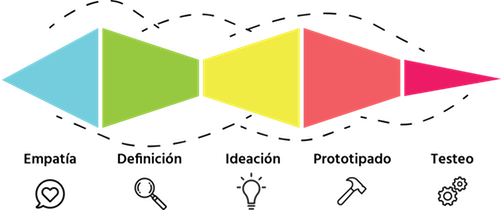
- The Design Thinking process consists of five stages. It is not linear. At any time you can go backwards or forwards if you see fit, jumping even to non-consecutive stages. You will start collecting a lot of information, generating a large amount of content, which will grow or decrease depending on the phase you are in.
- BEGINS: The Design Thinking process begins with a deep understanding of the needs of the users involved in the solution we are developing, and also of their environment. We must be able to put ourselves in the shoes of these people to be able to generate solutions consistent with their realities.
- DEFINE: During the Definition stage, we must screen the information collected during the Empathy phase and keep what really adds value and brings us to new interesting perspectives. We will identify problems whose solutions will be key to obtaining an innovative result.
- IDEA: The Ideation stage is aimed at generating endless options. We should not keep the first idea that comes to mind. In this phase, activities favor expansive thinking and we must eliminate value judgments. Sometimes, the most bizarre ideas are those that generate visionary solutions.
- PROTOTYPE: In the Prototyping stage we return ideas to reality. Building prototypes makes the ideas palpable and helps us visualize the possible solutions, revealing elements that we must improve or refine before reaching the final result.
- TESTEA: During the Testing phase, we will test our prototypes with the users involved in the solution we are developing. This phase is crucial, and will help us identify significant improvements, failures to solve, possible shortcomings. During this phase we will evolve our idea until it becomes the solution we were looking for.
- The Design Thinking process consists of five stages. It is not linear. At any time you can go backwards or forwards if you see fit, jumping even to non-consecutive stages. You will start collecting a lot of information, generating a large amount of content, which will grow or decrease depending on the phase you are in.
personal information
- Name: Alvaro Javier Salcedo Date: November 21, 2019
Images and files in the map
Information
- Description
- Mind Map on What is Design Thinking?, created by Javier Salcedo on 21/11/2019.
- Created by
- Javier Salcedo
- Views
- 0
- Rating